Krishna Srinivasan was explaining force and motion with a high-low road science exhibit. The setting was a long way from the mortgage technology business he had founded. Here, the question was whether a child could understand what happened in front of them. The apparatus had a modest advantage over a textbook: it could answer back.
By 2013, Srinivasan was bringing that approach to QED, short for Quest Explore Discover. He had spent years working on enterprise systems and mortgage operations. Now he was arguing that students needed to experience science, and worrying about schools that wanted the equipment but could not afford it. His next business problem had arrived wearing a school uniform.
A headmaster’s son, far from the blackboard
There was a family connection to the classroom. His father was a village school headmaster; Srinivasan attended a government school in Trichy. His interest in education therefore had a history before it had a business model. Much later, he would talk about building something commercially viable that also mattered socially. The old classroom had followed him into the balance sheet.
First came a career in technology. At Ramco Systems, he worked on technology and channel relationships with Microsoft in the United States, beginning with the US operation’s early years in 1993. His experience included the architecture of enterprise products, where an appealing idea has to survive the demands of an organization using it.
He then founded Neptune Technologies, a systems architecture consulting business. By the account of his early career prepared for a 2006 conference, Neptune reached $11.5 million in annual revenue and employed 140 people, with customers including Visa and Microsoft. He sold the business to Sand Hill in 2004. In 2005, after more than thirteen years in the United States, he relocated to India.
The same early biography allowed him interests outside the meeting room: deep-sea diving and time with friends at a ranch. Those details make a useful interruption in a career otherwise crowded with corporate names. There was, apparently, somewhere to go when the enterprise architecture had been discussed quite enough.
Buying the pieces of a mortgage
At ISGN, Srinivasan took on a field with an unusually long chain of dependencies. Making a mortgage involves selling it, processing it, closing it and servicing it. Problems can emerge in any of those stages. A software provider working across the chain needs to understand how one piece of work changes the next.
In March 2007, ISGN acquired assets from Fair Isaac’s mortgage banking division, to integrate with MortgageHub. The collection included loan origination, servicing and construction lending systems, along with networks and software for default management. The deal also brought more than 150 mortgage customers and more than 700 vendor partners through the BridgeLink network.
The breadth was deliberate. Srinivasan was describing an offering that could address a specific operational problem or supply a complete outsourced process. The purchase assembled software for different moments in a loan’s life. It also assembled the less photogenic responsibilities that come with such software: existing customers, working relationships and systems already doing a job.
Different stages of the loan. One expanding technology portfolio.
That June, ISGN announced $25 million in funding from New Enterprise Associates and NEA-IndoUS Ventures. The planned uses included global delivery infrastructure and sales and marketing. It expected to put about one-fifth of the funding into physical infrastructure in Chennai and Delhi. Expansion meant premises and people as well as products.
The company had also bought Dynatek, a mortgage automation software provider. Capital and acquisitions were moving together: buy capabilities, then build the organization needed to deliver them. Srinivasan was working with investors who brought technology experience to a business focused tightly on mortgage finance.
By May 2008, the portfolio needed a clearer name. MortgageHub and Dynatek were to be rebranded as ISGN. Other operations would take names such as ISGN Fulfillment Services and ISGN Inspection Services. The announcement made a point of saying the change would not alter locations or headcount. A common name was meant to help customers understand what the collection could do.
This is a revealing stage in an acquisition story. Buying companies adds capabilities; explaining the resulting company requires another kind of work. Srinivasan’s job included making a growing set of businesses legible to a lender that had its own problems to solve. The organizational chart could be complicated. The offer had to be comprehensible.
A crisis changes the work
The mortgage market then supplied complications of its own. As new lending contracted, servicing, repayments and distressed loans required attention. The work followed borrowers beyond the original transaction. An industry built around getting a loan made was having to deal with what happened afterward.
Srinivasan saw room to expand during the disruption. In December 2009, ISGN bought Fiserv’s loan fulfillment unit, adding capabilities in closing and settlement, valuation and loan modification. His stated approach was to offer services across the process. The acquisition was a concrete expression of it, made when uncertainty could make an additional business look either useful or uninviting.
There is a practical lesson in that period of his career. A company serving lenders has to respond when the lenders’ work changes. Its expertise cannot end at the process that happened to be busiest yesterday. In ISGN’s case, the company’s range mattered because the mortgage relationship continued after the enthusiasm of the original sale had departed.
In October 2011, ISGN announced another $30 million from existing investors, alongside a new leadership team. Shailendra Gupta became CFO; John Fults led mortgage processing; John Axt took responsibility for title operations and delivery; Raghavan Tiru became CIO; Scott Slifer led sales and marketing. The appointments put named executives against particular operating responsibilities.
There was product work, too. Catapult, its loan origination system, included access through mobile devices. The company was preparing for growth while dealing with an industry still changing around it. Srinivasan’s public comments emphasized helping lenders manage fluctuations. Behind that phrase sat a straightforward demand: customers needed systems and services that remained useful as conditions moved.
On June 11, 2012, Ritesh Idnani succeeded him as CEO. Idnani came from Infosys BPO, where he had been chief operating officer. Srinivasan continued as executive vice chairman and a board member. The founder had handed over day-to-day leadership while retaining a formal place in the company he had built.
The experiment comes off the page
Another undertaking was already developing. Srinivasan and his wife Hymavathy had begun the QED venture in 2011. Her interests in research and technology-assisted education helped shape it. By January 2013, after two years of research and development, the program was officially launched. The point was to give science concepts a physical form that students could investigate.
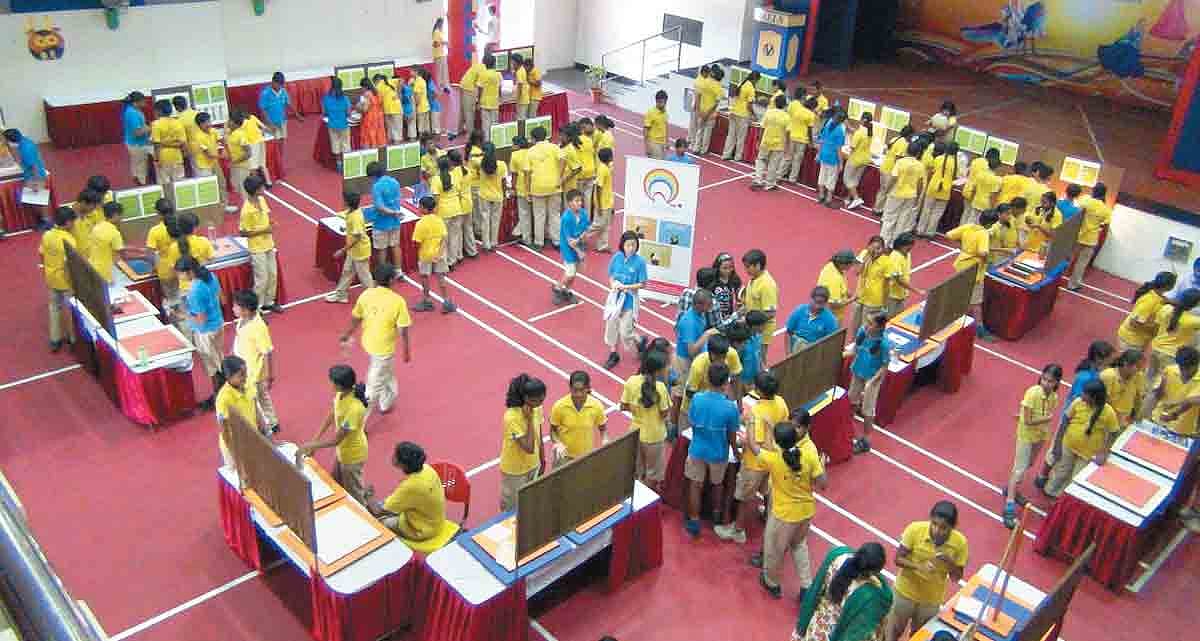
The venture also had to work for teachers. Its exhibits were mapped to curricula, with teaching material to help incorporate them into lessons. Hands-on activity could be followed by digital material and assessments. The sequence gave the equipment a place in a school’s existing work; a fascinating object still needed to earn its space in the timetable.
In 2014, Srinivasan described the appeal of pursuing financial sustainability and social purpose together. He discussed a partnership involving Cognizant Foundation and a science gallery at Thambithottam Higher Secondary School in Gandhigram. Bringing an experiment to a rural school made the access question concrete. Someone still had to organize, support and pay for the experience.
Everest Edusys raised Rs 5.7 crore in Series A funding that March, led by Lok Capital with participation from Chennai Angels. The stated plan was to expand sales and marketing across Tamil Nadu, Karnataka and Kerala. It was a smaller capital figure than ISGN’s rounds, attached to a different kind of distribution problem: reaching schools.
“We have huge plans, but let this flourish.”
Krishna Srinivasan, discussing QED in 2013
The restraint in that sentence is appealing. The exhibits needed to work in the schools that had them. Teachers and trainers needed preparation. Ambition had to pass through those ordinary requirements before it could become somebody else’s useful experience.
Back among the learners
His later public work leads to PALGenie Technologies, where he is founder and chairman. In March 2024, he welcomed associates who had completed a year of training with PAL’s AI lab. He thanked Velammal Engineering College’s management and academic leadership for supporting the program. The recruits included AI engineers and inference instruction designers, working on the company’s copilot technology.
In December 2023, he also appeared on Kalaari Capital’s podcast for a conversation about company exits. The episode ran for 47 minutes and addressed the founder’s task of navigating an IPO or acquisition and managing stakeholders. It placed him in another teaching setting, sharing experience from the end of a business-building process.
By March 2026, the public conversation included agentic AI. At HYSEA’s annual summit in Hyderabad, Srinivasan joined a panel about intelligent enterprises and AI in action. His fellow panelists brought perspectives from large organizations; the discussion concerned how the technology enters real workflows. For a founder whose career had already involved connecting mortgage systems, the setting had a recognizable operational emphasis.
There is a smaller scene from this period that suits him. Divya Kumar, his former ISGN colleague, described him hosting a discussion of her book and arriving with a copy full of written notes. The former boss had done his homework. After the acquisitions, the handover, the science exhibits and the AI panels, that is a pleasing place to leave him: still preparing for the next question.