There is a sentence Krish Krishnan likes to use about an initial public offering, a sentence capable of removing several thousand pounds of ceremony from a room: it is just a financing transaction. In 2017, when Krystal Biotech reached Nasdaq only 18 months after he and his wife, Suma Krishnan, began funding it themselves, he already knew what came after the photographs. Forms. Trials. Factories. More forms. An IPO gives a company money and a ticker. It does not give the science an alibi.
That unsentimental distinction is the key to Krish's career. He is a founder, certainly, but his more revealing identity is operator. His route to biotechnology passed through mechanical engineering, management consulting, corporate finance, public markets and manufacturing. It is a career assembled less like a ladder than a well-stocked tool chest. When Suma brought him the scientific concept that became Krystal, his job was not to borrow her lab coat. It was to build the institution around the experiment.
He tells the origin cleanly. The idea was Suma's. The couple had worked together in startup biotech for more than a decade and each had previous experience in the field. In early 2016, she proposed a new delivery approach for genetic medicine - elegant on paper, difficult in practice. Krish once compared the pitch to someone announcing a plan to build a house on Mars. Lovely address. Considerable commute.
“The real goal is not as much to go IPO, it's to get a good treatment for a disease approved.”Krish Krishnan, 2019
The toolkit before the bet
Krish began with machines. He earned a bachelor's degree in mechanical engineering from the Indian Institute of Technology, followed by a master's in engineering from the University of Toledo. His first professional chapter was as an engineer at DuPont in Wilmington, Delaware. The training matters. Engineering teaches an intolerance for magic: inputs, tolerances and failure modes must eventually reconcile.
Then he widened the frame. At A.T. Kearney, he advised large companies on strategy. He moved through Ariba and Third Security, collecting the capital-markets vocabulary that laboratories rarely teach. At Wharton he earned an MBA in finance. He also met Suma, who was studying at nearby Villanova. The partnership would become personal and, over years of shared operating experience, unusually professional.
At New River Pharmaceuticals, Krish served as chief financial officer and chief operating officer from 2004 to 2007, as well as a director. The company was acquired by Shire for $2.6 billion. He later ran Pinnacle Pharmaceuticals, then served as Intrexon's chief operating officer from 2011 to 2016. By the time Krystal began, he had already stood inside public companies, financings, drug development and an acquisition. Prior success did not make the new bet safe. It made the risks legible.
A laboratory, a marriage, a deadline
The couple committed roughly $5 million of their own capital, earned largely through earlier biotech ventures. Friends and family added a modest amount. The warning attached to those early checks was strikingly plain: consider this philanthropy. If the evidence failed, the founders would close the project. Hope was welcome; sentiment would not be permitted to overrule data.
There was also a geography problem. Laboratory space around San Francisco was difficult to secure, so the Krishnans searched elsewhere and found a vacant facility in Pittsburgh. The city offered practical square footage and access to technical graduates. At first, they flew back and forth from their home in Northern California. Pittsburgh was not selected as a branding exercise. It solved the immediate constraint. Practical choices have a habit of becoming origin myths only after they work.
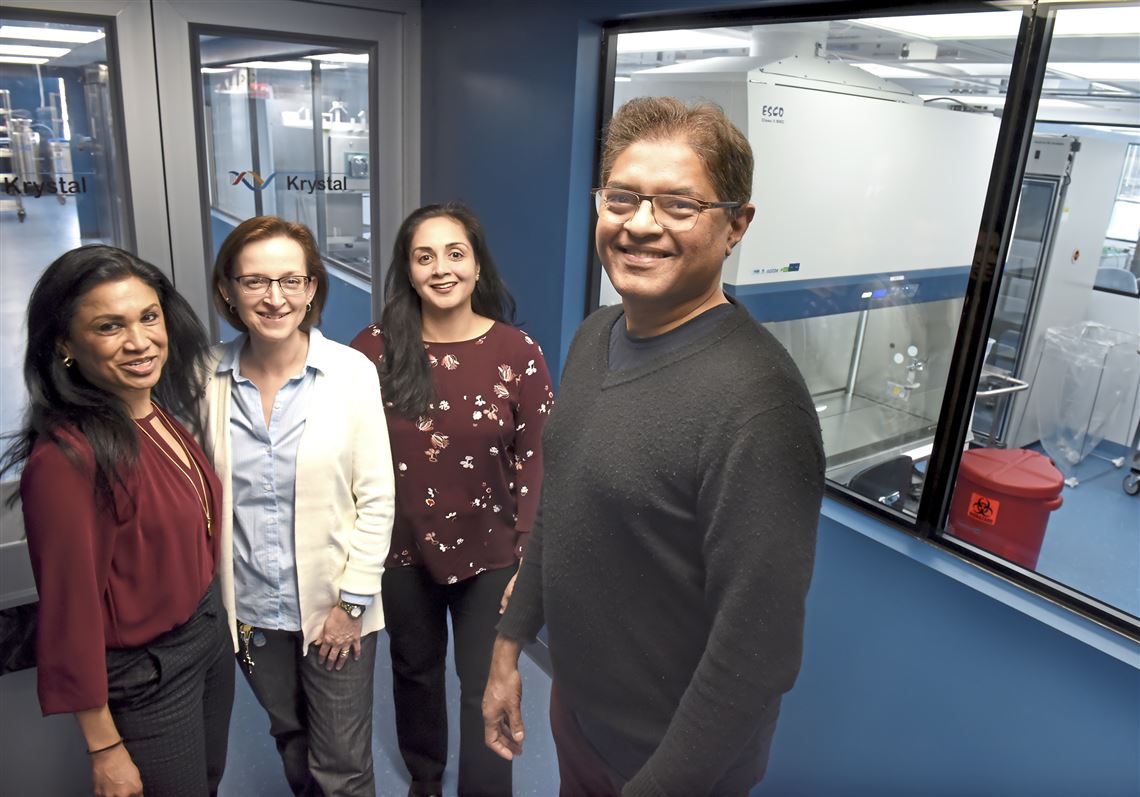
Krystal began self-funding in April 2016. Two corporate venture rounds brought in more than $18 million. Then patient, long-term biotech investors began showing interest. The founders had assumed a public offering might come in 2018 or 2019. Instead, the company listed in September 2017. Krish called the period a whirlwind and, later, the deal a “Mickey Mouse IPO.” The phrase is funny because the result was real: $45 million raised, without pretending the listing had completed the work.
Capital with a temperament
Krish's public-market advice sounds less like bell ringing than guest-list management. Investors have temperaments. Some are patient with the uneven calendar of biotechnology; others sell at the first delay. A founder who has met the names before can decide who receives more shares and who receives fewer. Bankers can place stock, but their incentives and the company's long horizon are not always identical.
This is the useful theft from Krystal's compressed IPO story. Speed was not the strategy. A clear business plan came first; the public market then financed its execution. Krish warns that Wall Street does not enjoy watching a company iron out its strategy in public. Data should lead financing where possible. Ownership matters because it preserves room for judgment. Capital is never merely capital. It arrives with a clock, a mood and occasionally a hand on the steering wheel.
“A lot of people assume that going public is like the you-have-arrived moment, but it's actually just the beginning.”Krish Krishnan
His language about the company itself follows the same division of responsibility. “Krystal is the sum of individual parts,” he has said. Each person owns a task or function, masters it, and joins the aggregate. It is an engineer's description of culture: not a family, not a rocket ship, but refined components. The romance lies in whether the machine works.
Build the factory before certainty
The boldest operating decision may have been quieter than the IPO. Krystal invested heavily in its own manufacturing before it knew whether its first product would be approved. Genetic medicine carries unforgiving demands around quality and process control. It also contains trade knowledge worth keeping close. Krish concluded that production was not a service to bolt on later. It belonged inside the strategy.
The company now operates two manufacturing facilities in Pittsburgh and ships globally. This vertical integration connected research, production and commercialization under one roof at a stage when outsourcing might have looked tidier. The choice fits Krish's biography almost too neatly: the former mechanical engineer running a biotech in which the factory is part of the intellectual property.
By the second quarter of 2026, Krystal reported $119.2 million in quarterly global product revenue and $965.9 million cumulatively since launch. Cash and investments stood at $1.1 billion. The first commercial foundation was supporting work across the eye, lung and skin, with several clinical readouts expected later in the year. Spain and Italy were slated for launches, following expansion into Germany, France and Japan, while UK approval had arrived in May.
The handoff is the company
It would be easy to tell this as a lone-founder parable, which would also make it false. Suma supplied the original scientific insight and continues to lead research and development. Krish supplied a broad operating system: finance, capital markets, organizational design and manufacturing. Their connection is not decorative context. It is the architecture of the company.
They had worked together for roughly 20 years by 2026. That shared history allowed a difficult kind of clarity: credit can be specific without being scarce. Krish consistently names Suma as the source of the founding idea. His own contribution becomes more interesting, not less, when accurately bounded. Ideas do not walk themselves into laboratories, through public markets, across factory floors and into multiple countries. Institutions make the journey.
His stated aspiration is now another transition - from a commercial success built around one product to a multi-product genetic-medicines company. He talks about positive pivotal readouts, wider global reach and eventually manufacturing beyond the United States. The ambition is substantial, but the grammar remains operational: trials, capacity, delivery.
There is wit in that restraint. Biotechnology is a field fond of heroic nouns and distant futures; Krish prefers verbs with owners. Raise. Build. Test. Manufacture. Ship. His sharpest observations are often about what a milestone cannot do. A listing cannot settle a strategy. Money cannot turn hurried evidence into good evidence. A promising invention cannot create its own supply chain. This is less glamorous than vision, perhaps, but considerably more likely to survive contact with Tuesday morning.
“Innovation only matters if it reaches the people who need it and changes their lives fundamentally - that's the true value of an idea.”Krish Krishnan, 2026
Ten years after the first self-funded experiment, Krish Krishnan's story offers no shortcut through biotechnology. It offers something more durable: sequence. Learn how systems fail. Understand money without worshipping it. Choose partners who own different truths. Build production before applause. Treat the listing as fuel, not a finish line. And when an idea sounds like a house on Mars, do the sober, unglamorous thing. Price the materials. Find the land. Start with one room.