Kris Williams grew up on a university campus with a geography professor for a father. Years later, when she took charge of a bank whose district stretched across 13 states and three Pacific territories, geography became part of her job description. A decision made in Des Moines could matter to a lender thousands of miles away. The map was large. The purpose was much closer to home.
Williams spent her working life moving through the less theatrical rooms of finance: accounting, regulatory reporting, wholesale banking, operations. These are places where the useful questions tend to begin with how, when and how much. By the time she became president and chief executive of the Federal Home Loan Bank of Des Moines in January 2020, she had accumulated experience in all three.
Her first description of herself as a new chief executive was more modest than the title might suggest. She talked about listening and seeking different perspectives. There was also a small word she said she used frequently. It would look rather lonely on an executive’s nameplate, but it makes a serviceable starting point for understanding her career: why.
“I ask ‘why’ a lot, as it helps me learn.”
Kris Williams · 2020 interview
A campus before a corner office
Born and raised in Wheeling, West Virginia, Kristina K. Williams spent much of her childhood around West Liberty. Her father, Roland E. “Rollie” Williams, taught there for 37 years. Her mother, Vera, worked in the university’s Elbin Library. The institution was a family address as well as a future entry on her résumé.
She graduated from West Liberty in 1986, magna cum laude, studying business administration with an accounting specialization. A master’s in professional accountancy at West Virginia University followed. Her early career included public accounting at PricewaterhouseCoopers and Deloitte & Touche, then PNC Financial Services, where she spent 12 years.
At PNC, her responsibilities included accounting policy, SEC and regulatory reporting, and eventually the chief financial officer’s role in wholesale banking. There is a certain continuity here: before she was responsible for an institution’s direction, she was responsible for understanding what its numbers meant. Policy and reporting are patient occupations. They reward the person willing to ask an extra question before accepting an attractive answer.
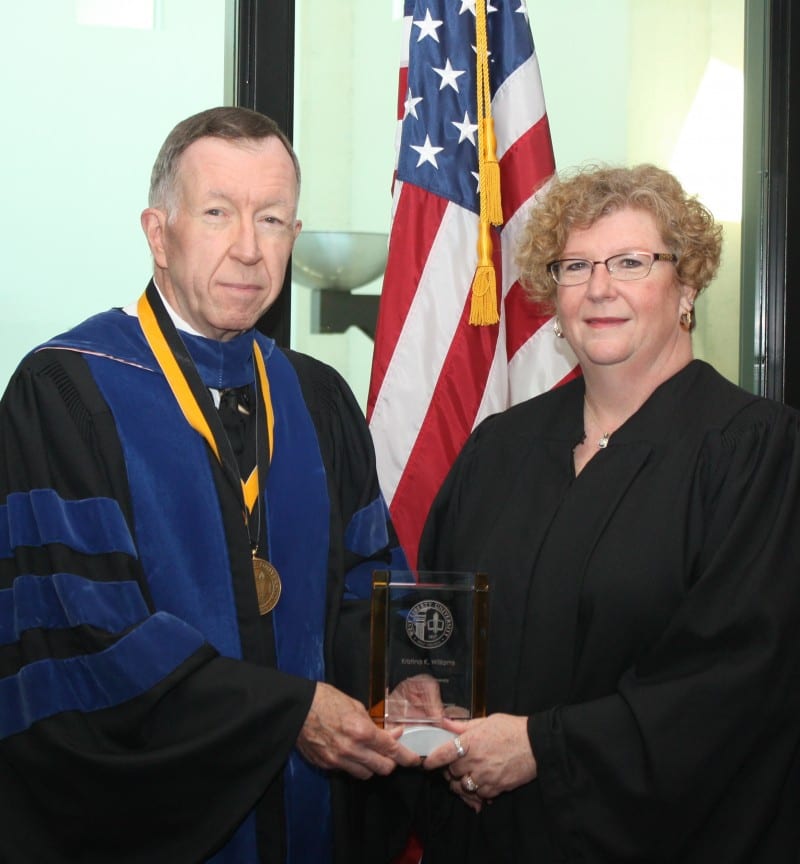
West Liberty remained in her life long after graduation. In 2015 she returned as commencement speaker and received an honorary Doctor of Humane Letters. Later that year she entered the university’s Alumni Wall of Honor. The photograph from commencement has the familiar academic ingredients: robes, a flag, an award. Behind the ceremony was an unusually long acquaintance with the place.
Learning the bank from the inside
Williams joined the Federal Home Loan Bank of Pittsburgh as chief accounting officer in December 2004. She became chief financial officer in 2006, executive vice president in 2010 and chief operating officer in 2011. The sequence is revealing. Her responsibilities widened from the accounts to the machinery around them.
As chief operating officer, she oversaw member-facing work that included community investment, communications, member services, product delivery and information technology. Affordable housing and computer systems might seem like distant neighbors on an organizational chart. In a wholesale bank, their connection is practical: a financial product has to reach a member institution through operations that actually function.
This was also a role that required attention to other people’s institutions. A member bank arrives with its own customers, local economy and funding needs. Serving it well involves understanding those circumstances. The accountancy background gave Williams one vocabulary for that work. Operations added another: what happens after the numbers have been approved and someone needs the service delivered?
In July 2016, she was appointed to the Pennsylvania Bankers Association’s Women in Banking Advisory Committee for a one-year term. Its work covered professional development, networking, recognition and mentoring. She also participated in Strong Women, Strong Girls, including as a development committee chair. Her interest in women’s advancement had a place on the calendar, alongside the daily business of running a bank.
The bank behind the local lender
Williams arrived in Des Moines on January 20, 2020. Her new employer was a member-owned cooperative, part of an 11-bank national system. Its customers included banks, credit unions, insurance companies, thrifts and community development financial institutions. A resident shopping for a mortgage would ordinarily encounter one of those local institutions first.
The distinction helps explain the job she had accepted. FHLB Des Moines provides funding and liquidity to its members, supporting their mortgage lending and other community activity. The work sits behind the familiar bank counter. Its effects depend on what member institutions can do with that access to funds.
Williams brought a broad operating background to this arrangement. She had spent years supervising departments that dealt directly with members. Her new district added a formidable range of places and needs. A cooperative serving more than 1,200 institutions cannot treat local knowledge as a decorative extra. Its members are the people working with those communities every day.
Her public writing in December 2020 carried that interest in other perspectives into the workplace. She described a virtual Day of Understanding attended by more than 200 employees and leaders, and her participation in CEO discussions about diversity and inclusion. She called for continued conversations, self-reflection and specific actions that could be measured. Listening, in that account, came with follow-up work.
Three dollars alongside one
One of the clearest illustrations of the bank’s approach during her tenure was the Member Impact Fund, created in 2023. Its matching structure gave member institutions a way to bring additional money to eligible nonprofit and government organizations. The arithmetic was accessible enough to escape a finance committee: three bank dollars could accompany one member dollar.
In March 2024, the bank announced nearly $20 million in its awards through partnerships with 94 members. Later that year, a Washington round involved 49 member institutions and more than 250 grants. The recipients’ work included down payment assistance, emergency housing, financial literacy, food banks and youth programs. Those categories give the abstract phrase community development something recognizable to do.
The mechanics also distributed a degree of judgment. Member institutions helped identify organizations important to their communities. The cooperative supplied matching resources. For Williams, whose career had taken her through both financial control and member services, the arrangement brought those disciplines together: money needed a structure and a route to a useful destination.
It is easy to read a grant announcement as a string of numbers separated by handshakes. The more interesting detail is the partnership underneath it. A local contribution could bring additional funding with it. An organization’s relationship with its own financial institution could become a connection to a much larger pool of resources.
A front door, and a door back home
The housing work continued at larger scale. In December 2025, FHLB Des Moines announced $102.4 million for 54 affordable housing initiatives through its competitive Affordable Housing Program. The collaboration involved 40 member financial institutions and 50 housing organizations, with the awards expected to benefit more than 1,700 families and individuals. Nine projects concerned Native housing.
54 initiatives · 40 member institutions · 50 housing organizations
Awards announced during Williams’s tenure. Project outcomes involve the bank, its members and housing partners.These were institutional awards, made through a competitive program and the work of many participants. They also provide a concrete way to understand the business Williams led. The distance between a wholesale funding institution and a home can be measured in partnerships, applications, construction and rehabilitation. A front door comes at the end of a long sequence of decisions.
Her personal giving had another destination: West Liberty’s international program. A 2020 gift supported the Rollie Williams International Center in Shotwell Hall, where her father had kept his faculty office. He had taught geography and taken students abroad. The endowed support extended that connection through faculty travel and the international program’s needs.
In 2021, the university recognized Williams and her husband, fellow alumnus James Taibi, among its Impact of Philanthropy honorees. They had completed a commitment to expand the center and fund its activities. The connection between her childhood and her philanthropy was unusually literal. Her father’s name remained attached to a place intended to help students encounter a wider world.
Leaving the chair, keeping the connections
In June 2026, while Williams was still chief executive, the bank announced plans to contribute more than $200 million that year to housing affordability and community development. She described the increased contribution as a deliberate board decision and made clear that this one-time level would not become the standard. Even in an announcement about giving more, the accountant’s distinction between an exceptional year and a recurring commitment had its place.
Williams had announced her intention to retire in January. Her final day was September 30, 2026; Wil W. Osborn became president and chief executive the next day. The transition followed a board-led search. Osborn had been the bank’s chief business officer since 2020, giving the handover a connection to the team already doing the work.
There are quieter details alongside that career. Williams has spoken about family travel, boating and reading John Grisham. During her Pittsburgh years she held Penguins season tickets. The combination offers a pleasing range of preferred suspense: a legal thriller, an overtime finish, the question of whether everyone remembered what to pack.
Her career can be followed through titles and dates. It can also be followed through relationships: a campus family, member institutions, housing partners, a university center bearing her father’s name. For someone who grew up around geography, it is a fitting pattern. Places mattered because of the people in them. Her work was to help the money make the journey.