Breaking
Legal Karma now powers wills & trusts for 100+ financial institutions Kory Kelly closed ~$5M total funding, including a 2024 Seed 67% of Americans have no estate plan - Legal Karma is gunning for that number Co-founders met in World of Warcraft, didn't shake hands for seven years Yes, the CEO of a legal tech company is not a lawyer Estate planning, but through your credit union app
Profile / Founder Files

Kory & Karma

A farm-town Texan who detoured through Oxford, quit academia, got rejected by every lawyer in earshot - and convinced 100 banks to start selling wills instead.

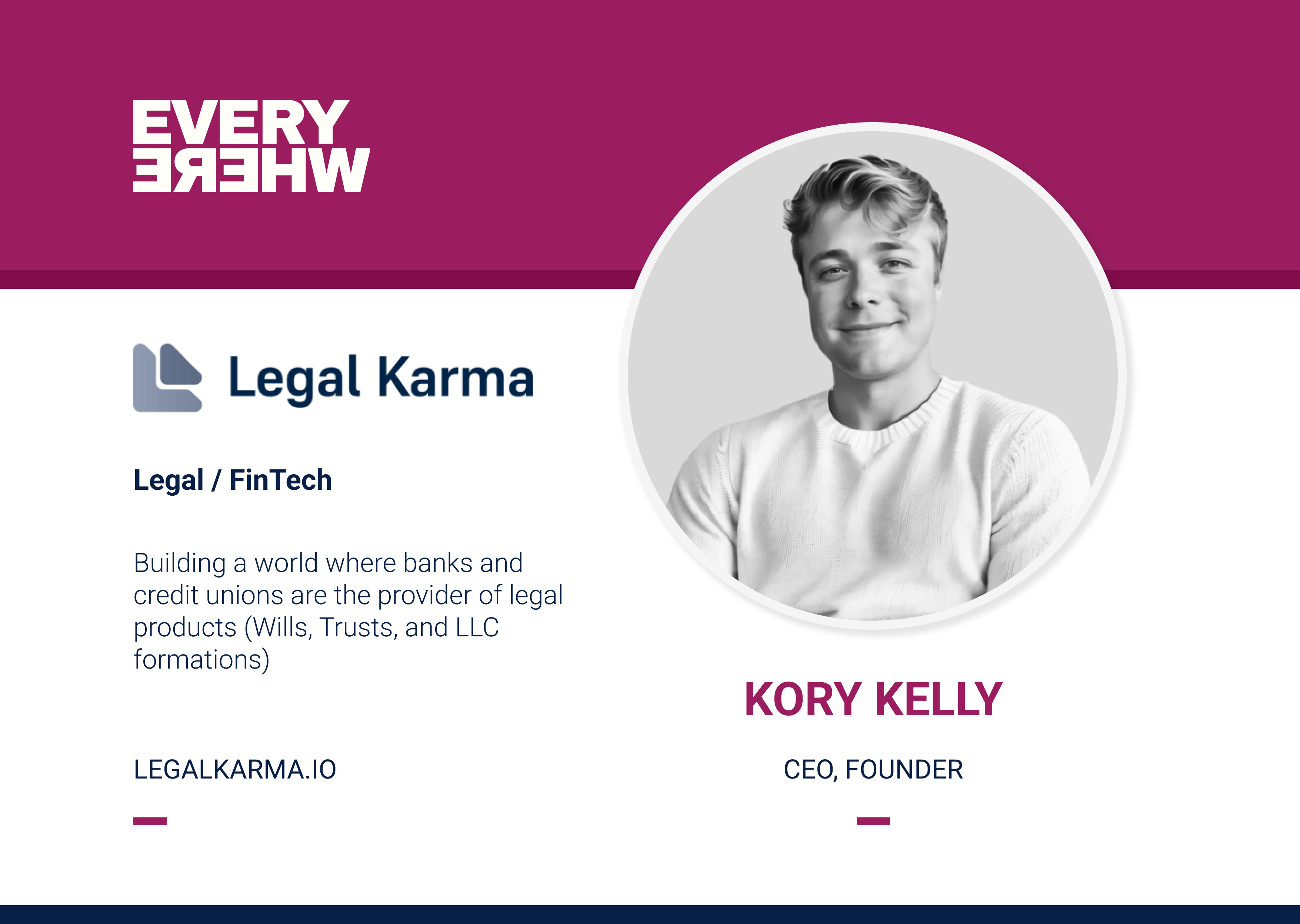
Kory Kelly, CEO of Legal Karma
// Kelly in conversation. The estate-plan evangelist who never went to law school.

An Austin operator with one idea: make a will boring.

Kory Kelly spends his days trying to make one of the most fraught moments in adult life feel as mundane as ordering checks. He runs Legal Karma, the Austin company that lets a bank or credit union slip estate planning into its product menu next to auto loans and overdraft protection. Open a savings account, set up a trust. Same login. Same brand. Same Tuesday afternoon.

The platform handles the document automation, the legal infrastructure, the compliance plumbing, and the member support. The financial institution gets the revenue and the credit. Members - that is, regular people who would otherwise pay a lawyer $1,500 they don't have, or more likely do nothing at all - get a will, a power of attorney, a trust. Roughly two-thirds of Americans have none of these. Kelly would like to fix that. Quietly. Through the bank.

It is a strange business to run if you are not a lawyer. Kelly is not a lawyer. He studied communication studies at Texas State, minored in chemistry, picked up a master's, and somehow landed at Oxford for graduate work in rhetoric. He taught for a while. He burned out on academia. He did a tour through change management consulting and a stint at Board.org. By the time he co-founded Legal Karma in 2020, he had a clear opinion about how messages should travel between institutions and humans, and almost no opinion at all about the difference between an LLC and a C-corp. He has since admitted as much, on a podcast, in his own voice.

His co-founder is Mauricio Cano, a first-generation American who handles the technology. The two met as teenagers in World of Warcraft, the way some founders meet in dorm rooms or accelerators. They were friends for seven years before they ever shook hands. By the time they did, they already knew how to disagree with each other.

Estate planning should be as accessible as opening a bank account. - Kory Kelly

Three years. One pivot. A hundred banks.

100+
FI Partners
Banks and credit unions live on the platform.
~$5M
Total Funding
Through a 2024 Seed of roughly $3M.
29
Team
Remote-friendly, Austin-headquartered.
67%
The Problem
Of Americans have no estate plan. The market is everyone.

The lawyers said no. The credit unions said yes.

Version one: doomed.

Kelly and Cano launched in 2020 with a clean theory. Law firms could automate the drudgery of will-drafting and use software to expand. They built it. They pitched it. The lawyers, predictably, were not interested in tooling that threatened the billable hour.

Founders romanticize the moment they realize the customer they thought they had is a customer they will never have. Kelly's version of that moment came after enough rejections to count. They had a product. They needed someone willing to put it in front of a person.

Version two: a credit union in Arizona.

The breakthrough was a credit union, of all things, already quietly selling estate planning services to its members. The Legal Karma team productized that motion - white-label it, plug it into the institution's brand, handle every piece of the legal infrastructure behind the scenes - and started knocking on doors that opened.

The pitch is brutally simple. People trust their bank. The bank already has their data, their address, their beneficiary forms. The bank has every reason to want them to stick around for another forty years. Why is the bank not the place you get a will?

A timeline that does not look like a straight line.

  1. 2014
    BA, Communication Studies (chemistry minor) - Texas State University.
  2. 2015
    MA at Texas State. Graduate study in communication & rhetoric at Oxford.
  3. 2017
    Membership Director at Board.org. Leaves academia for good.
  4. 2020
    Co-founds Legal Karma with Mauricio Cano. Pitches lawyers. Gets nowhere fast.
  5. 2022-23
    Pivots to financial institutions. White-label wills, trusts, POAs.
  6. 2024
    Closes a Seed round (~$3M). Crosses 100 FI partners.

The access gap, drawn out.

Americans without any estate plan
67%
Trust placed in community FI over an attorney
+80%
Legal Karma's footprint inside US FIs (and growing)
100+

Lines worth keeping.

"It takes a lot to show up when you don't know what the outcome is going to be - and that's all that being a founder is."

- On the job description

"People are 80% more likely to trust their community financial institution over an attorney."

- On why the channel is the credit union

"It's not a robot lawyer, it is a change of delivery."

- On what Legal Karma actually is

"Figure out what people want and figure out how to give it to them."

- On the whole strategy, basically

Wills, trusts, and the case for boring.

Product

Wills & Trusts

The core. Members complete documents in their bank's interface, at a price point built for the median customer, not the high-net-worth few.

Product

Power of Attorney

The document people forget exists until they wish they had it. Legal Karma puts it inside a flow people already trust.

Roadmap

Prenups, Divorce, LLCs

Kelly has telegraphed expansion into business formations and lifestyle legal events. Same white-label playbook, more shelves.

Channel

Credit Unions & Community Banks

The proof point. Institutions whose entire pitch is trust and proximity to members - exactly the right people to sell legal documents.

Engine

White-Label Platform

The institution keeps its brand, its pricing, and its revenue. Legal Karma takes the legal infrastructure off the table.

Belief

The Access Thesis

Two thirds of Americans have no will. Kelly's bet is that the missing piece is not awareness but distribution.

Four small facts the bio leaves out.

01
Met his co-founder in World of Warcraft. They didn't meet in person for seven years.
02
Studied communication, minored in chemistry. The chemistry didn't stick.
03
Did graduate work at Oxford. Then left academia, on purpose.
04
Runs a legal tech company without a law degree. Treats it as a feature, not a bug.

A communications major's company.

You can spot the rhetoric training in how Kelly talks about the company. He frames Legal Karma not as a robot lawyer or an automation play, but as a delivery change - the same legal infrastructure that already exists, rerouted through institutions people already trust. The argument lives or dies on a single sentence: estate planning should feel like opening a bank account. He repeats it the way a candidate repeats a stump line, because it does the heavy lifting.

The thesis is also personal. Kelly grew up LGBTQ in rural Texas. His co-founder is a first-generation American. Both have talked, publicly, about the way the legal system filters access through cost and intimidation, and the way that cost lands hardest on the people who already have the least margin. The push to embed Legal Karma in community financial institutions is partly a strategic insight about trust and distribution. It is also partly a quiet argument about who gets to plan for the future.

The company is still small by the standards of legal tech you have heard of. Twenty-nine people. A Seed round. A team that quietly added a Chief Strategy Officer and an Operations Lead while no one was looking. Kelly has talked about a Series A on the horizon and an expansion list that reads less like a roadmap and more like a list of life events people would rather not think about.

Ask Kelly about the playbook and he tends to point past the product. The pitch is not really the document. It is the conversation that happens when a credit union calls a member to say, "We can help you set up a trust by next Tuesday." That call does not happen today. Kelly is in the business of making it happen. Whether his startup is the one to fully build that future, or just the one that proves it can exist, is a story still being written - in Austin, in a small office, by a guy who used to lecture undergraduates about how messages travel.
Hear Kelly tell it himself.

Share this profile