Profile - Adtech / AI
Konrad &
the Quiet Math
A London-born computer scientist who has been training neural networks for thirty years - and arguing, lately, that the open internet is one of the things they can save.
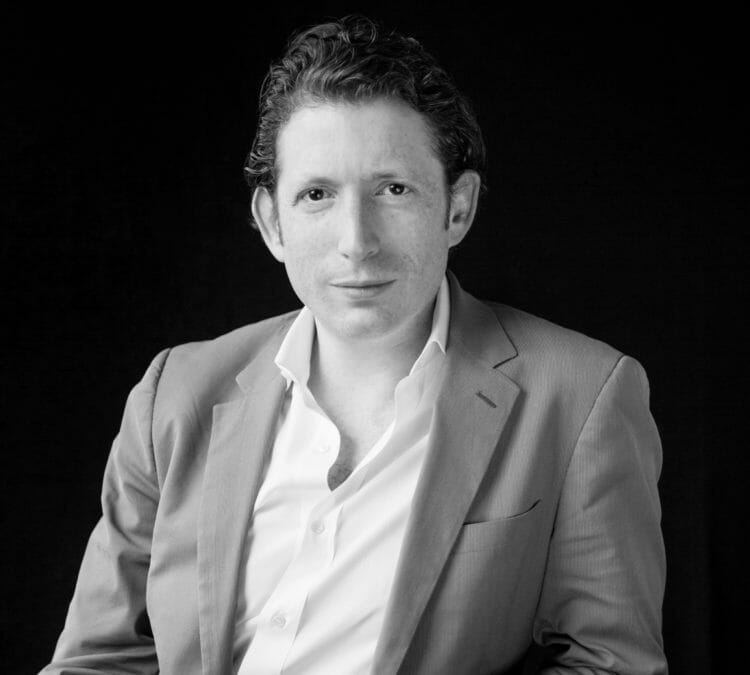
A London-born computer scientist who has been training neural networks for thirty years - and arguing, lately, that the open internet is one of the things they can save.
He has been working on machine learning since the people who funded it called it "expert systems" and the people who didn't called it dead. Both groups now want a meeting.
Konrad Feldman is in the middle of a very long argument. The argument, simplified: advertising, when it actually works, is what pays for the parts of the internet that nobody pays for. Newsrooms. Niche blogs. Recipe sites. The lousy regional papers that nonetheless cover the school board. Take advertising away and you do not get a cleaner web, you get a smaller one, with three landlords.
He has been making this argument from a corner office on Folsom Street in San Francisco since 2006, the year he and the physicist Paul Sutter started Quantcast with the bright idea of giving away an audience-measurement tool and seeing what people did with the data. What people did with the data, eventually, was let Quantcast build one of the largest pictures of consumer behaviour on the open web. The company now has roughly 800 employees in eleven countries. The pitch has barely changed.
What is unusual about Feldman is the timing of his patience. He started programming on a Commodore VIC-20 - five kilobytes of RAM, a calculator's worth - while at school in Saffron Walden. He read Computer Science at UCL. He stayed for a PhD in neural networks. This was the early 1990s, when neural networks were less a field than a rumour, and a slightly embarrassing one. Most of his classmates went into things with reliable salaries. He went into a research lab, and then into a company.
That company was Searchspace, started in 1993 with a few colleagues from UCL. Searchspace built software that watched bank transactions and flagged the ones that looked like terrorist financing or money laundering. Most of his future biographers will skim over this. They shouldn't. Detecting illicit money in a torrent of legitimate money is, mathematically, the same problem as finding likely car-buyers in a torrent of web traffic. Feldman has now spent three decades solving the same shape of problem with steadily more compute.
In 1999 he became CEO of Searchspace and moved to New York. In 2006 the company was acquired by Warburg Pincus. Most people at that stage of a career would have raised a fund, joined a board, taken a sabbatical. Feldman moved to San Francisco and started over.
Quantcast, in its first incarnation, was odd. Adtech companies in 2006 were noisy, transactional, demo-heavy. Quantcast was almost academic. It offered a free thing called Quantcast Measure - publishers stuck a tag on their site, Quantcast counted who showed up, and then Quantcast published the counts. This was, to many people, an obvious mistake. Why give away the data? The answer was the long one: because if you measure enough of the internet, you eventually have a model of the internet, and a model of the internet is the only thing worth selling.
The Series A came in April 2007. Five million dollars. Another twenty followed before the year was out. Quantcast Advertise, the commercial product, shipped in 2009. The recession was on, and adtech was unfashionable, and the press kept asking whether the open web had a future. Feldman, in interviews from the period, sounded calm. He was running a math experiment that happened to need a company around it.
AI will be utterly transformational for every industry. It took twenty-five years to be allowed to say that out loud.- Konrad Feldman
Quantcast in figures, as of public reporting through 2024.
Feldman has been on this riff since 2018. The interesting part is how cheerful he sounds about it.
Most adtech executives talk about the demise of third-party cookies the way insurance adjusters talk about hurricanes: solemnly, with one eye on the door. Feldman talks about it like a software engineer who has finally been given permission to delete some legacy code.
His position, sharpened over years of conference panels in Sydney, Munich, and New York, runs roughly: alternative ID systems will not scale, marketers are wildly underweighting contextual signals, and the privacy overhaul will be less apocalyptic than the industry believes. The thing that replaces cookies, in his telling, is a model. A big, hungry model that infers what cookies used to declare.
That model has a name. Ara, Quantcast's AI engine, launched publicly in 2021. Underneath it is a piece called Ara TopicMap, which threads contextual signals - what a page is about, what the reader is doing - into a guess about intent. The output is the same coupon you would have got from a cookie, minus the cookie.
It is a long bet, and it is not finished. The walled gardens - Meta, Google, Amazon - keep most of the data inside their fences, and Feldman is not pretending otherwise. What he is selling is a way for everyone outside the fences to survive.
This is also the part of the argument where he sounds least like a CEO. "Advertising funds the free and open internet," he says, often. "We've got to democratize ad funding." There is no nervous laugh after it. He means it the way an electrical engineer means that current flows from high voltage to low.
One reason to take the argument seriously is the bench behind him. Quantcast was an early operator on Amazon Web Services - Route 53, SES, the analytics suite - and an early adopter of Snowflake. The company runs on Apache Spark, Salesforce, Workday and a small army of Salesforce Lightning components. Boring infrastructure is the hidden cost of a long bet.
From a 5K home computer in a market town in Essex to a $130M-funded adtech in California.
Lifted from interviews with The Drum, Big Think, MarTech Series, Mi3 and the Quantcast blog.
What it takes to run an AI audience graph in 2026. A non-exhaustive walk through Quantcast's tooling, as cataloged from public sources.
Useful for anyone who is about to meet him.
His first computer cost the price of a coat and shipped with five kilobytes of RAM. Most modern web pages would not fit in it. He has not forgotten the discipline.
Paul Sutter, his Quantcast co-founder, came out of physics. Quantcast's first product was, in essence, a particle counter for the internet. The lineage shows.
The machine learning he built to flag terrorist financing is a sibling of the machine learning he now uses to flag likely buyers. Same shape of problem, different stakes.
Interviewers consistently describe Feldman as understated. In a category that runs on bombast, this is a competitive advantage that nobody else can copy by hiring.
Quantcast Measure is still free. Two decades in, the giveaway that funded the data set is also the most reliable distribution channel the company has.
Most adtech CEOs argue for adtech. Feldman argues for the open internet, and only incidentally for the company that helps fund it. Read his Collision 2021 talk.
A short shelf to catch up to the argument.
MARKETECH Expert Up Close - Feldman on the AI trends marketers are about to inherit.
"Personalized AI" - the case for models that work for the consumer, not against them.
Collision 2021 - the provocative open-web keynote, fully unpacked.
Healthy realism - his 2018 take, in Asia, on what adtech keeps lying to itself about.
DMEXCO interview - a longer conversation on adtech in Europe.
Stories within adtech - the founder, in his own voice, on the long arc.
Where Konrad Feldman shows up online, in the open.