Profile / Founder & Practicing Orthodontist San Francisco & Barcelona
Kjeld Aamodt
He treats patients on Sutter Street on Tuesday and reviews European P&L on Wednesday. The white coat stays on.
FILE PHOTO
He treats patients on Sutter Street on Tuesday and reviews European P&L on Wednesday. The white coat stays on.
THE STORY SO FAR
The frustration was specific. Eleven years of training, then ten minutes per patient. Kjeld Aamodt had finished his Doctor of Dental Surgery at UCSF, picked up a Master of Science in Orofacial Sciences along the way, and stayed on as faculty in the Division of Orthodontics. He watched colleagues squeeze a craft built on careful observation into the slot of a factory shift. The waiting rooms were full. The chairs spun. The software groaned. The smiles were fine. Fine was the problem.
So in 2018 he opened Uniform Teeth on Mission Street in San Francisco. A clinic, yes, but built sideways - tech-first, clear aligners as the default product, the kind of digital workflow that lets one orthodontist actually look at a patient's face without a tablet between them. It worked. Patients came. Investors followed. UCSF gave him its 2019 Campaign Alumni Award in the Pathfinders category - the school's particular brand of saying "we noticed."
Four years later he made a bigger bet. Barcelona-based Impress, founded in 2019, had become Europe's largest clear-orthodontics brand: Spain, France, Italy, the UK, Germany, Portugal. In 2022 the two companies merged. Uniform's North American footprint folded into Impress, and Aamodt became co-founder and CEO of Impress US. He kept the San Francisco practice. He kept the faculty appointment at UCSF. He simply added a Barcelona address and a much larger inbox.
Today Impress runs more than 110 clinics. Roughly 1,100 people work under the brand. Total funding sits around $257.5 million, the most recent tranche a debt round closed in late 2024. New York City got its first Impress clinic in 2023. The transatlantic experiment is no longer an experiment.
The Arc
The pivot, the one that explains everything else, happened inside a clinic, not a boardroom. Orthodontists, Aamodt has pointed out repeatedly, train for more than a decade specifically so they can sit with a patient, study the geometry of a face, and design a treatment plan that respects both. Then they graduate into practices where a tooth-straightening visit is sixty seconds of progress check and four minutes of administrative paperwork. The software fails. The schedule is brutal. The art evaporates.
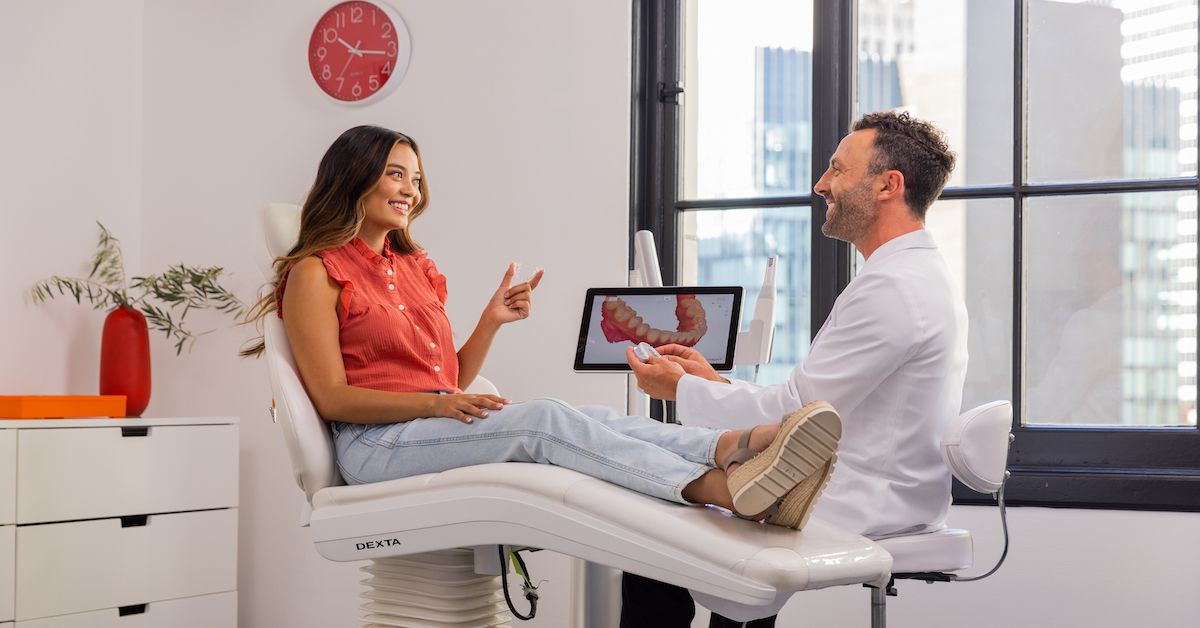
His response was a workflow. 3D intraoral scans replace gooey impressions. AI-assisted planning roughs out the treatment trajectory. Remote monitoring through a phone app catches problems between visits. When the patient does come in, the orthodontist is rested, prepared, and has actually looked at the scan. The doctor-patient time gets longer, not shorter. The visits get rarer, not denser. The chair stops spinning.
Uniform Teeth was the first version. It launched in 2018, served the Bay Area, and proved the workflow worked. Patients liked the cadence. Investors liked the unit economics. Aamodt liked that he was still allowed to be a clinician.
Then Impress called. Khaled Iskandarani and Diliara Lambert had launched Impress out of Barcelona in 2019 with a similar thesis and a faster European rollout. By 2022, Impress operated clinics across most of Western Europe, while Uniform Teeth was scaling carefully in California. The merger was less an acquisition than a stitching-together: same conviction, complementary maps. The combined company kept the Impress brand, kept the Barcelona HQ, and put Aamodt in charge of the American side.
The expansion has been deliberate. New York opened in 2023. The US clinic network has been growing in dense urban markets - the kind of places where a small studio, a single 3D scanner, and a couple of orthodontists can replicate. The Europe side keeps adding cities. The 1,100-person headcount is split across both continents. Aamodt's calendar is split with it.
He has not left UCSF. He is still listed as an assistant clinical professor in orofacial sciences. He still appears in research papers on orthodontic mini-implants and on aerosol risk in dental procedures. He still sees patients at the 999 Sutter Street practice in San Francisco. The CEO title sits beside, not above, the white coat.
If there is a single thread running from the Mission Street clinic in 2018 to the 110th Impress location in 2026, it is this: he never tried to disintermediate the orthodontist. The direct-to-consumer aligner companies that bypassed in-person doctors and shipped trays in the mail collapsed publicly and expensively. Aamodt's model is the inverse - more orthodontist, not less, with the technology buying back the minutes that admin used to steal.
Aamodt has told the story repeatedly: residents train 11+ years, then enter practices where they get ten minutes per patient. He calls it the factory problem. Uniform Teeth was the answer.
UCSF's 2019 Campaign Alumni Award named him in the Pathfinders category - the school's recognition for graduates who push the boundaries of science and health care.
His professional address rotates between Carrer de Roger de Llúria in Barcelona and Sutter Street in San Francisco. He still treats patients personally at the latter.
His favorite metaphor: "Teeth move like icebergs - what controls their movement lies beneath the surface." Bone biology over plastic geometry.
Career, Annotated
By the Numbers
In His Own Words
What He's Actually Building
Replaces the impression goo. Same data, more accurate, no gag reflex. The scan becomes the planning surface.
Software roughs out the tooth-movement trajectory; the orthodontist edits rather than originates. Buys back hours per case.
Patients photograph progress between visits. Problems surface earlier. The chair time gets fewer, longer appointments instead of many short ones.
The Receipts