BREAKING - KHACHIK SAHAKYAN NAMED CO-FOUNDER, CEO OF GROVF 800 GBPS ETHERNET FABRIC SHIPPING FROM NEWARK SUB-2 MICROSECOND RDMA LATENCY CONFIRMED YEREVAN HQ + BERKELEY OFFICE NOW HIRING - RTL DESIGN ENGINEERS WANTED BREAKING - KHACHIK SAHAKYAN NAMED CO-FOUNDER, CEO OF GROVF 800 GBPS ETHERNET FABRIC SHIPPING FROM NEWARK SUB-2 MICROSECOND RDMA LATENCY CONFIRMED YEREVAN HQ + BERKELEY OFFICE NOW HIRING - RTL DESIGN ENGINEERS WANTED
Vol. 01 / Issue 06 / Profile

Khachik
Sahakyan.

He left a physics lectern in Yerevan to build the plumbing of the AI gold rush - 800 Gbps fabric IP, UCIe chiplets, and SmartNICs that move data between accelerators faster than most people can blink twice.

Co-Founder, CEO - Grovf Newark, CA Yerevan, AM RTL + RDMA + UCIe
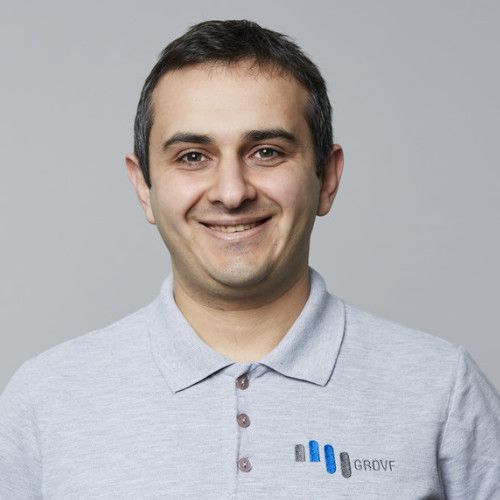
Khachik Sahakyan, Co-Founder and CEO of Grovf
Khachik Sahakyan / file photo

The Quiet Engineer Wiring the AI Data Center

Walk into any data center in 2026 and the loudest argument in the room will be about GPUs. Khachik Sahakyan is having a quieter argument, one floor down, in the space between the racks. He runs Grovf - a company most casual AI watchers have never heard of - and he is convinced the next decade of machine learning will not be won by whoever makes the fastest chip. It will be won by whoever wires those chips together without losing a microsecond.

That conviction is the thread running through every Grovf product page. AI Back End Fabric IP. AI Back End Fabric Chiplets. AI Scale-Out NIC. Each of them designed to do the same unglamorous thing: shuttle tensors between accelerators at 400 to 800 gigabits per second, with under two microseconds of RDMA latency, across a topology meant to stretch past a million nodes. It is the kind of work that does not trend on social media. It is also the kind of work that decides whether the model you trained next year finishes in three weeks or three months.

Sahakyan did not arrive here through the usual founder script. He studied microwave engineering and photonics at Yerevan State University, then stuck around as a lecturer teaching computational physics and the automation of scientific experiments. He spent time as a senior systems engineer and team lead at Ovak Technologies. Somewhere in there he picked up a business education from Berkeley. The combination - physicist's patience, engineer's discipline, and a quiet line of credit with the Bay Area - turned out to be exactly the toolkit a deep-tech founder needs.

~60
Team Size
800Gbps
Per Port
<2µs
RDMA Latency
1M+
Scale-Out Nodes
Our hardware database prototype achieved 10 times faster transactions, and hundred times faster response in comparison with software databases.
- Khachik Sahakyan, on early Grovf benchmarks

From JVM-on-FPGA to a Fabric for the Future

Grovf's first act, in 2017 and 2018, looked like a clever party trick. Take the Java Virtual Machine - the runtime that powers a sizable fraction of enterprise software - and offload its library functions onto bare hardware. The promise: ten to a hundred times faster execution, with no code changes, by trading silicon for cycles. Two years of R&D, a patent-pending architecture, and a SaaS launch on AWS Xilinx Alveo boards followed. SmartGateVC led a pre-seed round in December 2018. Granatus Ventures piled in. A pair of EU innovation grants worth about $120,000 padded the runway.

If Sahakyan had stopped there, Grovf would be a respectable footnote in the history of hardware acceleration. He did not stop. The company spent the next several years walking up the stack from JVM acceleration to database hardware, from database hardware to storage clustering and memory pooling, from memory pooling to the full-stack vision now on the Grovf homepage: a standards-based back-end fabric for the AI accelerator economy. The pivot is not advertised as a pivot. It reads as a logical progression for anyone who watched the data-center bottleneck shift from compute to interconnect to fabric.

The capital-efficiency story almost reads as a dare. Apollo lists Grovf's total funding at $360,000, with the most recent raise - a seed - closing in February 2021 at $240,000. Sixty employees. Offices in Newark and Yerevan. A product roadmap aimed at hyperscale buyers. The math only works if you assume the founders are very good at engineering and very patient about ownership. Both appear to be true.

Where the Bandwidth Goes

AI Back End Fabric IP800 Gbps
AI Scale-Out NIC400 Gbps
UCIe ChipletPlanar Integration
RDMA Latency< 2µs

Anecdotes, Quirks, Marginalia

Recruiting Notice

His LinkedIn headline is not a title. It is a hiring ad: "CEO at Grovf. Now Hiring RTL Design and Verification Engineers!" Subtle.

Two Area Codes

+1 408 and +374 41. Twelve digits that tell the whole Grovf story before you reach the second slide of the pitch.

Prior Life

Lectured on computer modeling of physics problems at Yerevan State. A strange feeder pattern for someone who would later spec back-end fabric for AI clusters.

Berlin Demo Days

Took the prototype to IFA Berlin through the Armenian Startup Academy program. Five-person team. Big show floor. The bet aged well.

The Other Co-Founder

Artavazd Khachatryan, CTO, has been the technical other half from day one. Two years of intensive R&D, one patent-pending architecture.

The Newark Pin

39899 Balentine Drive. A nondescript building down the road from where most semiconductor history quietly gets made.

A Decade-Long Trail

Pre-2017

Senior systems engineer and team lead at Ovak Technologies. University lecturer at Yerevan State University - computational physics, automation of scientific experiments. Quiet years of compounding technical depth.

February 2017

Co-founds Grovf with Artavazd Khachatryan. Pitch: IIoT-scale big data, solved in hardware instead of software.

October 2017

Team grows to five. Wins the EU4Business SMEDA Innovation Matching Grant. Partners with National Instruments for prototyping. Presents at IFA Berlin.

December 2018

Closes pre-seed round led by SmartGateVC. Granatus Ventures and US angels participate. EU innovation grants total roughly $120,000.

Q1 2019

Launches JVM-acceleration SaaS on AWS using Xilinx Alveo boards. Opens recruiting for FPGA developers and an intern training pipeline in Yerevan.

February 2021

Raises a $240,000 seed round. Disclosed cumulative funding sits around $360,000 - small for a hardware company about to ship 800 Gbps IP.

2024 - 2026

Repositions Grovf around AI back-end fabric. Launches IP, chiplet, and NIC product lines targeting 400/800 Gbps Ethernet at scale.

What Makes Him Tick

01 / Patience

Nine Years, One Bet

Grovf has been alive long enough to outlast three or four data-center fashions. Sahakyan has been steering the same boat through all of them.

02 / Discipline

Capital As a Constraint

$360K disclosed across the company's life. The product roadmap reads like it had ten times that. Frugality is the strategy, not a side effect.

03 / Geography

Yerevan + Newark

A two-country org chart is a logistical headache for most founders. For him, it is the entire competitive moat - and a vote for what Armenia's deep-tech sector can become.

04 / Identity

Engineer First

The lead engineer credit on his F6S profile is still there. The CEO title comes second. That ordering is intentional.

End of section

The Aspiration, Said Plainly

Build the standards-based AI fabric that connects more than a million accelerator nodes. Put Armenia on the global semiconductor map. Keep hiring RTL designers until the world runs out of them. There is no founder mythology in this list. There is only a punch list.

Where to Find Him

Spread the Word

If a friend keeps asking what is going to wire the AI data center, send them this. Their oncall rotation will thank you.