Between high school and university, Kevin Rudahinduka took a job at a microfinance bank. The work was data processing, and he had a knack for it. His employers noticed. A full-time offer followed, the sort of practical invitation that can make further study feel needlessly ornamental. Rudahinduka turned it down and went to the Kigali Institute of Science and Technology to study information technology.
The choice tells you something useful about his career, although not quite the usual sermon about credentials. Rudahinduka did not retreat from the working world. He went away to understand it more deeply, then returned with better questions. Over the next two decades he would move through microfinance, banking technology, digital channels, enterprise transformation and insurance. The job titles grew. The underlying assignment remained wonderfully stubborn: make complicated systems useful to people.
Today he is CEO Rwanda at Eden Care Medical. Before that, he directed the transformation program at Bank of Kigali. Earlier still, he led IT at KCB Bank Rwanda and held senior technology roles at Urwego Opportunity Bank and I-Finance Microfinance Bank in Kinshasa. This looks like a steady ascent on a résumé. Up close, it is a sequence of translations: from data to decisions, infrastructure to products, and engineering language to the language of a budget meeting.
The first useful refusal
Rudahinduka's early full-time offer could have settled the question of what he was good at. Instead, it opened the question. He studied computer engineering and information technology in Kigali, then spent seven years applying what he had learned in industry. By then he knew enough to know what else he needed.
Carnegie Mellon University Africa was just beginning to take students. It offered one program, the Master of Science in Information Technology, and its small early cohorts had to choose courses strategically. Rudahinduka had family ties to Carnegie Mellon in Pittsburgh and could study in Kigali while remaining with his family. He joined, graduated in 2014, and came away with more than another line on his biography. He had found the middle territory between engineering and the enterprise.
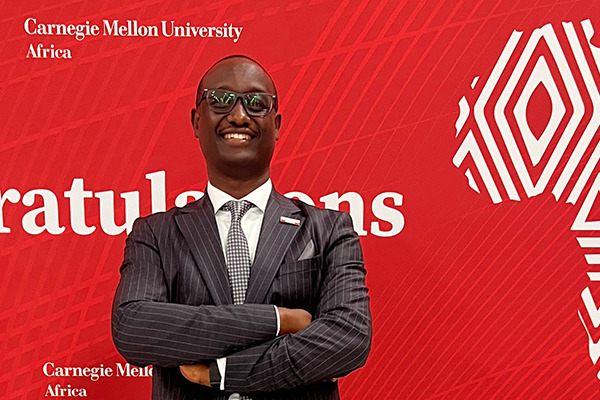
I had to move to the other side, on how to use information in business and start talking business language to get work for engineering.Kevin Rudahinduka, Carnegie Mellon University Africa
There is a compact career curriculum inside that sentence. Technical correctness does not automatically produce organizational movement. A clean architecture still needs sponsorship. A digital product still needs an owner, a customer and a reason to exist. Rudahinduka began adding the neglected subjects: sales, operations, finance, project management and people management. Engineering remained the foundation. Business became the means of giving it somewhere to go.
The Rudahinduka bridge
His operating advantage is not choosing one side. It is carrying context across the span without dropping the details into the river.
A bank is a city of systems
Banking gave Rudahinduka a demanding laboratory. A bank is a city of systems where nothing interesting happens in isolation. Mobile channels touch identity, payments, risk, customer support and the core ledger. The software can behave impeccably while the experience remains maddening. Moving one part means negotiating with the rest.
At KCB Bank Rwanda, his published record includes the introduction of a mobile app and digital-lending solutions. He joined Bank of Kigali in 2016 as Head of Electronic and Digital Channels, became Head of Digital Banking, and then Transformation Programme Director. The widening titles trace the widening problem. He was no longer responsible only for technology working. He was responsible for change working.
IT management and CIO-level work across Urwego and I-Finance turned systems knowledge into operational responsibility.
As Head of IT, he worked on mobile banking and digital lending, bringing services out of the branch and onto the phone.
He moved from electronic channels to digital banking and then enterprise transformation, linking products, platforms and teams.
As country CEO, he carries a systems operator's habits into the wider decisions of an insurance business.
The portfolio at Bank of Kigali ranged from BKquick, an instant digital-lending product, to Mastercard Payment Gateway Services for e-commerce merchants. It also included the T24 Transact R20 core-banking implementation and the bank's first cloud-hosted enterprise resource planning platform. These are different machines with a common demand: align the human element before expecting the technical element to transform anything.
That human element was explicit in his approach to digital-finance training. Rudahinduka pushed team members to take courses, negotiating scholarships and discounts because common vocabulary mattered. If colleagues came to the table with different mental models, they could discuss the same system and leave with different conclusions. Shared learning was part of the infrastructure.
You can't discuss and come to the same solution if you are not on the same page.Kevin Rudahinduka, Digital Frontiers case study
The 50/50 rule
When Rudahinduka speaks to engineering students, he offers a division so neat it could be mistaken for a slogan. Put at least half your focus into mastering engineering, he says, and the other half into understanding core business functions. The percentages are less interesting as arithmetic than as permission. A young engineer may study a balance sheet, a sales process or the awkward choreography of a team meeting without feeling disloyal to the craft.
His warning is almost comic in its realism: employers impressed by your education may put you in charge. Competence has consequences. Suddenly the engineer must schedule, persuade, hire, listen, decide and explain. The promotion arrives carrying several new professions in its coat pockets.
Rudahinduka's own route is evidence for the formula. He did not exchange engineering for management as though trading in an old car. He expanded the frame around the engineering. A chief executive still deals in systems, but some of the most temperamental components have calendars, opinions and expense accounts.
From the ledger to the member
In September 2023, Rudahinduka became Eden Care's CEO in Rwanda. The sector changed, but several familiar operating questions followed him: How do digital tools remove friction? How does information improve a service? How do you earn trust when the product is mostly a promise about what will happen later?
Eden Care's model is built around digital access, automated administration and a large provider network. Rudahinduka's banking years fit the assignment with surprising neatness. Banks and insurers both turn records, rules and confidence into an everyday service. Both can lose a customer in the gap between what a system permits and what a person experiences.
His public comments keep returning to trust, tailored solutions and direct customer contact. In late 2025, he visited Kivu Choice's Rusizi branch with Eden Care colleagues to meet members, listen to their challenges and discuss improvements. It is easy to proclaim customer centricity from a slide deck in Kigali. Rusizi is where the nouns acquire faces and the workflow meets a working day.
A team milestone, collected in person
Rudahinduka and colleague Rangira Sandrina accepted Eden Care's Best Medical Insurance in Rwanda award at the Rwanda Insurance Brokers Association conference.
When Eden Care received that recognition in 2025, Rudahinduka credited a focus on trust and solutions suited to different customers. The company reported nearly 2,000 partner providers and more than 30,000 people covered across Rwanda at the time. The numbers give the digital model physical weight. A platform may live on a screen, but its usefulness is measured across a map.
Range without theatre
Rudahinduka's official biography includes a detail that rescues him from the fluorescent light of enterprise software: he likes scaling mountains and exploring natural sites across Africa. It is a pleasing counterweight. Someone who spends a career integrating systems apparently enjoys terrain that refuses integration.
The more revealing trait, though, is range. His career crosses nonprofit and private institutions, Rwanda and the Democratic Republic of the Congo, microfinance and commercial banking, infrastructure and customer experience. In 2016 he sat on the jury for Seedstars Kigali, evaluating startups while still leading digital channels at Bank of Kigali. The engineer had become someone asked to judge businesses.
Range can become performance, a long list of domains worn like medals. Rudahinduka's version appears more functional. Each discipline supplies a missing part of the same operating picture. Engineering explains what the system can do. Finance explains what it can sustain. Operations reveals where it catches. Sales and customer conversations reveal whether anybody wants the result.
The boy processing data at a microfinance bank could already make information move. The executive in Kigali now makes decisions move through organizations. Between those points lies a patient accumulation of languages. His career offers no magic phrase for transformation. It offers the harder and more reusable habit of learning what every person around a system needs to hear, then building enough shared understanding for the machinery to matter.