Kevin Priddy’s coworking business has a dog with a travel schedule. Magic, the statue awarded to a winning location, arrives for a monthly stay with the team that has earned it. In a recent celebration, the Palm Beach Gardens staff rolled out a red carpet, supplied a wardrobe and renamed their visitor Palmie. An office award had acquired the habits of a touring celebrity. Apparently, even the trophy needs somewhere to work.
Priddy says the Top Dog tradition goes back to 2010, to the business that became PlanHub. It is a small piece of continuity in a career that has changed its outward appearance several times: concrete contracting, construction software, flexible offices. The furniture changes. The attention to the people doing the work remains.
There is a temptation to tell a founder’s story backward from the financing announcement, as though the capital had been waiting patiently for the idea to arrive. Priddy’s story is more interesting when it begins earlier, with the unglamorous business of finding the next job. Before the platform and the boardroom, there was a contractor who had bids to prepare.
The bid before the building
Priddy worked as both a concrete general contractor and a subcontractor. He owned Priddy Concrete Construction, which specialized in decorative concrete. That background put him on both sides of a commercial relationship: assembling a project and trying to win a piece of someone else’s. Each side depends on the other, although they may experience the same paperwork quite differently.
The general contractor wants enough suitable bids to put a proposal together. The subcontractor needs access to a project, the right information and a reasonable chance that preparing a bid will lead somewhere. A supplier needs to know what materials will be required and who is making the decisions. A building may end up as one address. Getting it built begins with a crowd.
PlanHub grew out of an earlier lead service for subcontractors. Around 2015, Priddy and co-founder Kyle Conlan saw general contractors using a collection of tools to share project files. They built a platform that general contractors could use free of charge. That choice addressed a practical requirement of any marketplace: the people bringing the opportunities need a reason to bring them.
Priddy’s account of the product is grounded in those working relationships. General contractors could post projects and track interest. Subcontractors could obtain files and send a bid to multiple general contractors considering the same project. The software gave an existing commercial exchange a more organized place to happen. It also widened the circle beyond the contacts a contractor already knew.
A simplified view of PlanHub’s early marketplace model.
The useful question here is how experience becomes product judgment. Someone who has prepared a bid understands that the work begins well before submission. Finding the documents, checking whether the opportunity fits and reaching the relevant people all take attention. A tool has to repay the time spent learning it. Familiarity with that sequence gave Priddy a concrete problem to work on.
His own version of the company’s origin fits on a much smaller surface. When he later left the CEO role, he remembered an idea first put on a legal pad. Paper has a pleasingly modest place in this software story. It was enough to hold the beginning.
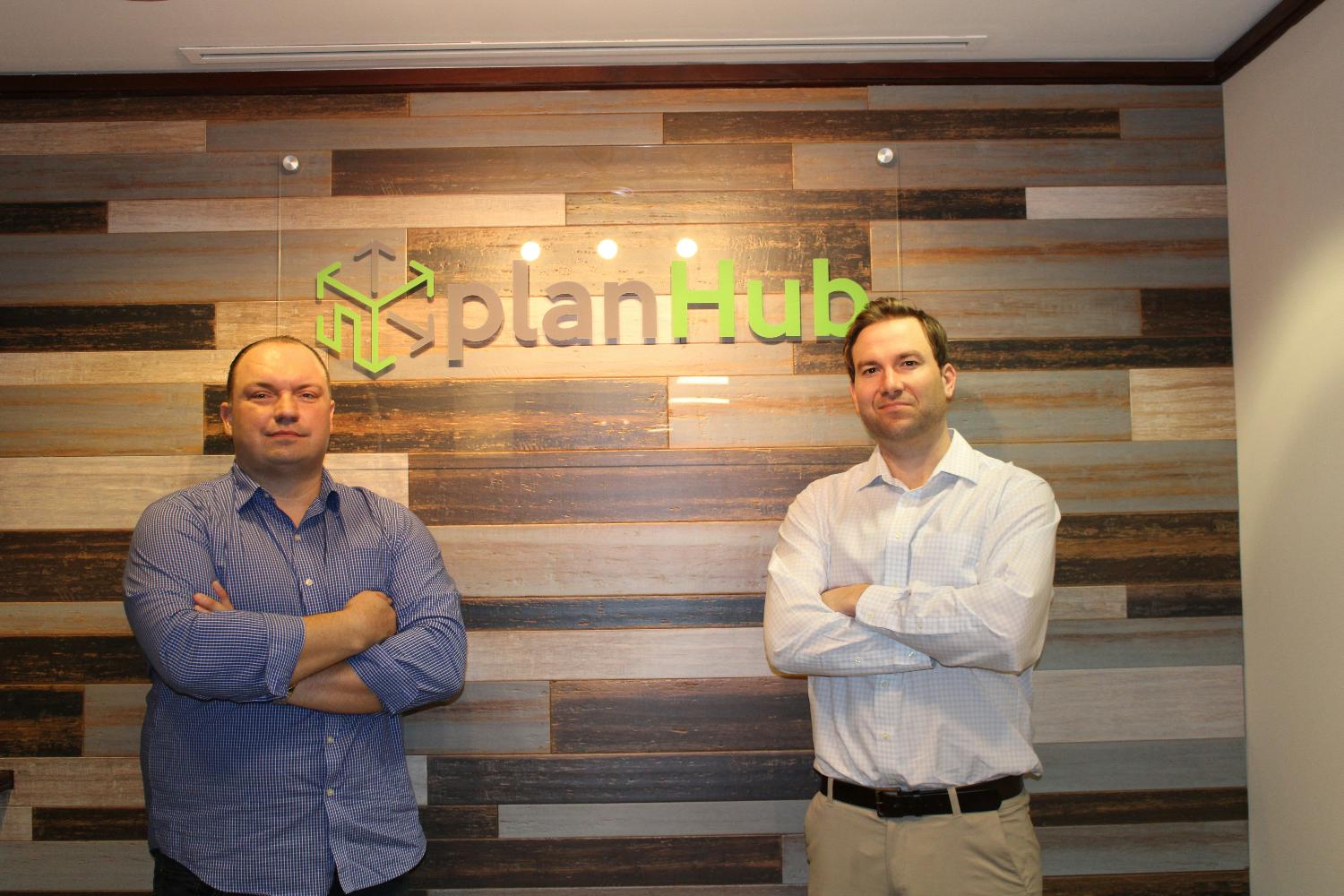
A company learns to carry its own weight
By November 2019, Priddy described a company with 26 employees, including colleagues working remotely across the United States. He was hiring in support, market research and sales, and adding senior leadership. PlanHub had also introduced a monthly, voluntary Think Tank meeting where employees could bring ideas about the product, service and customers.
That detail belongs beside the user numbers. Growing software businesses need more than a way to attract customers. They need a way to hear from people who spend their days dealing with them. The employee who handles a repeated request may notice something the founder no longer sees. A regular meeting gives that observation somewhere to go.
On October 20, 2020, PlanHub announced a $41 million investment from Mainsail Partners. The announcement described a network of approximately 300,000 general contractors, subcontractors and suppliers. The planned uses of the money were specific: management, product, customer success, sales and marketing. The company needed to build more capacity around the activity it had already attracted.
Mainsail Partners’ investment in PlanHub.
Priddy later described how Mainsail’s recruiting resources helped PlanHub bring in experienced executives. Those leaders, in turn, drew on their own networks to recruit. It is a less theatrical account of growth than the solitary founder story. An organization expands through people who know how to do jobs its founder can no longer perform alone.
In 2021, PlanHub opened an office in Lehi, Utah. Priddy said it helped attract employees with software experience and support users around the country. The move gave the business a second recruiting geography as well as room to grow. For a company founded by a contractor, there was a certain logic in paying close attention to where the team would work.
His public ambition was direct. In a television interview about hiring, he described a vision in which commercial projects would begin on PlanHub. It was an aspiration, rather than a description of the whole industry. The distinction matters: the company had made a place for an exchange, and its founder wanted that place to become a regular starting point.
The anniversary with two meanings
On January 31, 2022, Ro Bhatia succeeded Priddy as CEO. Priddy moved to executive chairman. His farewell message marked thirteen years since he had opened the office doors of the business. The anniversary became both a measure of persistence and a moment to stop running its daily operations.
He acknowledged what those years had required: long hours, flights across the country, missed children’s practices and dinners. He thanked the people who had helped him and backed Bhatia as the next leader. He would remain involved in strategy and advise the CEO. The arrangement kept his experience available while giving someone else responsibility for the working day.
A handoff is an unusually revealing part of a founder’s biography. Starting a company concentrates decisions in one person. Building a company that can continue requires those decisions to move outward. Priddy’s farewell made room for another executive’s future and for his own. Thirteen years is a substantial stretch of anyone’s calendar, even before counting the dinners.
- 2009The business behind PlanHub begins.
- 2015The construction marketplace launches.
- 2022The CEO handoff; Priddy Spaces is founded.
- 2026A coworking portfolio across three states.
The next room
Priddy Spaces, founded in 2022, brought him into coworking with his wife and business partner, Giedre. Its portfolio uses the Venture X and Office Evolution brands. The product is tangible in a way software is not: someone walks through the door and decides whether this feels like a place to spend the day.
At their downtown Orlando Venture X, Kevin described members moving from community space into an office, then into multiple offices. He saw the operation as an incubator. A member could grow through the available options and eventually need more space than the location could offer.
“Our job is to help them until they outgrow us.”
Kevin Priddy, on coworking members
Giedre’s description of service was wonderfully particular. Conference rooms should have ice water and glasses. The chairs should face the right way. The room should look ready for the person who booked it. Kevin noticed members putting their children’s artwork on the walls. Those personal touches suggested they were making a place for themselves.
There is considerable business sense tucked into that domestic detail. A member who brings a child to see the office has given the space a role beyond its floor area. The place has become part of how they explain their working life. Hospitality is felt through objects and routines small enough to escape an expansion announcement.
Priddy’s own writing about scaling records a contrast. One acquired location reached full occupancy within twelve months after leadership, amenities and service improved. Another opened without a strong sales lead and took twice as long to ramp up. He also described two locations less than seven minutes apart serving different members at different prices.
These examples put judgment ahead of a universal formula. Nearby offices can coexist when their customers differ. An attractive space can struggle when the team is incomplete. His advice is to establish repeatable operations, visit the neighborhood and build the staff before assuming the next location will reproduce the first. The floor plan cannot conduct the sales tour by itself.
Growth has a geography
By September 2026, reporting described twelve operating Priddy Spaces locations across Florida, Texas and Georgia, with more under construction. His preference was to cluster offices within markets. Close locations can support one another; a distant outpost is harder to cover when staffing changes. Seven acquisitions had also made him more selective about prospective deals.
The individual transactions give that strategy some scale. In February 2026, the Priddys’ Dallas-Fort Worth expansion included four acquired coworking spaces, totaling roughly 125,000 square feet. Priddy discussed a ten-year plan that could eventually reach fifteen to eighteen locations in that market. Those were ambitions, with more work still to do.
In June, Priddy Spaces acquired Venture X Palm Beach Gardens. The location contained sixty-seven private offices and four meeting rooms. In August, a Pompano Beach Venture X was announced, with reporting pointing to a 2027 opening. Each addition brings another local team and another set of members into the operation.
The geography gives the new chapter its own character. PlanHub connected businesses through a shared online marketplace. A coworking portfolio has to earn its place neighborhood by neighborhood. Parking, distance, the available offices and the people greeting a visitor all become part of the decision. The founder’s attention has moved from the project file to the room around the worker.
Magic goes to work
Which brings us back to the dog. The traveling award has survived the move between businesses, carrying a little of Priddy’s old company culture into his new one. He describes recognizing great work as something he values. The Palm Beach Gardens team supplied the costumes and the joke. An owner can begin a tradition; the staff give it a personality.
Priddy’s career offers several ways to measure progress: a marketplace, an investment, a leadership transition, a growing collection of offices. It also offers smaller evidence of what he pays attention to. The employee’s suggestion. The member’s wall. The successor’s opportunity to lead. And a statue whose latest hosts decided its arrival deserved a red carpet.
Continue the conversation
- Priddy Spaces
- PlanHub
- Kevin Priddy on LinkedIn
- Kevin Priddy on X
- Watch: Commercial Construction Coffee Talk
- Listen: Art of Construction, episode 179
- Read: Priddy on scaling coworking
- The 2022 leadership announcement
- The 2020 investment announcement
- Inside the Orlando coworking space
- The Sun Belt clustering strategy