The first version of Kevin Charles's fintech career did not begin with a wallet. It began with an exchange, a depreciating currency and a meeting in New York. In 2014, Charles and his brother Victor met Rodrigo Souza, the Brazilian founder of BlinkTrade. Souza had built open-source software for operating a bitcoin exchange. The brothers had a more intimate asset: a clear view of what money felt like in Venezuela.
Kevin was born in Caracas in May 1992 and grew up among Valencia, Carabobo, and Valera, Trujillo. He studied economics and finance as well as computer science at Universidad de La Sabana in Bogotá. In 2013, he moved to New York. The education supplied two lenses that rarely sit comfortably together. Economics sees systems; code sees switches. Venezuela gave him reasons to use both.
The brothers put up the initial capital themselves and launched Surbitcoin. Contemporary coverage called it Venezuela's first bitcoin exchange. Its task was brutally concrete: let people buy and sell bitcoin with bolívares. Kevin believed early users would treat bitcoin more as a store of value than a currency for daily purchases. Volatility was a problem, but the bolívar's falling purchasing power made standing still feel like a decision too.
“Bitcoin has potential to grow in Venezuela.”Kevin Charles, at Surbitcoin's launch in 2014
There was no mistaking the regulatory anxiety. Surbitcoin required real names, identification and physical addresses, checked against Venezuela's electoral registry. Kevin told reporters the company needed to be transparent and take anti-money-laundering rules seriously. Even at the unruly edge of digital currency, the brothers were building gates as carefully as roads.
The grocery basket was the product memo
Four years later, the noun changed. Charles says Coco launched in 2018. Its original form, Coco Mercado, was an online supermarket for Venezuela. Rather than send cash and hope it survived the journey through fees, exchange rates and local scarcity, a Venezuelan abroad could choose groceries and essentials for delivery to family.
The idea came from studying what remittances became after arrival. In a 2020 podcast, the founders discussed research suggesting that 80 percent of remitted money was used for food. The observation shortened the path between intention and result. A transfer is abstract. A bag of groceries at a relative's door is not.
Protect and exchange value
Buy the useful outcome
Move and hold digital dollars
This is the less glamorous craft of product building: noticing that the customer does not wake up desiring infrastructure. The customer wants dinner handled, a bill paid, savings kept in something steadier, or money delivered before a bad day becomes worse. Coco made the pipes more sophisticated while trying to make the errand feel ordinary.
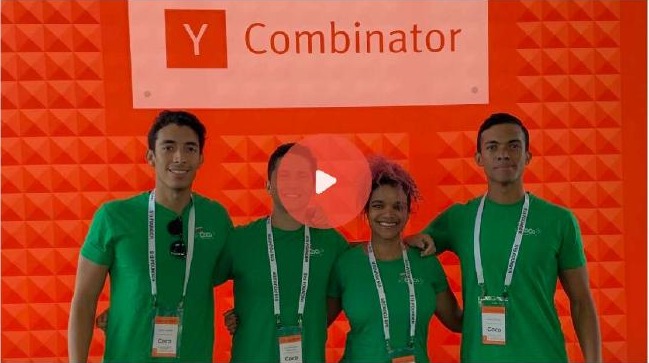
A Venezuelan company in the S19 room
In the summer of 2019, Coco joined Y Combinator. Charles has described it as the first Venezuelan startup to receive backing from the accelerator. The current YC directory lists Kevin, Victor and Francisco Martin Toro as active founders and Coco Wallet as an active company. The directory's neat facts - S19, New York City, a team of 50 - compress a messier reality: the founders arrived with five years of accumulated lessons about crypto, migration and Venezuelan commerce.
The accelerator badge brought the company into a global startup network, but the product remained insistently regional. Coco's initial users were members of a diaspora trying to help people at home. Its premise was born in a market many investors could dismiss as small or dangerous. Charles has since written that Y Combinator was among the few investors willing to believe in a Venezuelan starting market at the time.
The co-founder arrangement also has the texture of family. Kevin and Victor have built together since Surbitcoin. Francisco, a Venezuelan migrant in Spain with experience in crypto payment services, joined them at Coco. Their public materials describe the company in the first-person plural of migrants who understand what remittances mean to both senders and recipients. It is biography rendered as a product requirement.
From sending groceries to sending dollars
Coco Pago returned the business more explicitly to money. In 2021 fundraising materials filed with the SEC, the company pitched smartphone transfers using stablecoins. The filing reported $17 million in cumulative revenue, $7.3 million in 2020 revenue and users sending from more than 100 countries. Those numbers belong to that campaign's own account of the business, but they show the scale of the experiment by then.
By 2023, Charles described Coco Pago as a web3 wallet for Latin American migrants sending stablecoin-based transfers to their families. He tied the idea directly to his New York experience: traditional money transfers felt costly, and blockchain offered a route to something cheaper. His stated plan was to use Venezuelan migrant corridors across the United States, Spain, Chile, Colombia and Brazil as the starting point for a wider financial service.
The product kept changing. The customer kept trying to get value safely across the same stubborn distance.
The latest name, Coco Wallet, gives the ambition a cleaner container. The website now presents a global digital-dollar account where people can send, receive and save using USDC and USDT. It advertises transfers across Latin America, the United States, Canada, Europe and New Zealand, with local routes ranging from ACH and SEPA to PIX, SPEI, Nequi and Venezuelan Pago Móvil.
The product language is deliberately plain: email login, no recovery phrase, no bank queue. This ease introduces its own design tension. Self-custody once meant making users responsible for a secret string that could not be recovered. Coco's current pitch favors a familiar account experience while still using blockchain networks underneath. Charles's career has repeatedly occupied this awkward translation layer, where a technically pure idea has to survive contact with a tired person holding a phone.
The map on Coco's site is almost a portrait of that translation work. A transfer leaving the wallet may arrive through ACH in the United States, PIX in Brazil, SPEI in Mexico, a bank alias in Argentina or Pago Móvil in Venezuela. One balance has to converse with dozens of local habits. The customer sees a destination; the operator sees a thicket of payment methods, exchange routes and compliance obligations. Charles's economics training helps explain the appetite for systems, while his software background explains the instinct to build the interface himself.
It also clarifies why the company's vocabulary has shifted away from crypto ceremony. The current site leads with dollars, saving and sending. Blockchain networks appear lower on the page, as rails rather than religion. This is not a retreat from the technology. It is what happens when a tool is asked to earn its place in daily life. A useful wallet cannot require its user to admire the plumbing before turning on the tap.
The founder as feedback loop
Charles's public posture in 2026 is less oracle than working operator. In one product post, he announced a new Coco Wallet release, offered small USDC rewards for the best feedback and asked a precise question: what was missing, and what would prevent someone from using the app every day? It is a revealing formulation. Features are interesting. Daily resistance is useful.
In another post, he described four years of work on the wallet and reported 120,000 active users, $60 million in transactions and $2 million raised. Those are founder-reported figures, not independently audited numbers. They nevertheless reveal the scoreboard he chooses: people, movement and endurance. He also traveled to San Francisco for Stripe Sessions, openly inviting conversations with founders and investors curious about stablecoins and markets such as Venezuela.
The aspiration is not coy. Charles has said he wants Coco to become a leading service in Latin America, comparable in role to Revolut or Cash App, and eventually payment infrastructure for web3. The phrasing is Silicon Valley-sized. The route remains very Venezuelan: start with the corridor you know, make the transfer less punishing, then find out how many other borders produce the same ache.
His public life remains bilingual in more ways than one. He moves between Spanish and English, New York and Latin America, founder rooms and user replies, financial language and product language. Even his handle, @kevinconecta, makes a modest thesis of connection. In recent posts he has sought conversations with investors while also answering individual questions about the app. The two audiences can demand different performances. Charles tends to bring them back to the same demonstration: ship something, ask where it fails, make the next version easier to use.
There is a pleasing loop in the story. An economics student from Caracas learns to code. A migrant in New York tries to solve a transfer problem. An exchange becomes a supermarket; the supermarket becomes a wallet; the wallet tries to make a novel financial rail disappear behind ordinary verbs: send, save, receive. The tools grow more complex. The promise gets shorter.
Kevin Charles has spent more than a decade near crypto without making abstraction the hero. The enduring character is the person on one side of a border thinking about someone on the other. Everything else - bitcoin, stablecoins, a grocery cart, a green team shirt under an orange Y Combinator wall - is machinery arranged around that relationship.