Kevin Boyle can find an engineering problem in a dishwasher. Loading it, waiting in an airport queue, cooking dinner: each offers a little system to understand and, perhaps, improve. It is an endearing admission, unless you happen to be the person whose plate arrangement is under review. The habit followed him into software. Then it followed him out of the code editor and into the chief executive’s chair at Gearset.
There is a particular sort of founder story in which the destination seems obvious from childhood. Boyle’s is more interesting when the destination stays uncertain. He wanted to be good at programming. Later, he wanted to build useful products with other people. Running a company brought a succession of jobs he had to learn. The connection was an appetite for understanding how work gets done, and where it gets stuck.
A computer that expected an answer
The early machine was an Amstrad CPC. For a child who wanted to play games, a computer that deposited its user at a programming prompt offered an unusually direct introduction to the machinery beneath the entertainment. Boyle grew up enjoying computers, building PCs, and writing software. Studying computer science at Queen’s University Belfast followed naturally. His master’s was completed in 2009.
Microsoft internships took him to Dublin and Seattle. They gave him experience of professional development teams before he finished university, and helped settle his preference for industry. A job opportunity subsequently offered a choice between Belfast and Cambridge. He chose Cambridge, worked at Autonomy, and later joined Redgate Software. The city became the setting for a career that would gradually move from making software to making the decisions around it.
The problem in the next office
At Redgate, Boyle and his future co-founder Matt Dickens worked on tools for developers. The company’s own customer relationship management system needed replacing, and Salesforce supplied the alternative. The platform could be adapted to the business. The development experience left their colleagues wanting the conveniences they already knew elsewhere: keeping track of changes, integrating teammates’ work, and releasing without so much manual effort.
That frustration had an audience beyond one office. The team tested its thinking with Salesforce developers and administrators, showing prototypes and learning how other people worked. Gearset’s origins belong to this period of investigation and product development. Corporate accounts date the business to 2015; the seven-person team left Redgate together in February 2017. The distinction matters. A company’s beginning can take longer than the date printed beside its name.
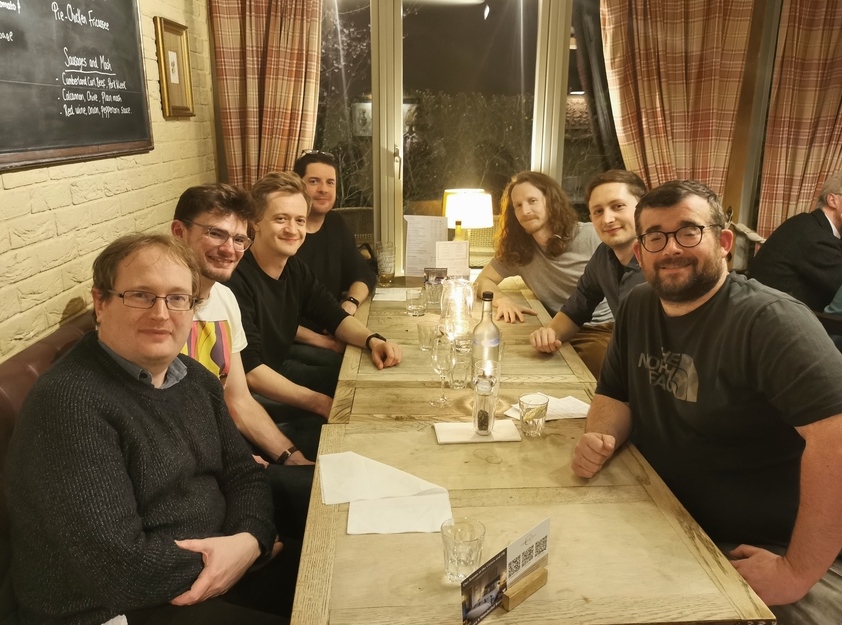
The first paying customers arrived that summer. Later, the team marked five years of independence by returning to the restaurant where they had celebrated the start. The photograph offers a useful corrective to the solitary-founder portrait: seven colleagues, a table, and a business they had made together. Entrepreneurship, on this evidence, also involves remembering who should be invited to dinner.
The 400th small improvement
By November 12, 2019, Boyle had a precise way to describe the benefits of the working methods Gearset sold. His own company had shipped its 400th production release of that year. These were changes reaching its users, rather than rehearsals confined to development. The number makes a technical preference tangible: useful work could leave the building while it was still fresh.
Frequent releases also created more opportunities to discover whether an improvement was actually useful. In Boyle’s account, early feature requests could sometimes reach customers within hours. Marketing worked through GitHub pull requests; sales participated in product planning. The feedback cycle was becoming part of the company’s general behavior. A release process had implications for who talked to whom, and how soon a mistaken assumption might be corrected.
Work delivered. Feedback invited. Another chance to improve.
Sales required a more personal adjustment. Boyle had never built a sales organization before Gearset. He found a connection with product management: understand the customer’s problem, work through a possible solution, and establish whether the software belongs in it. The conversation had familiar ingredients, with the added business of asking someone to pay. The unfamiliar job became easier to approach once he could recognize some of its parts.
His progress into leadership has retained that emphasis on iteration. Understanding a user, making a change, and hearing what happened next is a practical discipline. It gives a founder something more useful than the expectation of being right on the first attempt. It also leaves room for employees to learn the habit, rather than reserving decisions for the person who happened to arrive first.
Low-code, with the standards left in
Boyle’s view of Salesforce development extends the same courtesy to administrators as to programmers. Software made with visual tools still describes a system. Other people still depend on its behavior. Its makers still need ways to track changes, test assumptions, and recover when something goes wrong. The amount of typing involved offers a poor guide to the consequences of a mistake.
“Low-code shouldn’t mean low engineering”
Kevin Boyle · 2021
His argument for low-code includes its promise of wider participation. Keeping source control and reliable release practices within reach makes that participation more sustainable. It also explains why Gearset’s product ambitions have spread beyond moving changes from one Salesforce environment to another. Backup, testing, and code analysis all sit close to the moment when an attractive improvement meets the working business.
In 2024, that approach produced features including Flow Navigator, which helps teams visualize changes to Salesforce Flows, alongside archiving and extensions to comparison and deployment. Boyle connected the additions to customer feedback. The practical detail matters: a team looking at a complex configuration needs to understand its changes before confidently changing it. The helpful tool gives them a clearer view of the work already in front of them.
A reason to go back
Cambridge supplied Boyle with colleagues, experience, and a place to build. Belfast remained part of the plan. He is from Aughnacloy in County Tyrone, and his university connection gave the city a personal significance alongside its engineering talent. When Gearset announced a Belfast development hub in 2022, it was fulfilling an intention he had carried since the company’s early days.
“But I always had that hankering to bring it back.”
Kevin Boyle · on establishing Gearset in Belfast, 2022
His brother Eamonn, an experienced software engineer, was appointed to lead the hub. The decision joined a family connection to a hiring strategy. International expansion had already taken Gearset to Chicago: when the US headquarters was announced in March 2021, the company said the United States accounted for 70 percent of its customer base. Offices followed both the people who could build the product and the people who used it.
Choosing what growth is for
In June 2022, Gearset announced a $55 million growth investment led by Silversmith Capital Partners. Years of building had preceded that first institutional round. Boyle’s stated concern was finding a partner whose approach fit a company intended to grow sustainably. The investment would support the product, commercial teams, and expansion across the United Kingdom and United States. Silversmith’s Sri Rao joined the board.
The responsibilities widened again in September 2024, when Gearset made its first acquisition. Clayton brought Salesforce code analysis into the company, adding capabilities for finding problematic patterns and vulnerabilities earlier in development. Its founder, Lorenzo Frattini, joined a business whose original concern had been the release process. The scope now reached further back into the quality of the work being released.
- 2017Seven colleagues leave Redgate together
- 2022$55 million growth investment
- 2024Clayton becomes the first acquisition
- 2026Cam joins the product line
Growth also meant making room for colleagues. A new Cambridge Science Park headquarters opened in September 2025, with 16,000 square feet on a single open-plan floor. Departmental neighborhoods sat alongside spaces for work across teams and for individual concentration. Boyle emphasized collaboration and communication. It is a rather physical expression of an organizational question: how do people keep working together as the number of people increases?
By February 2026, Gearset was reporting 37 percent revenue growth for the previous year and more than 3,500 customers. Such figures describe the scale of the responsibility; they cannot do the work of leadership themselves. Boyle’s public discussions continue to return to users, their changing expectations, and the need to learn from them. The larger business still needs the small conversation.
The queue after the code
AI gives that conversation fresh urgency. In his March 2026 writing, Boyle argued for measuring outcomes rather than trusting the feeling that a tool makes work faster. Domain knowledge mattered, as did understanding the particular problem being solved. It is a recognizable concern for someone whose company emerged from seeing a gap between a platform’s possibilities and the daily experience of building on it.
That month, Gearset launched AI-powered Automated Testing, offering Salesforce teams a no-code way to create and run interface tests within their delivery pipelines. September brought Cam, an AI agent designed to plan and build Salesforce changes toward a pull request, under a team’s existing controls. Creation was moving closer to the release machinery that had been Gearset’s original business.
Boyle’s explanation of the agent launch concentrated on what happens after code is generated. Faster individual output can leave a team waiting on reviews, corrections, and reconciliation. The queue has moved. His ambition for Cam was to help teams take work through the process while preserving their standards and control. For the engineer who sees systems in everyday activities, a faster first step still leaves the rest of the journey to examine.