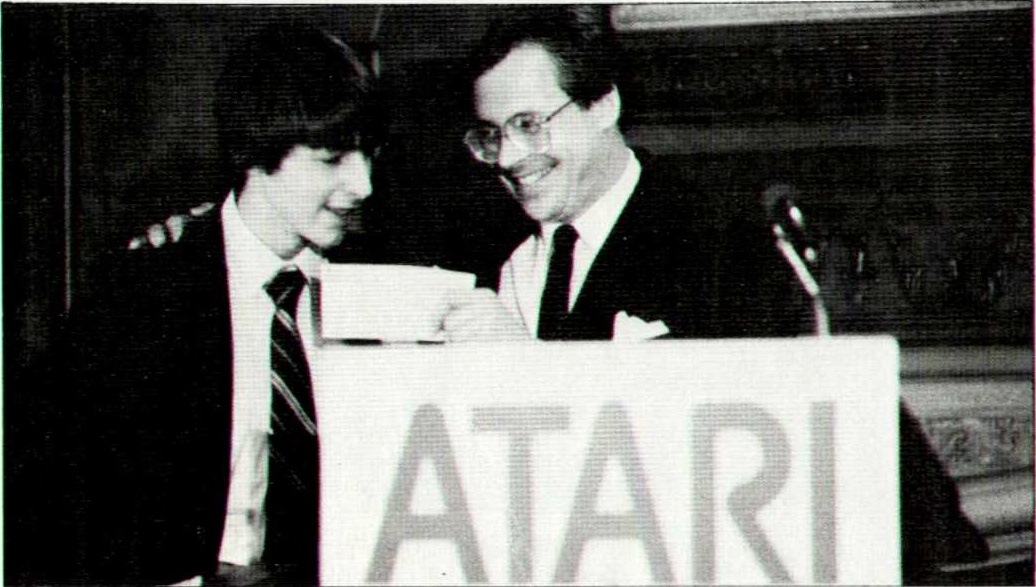
Keith Schaefer knew how to make a teenager wait. At San Francisco’s St. Francis Hotel on January 15, 1983, he stood before an Atari awards banquet with a package containing the winner’s plaque. He opened it slowly, adding a few jokes while a television crew watched. The winner, David Buehler, was seventeen. His educational game, Typo Attack, had earned him $25,000.
Schaefer then asked Buehler’s parents and grandparents to stand for applause. A software competition had become a family occasion. The photograph catches the transaction midway: the young programmer, the executive, the cheque, and an Atari sign large enough to discourage any uncertainty about the sponsor.
It is an appealing place to begin a career that can otherwise look like a directory of American technology companies. Atari. NEC. Paramount. USWeb. BPL Global. Connected Energy. Today, Zermatt Capital Advisors. Across those names runs a recurring practical question: how does an interesting piece of technology become something people will buy, finance, or build a business around?
A salesman’s education, measured in kilobytes
Schaefer graduated from the University of Pittsburgh in 1971 with a Bachelor of Science, concentrating in political science and economics. He served as a naval officer, then attended UCLA’s Graduate School of Business. His early commercial training came in sales and marketing at Procter & Gamble and Clorox, before consumer electronics supplied a different set of products to explain.
At Atari, the sales pitch could be wonderfully tangible. A late-1982 promotion offered two free 16K memory modules with an Atari 800. Schaefer described the offer in terms a buyer could understand: 48K of memory for the $899 normally charged for a 16K machine. The saving was $200. Computing’s future had a price tag, a deadline, and a retailer who needed to move a box.
The figures now seem almost comic. Forty-eight kilobytes would scarcely accommodate the furniture of a modern webpage. In that market, however, memory was a visible reason to buy. Schaefer’s work involved translating a technical specification into a reason for someone to open a wallet. That translation would remain relevant long after the Atari hardware disappeared from shop windows.
There was another commercial boundary to cross. Atari began selling software for rival computers, including Commodore machines. Schaefer publicly backed making popular titles available across different home computers. A game could find a customer beyond the company’s own hardware. The box was useful; the audience could be larger.
The business card kept changing
His subsequent appointments moved through several layers of the technology business. At NEC Technologies he held senior management responsibilities during the second half of the 1980s. By May 1989, NEC’s new home-entertainment operation included another former Atari executive, Kenneth Wirt, reporting to him. The industry was changing employers while retaining some familiar faces.
Later came leadership at Computer Curriculum Corporation, Paramount’s technology group, and Viacom. He co-founded Cybernautics in the 1990s, then became an executive partner at USWeb/CKS. Liquid Thinking and Constellation Partners followed. The sequence stretches from computers and entertainment into the companies helping other businesses establish themselves online.
Read as a list, these appointments suggest constant movement. Read as a working life, they show how often the commercial setting around technology changes. A consumer-electronics company needs distribution. A digital-services business needs clients. A young venture needs financing. The executive’s job acquires a different vocabulary while retaining its appetite for customers and cash.
When the customer was the electricity grid
BPL Global brought Schaefer into an industry where the consequences of an unsuccessful demonstration were rather less forgiving than a disappointing game. He was its co-founder and chief executive. The company’s early work included broadband over power lines; its business developed toward software for managing electrical networks and the equipment attached to them.
In January 2008, BPL Global announced the acquisition of Connected Energy. The attraction was an operating demand-management product, already used by utilities and research institutions. Customers were monitoring and controlling more than 450 megawatts of demand and generation assets. The list included wind and solar installations, generators, industrial equipment, and building systems.
For Schaefer, the appeal lay in an established product with established users. Duke Energy, Southern California Edison, and Lawrence Berkeley National Laboratory were among the names he singled out. BPL Global could take that capability through its international network. A company with a communications heritage was buying a way to do something useful with the connection.
The distinction matters because a connection, by itself, is a rather accomplished means of doing nothing. Its value depends on what can happen at the other end. Managing electrical demand requires equipment that responds, customers willing to participate, and an operator who can see the result. The software has to earn its place in that chain.
By autumn 2010, BPL Global served more than 100 utilities worldwide and employed 150 people, including 25 in Cranberry, Pennsylvania. Its locations included Portland, Columbus, and Le Mans, with satellite offices farther afield. It had attracted strategic investors including Siemens, Morgan Stanley, and SAIC. These were contemporary figures for that stage of the company’s development.
The local detail is revealing. The business had begun in a co-founder’s Pittsburgh office, moved to Sewickley, and relocated to Cranberry in early 2008. Airport access, available talent, and suitable space all figured in the decision. Global work still depended on ordinary geography: where people could work, where they could be hired, and how easily they could catch a flight.
Pittsburgh was more than a return address
Schaefer’s earlier career had taken him to California. His work with Pitt’s Alumni Association helped reconnect him with western Pennsylvania. That connection became visible in both business and university service. In 2009, the Pittsburgh Technology Council named him CEO of the Year; BPL Global received its Green Tech award at the same ceremony.
He also served as president of the Pitt Alumni Association and spent years as a university trustee. In 2019, he received the Bill Baierl Distinguished Alumni Service Award. Those are different kinds of recognition, separated by a decade: one for running a technology company, another for sustained service to an institution he had attended decades earlier.
The university relationship continued beyond ceremonial occasions. Pitt’s Institute for Entrepreneurial Excellence included him among the mentors thanked for working with its 2024 Entrepreneurial Fellows. Mentoring offers a less photogenic form of participation than an awards platform. It asks an experienced person to spend time on someone else’s decisions.
There is a useful perspective here for anyone tempted to draw a clean line between a career and the network around it. In Schaefer’s case, the university supplied an education, then a continuing field of activity: alumni leadership, governance, business connections, and support for entrepreneurs. Graduation turned out to be an early appointment.
A newer use for an old university connection
In 2022, Schaefer and fellow Pitt alumnus Jonathan Dane began developing 1787 Ventures, named for the university’s founding year. Its launch was reported the following April. The idea gave alumni a mechanism to invest in companies led by other Pitt graduates, bringing professional relationships into the financing of new businesses.
“When alumni win, Pitt wins.”
Keith Schaefer, on 1787 Ventures
The intended participation extended beyond writing a cheque. Investors could contribute advice and experience, while the founders would evaluate opportunities. The plan focused particularly on seed through Series A businesses and allowed for alumni companies located around the country. A university connection could travel with a founder rather than require a Pittsburgh postcode.
That is a practical aspiration: make an existing network easier to use. Universities already contain people who have started companies, people who understand particular industries, and people looking for their next introduction. Turning those scattered relationships into a venture effort requires someone to organise them. Schaefer and Dane proposed doing that organising.
The next chapter has other people in it
Schaefer is now identified with Newport Beach and Zermatt Capital Advisors, where he is co-founder and managing partner. The firm’s team includes Larry Lucchesi and John Scavo. His public biography also lists a managing-partner role at Connected Energy. Advising businesses has become a continuing part of a career spent founding and operating them.
In a CalTier video, Schaefer and Scavo discuss alternative investments alongside the company’s announcement that it had engaged Zermatt for a Series B financing effort. The setting is a long way from the Atari banquet, but the commercial task is recognisable: explain an opportunity clearly enough that another person can decide whether to participate.
Connected Energy has meanwhile entered another chapter. CLEAResult announced its acquisition in August 2026, describing a business serving American utilities with demand-management software and direct-load-control technology, including agricultural applications. Mark Rupnik was the chief executive quoted for Connected Energy. The company’s subsequent history belongs to the team operating it today as well as to its founders.
Return to the photograph from 1983 and the scene has a modest continuity. Schaefer is beside someone else’s work, helping put it before an audience. The forms have changed: an award, a utility contract, an investment conversation, an alumni introduction. Across them, the work involves finding people who can take an idea further. Sometimes the useful contribution is a piece of software. Sometimes it is knowing whom to ask to stand up.