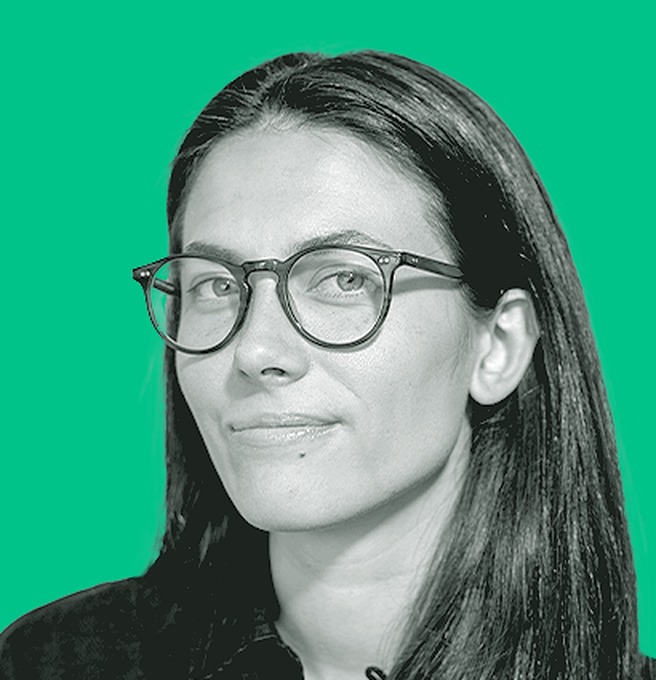
Katie Spies runs Maev from Austin, and the job looks less like a founder's and more like a scientist's crossed with a bartender's. She talks to about five customers every week. She hires PhD veterinary nutritionists to formulate food she cannot pronounce her way out of. And she still frames the whole operation around a single greyhound named George.
Maev sells human-grade raw food for dogs, by subscription, direct to your door. The category barely existed when she started. The bet underneath it is uncomfortable and specific: most dog food is built for shelf life, not for the animal eating it, and the healthiest diets stay locked away from ordinary owners behind price and inconvenience. Spies decided that was a design flaw, not a fact of life.
Here is the strange part. Before the funding, before the test kitchen, before the 8 million meals, she quit a good tech job and spent nearly a year walking other people's dogs. Not as a gap year. As research. "I spent a year as a dog walker figuring out what their headaches were," she has said. She wanted to sit inside the tight, opinionated community of city dog owners and learn the small daily frustrations that spreadsheets never surface.
The origin is smaller and sadder than the growth chart. In 2015, living in San Francisco and working in tech, Spies adopted a rescue Italian Greyhound named George. Not long after, George started having seizures. She tried the usual medical routes, then went at it from the other direction - nutrition. She switched him to raw food. "The seizures stopped. I watched his health improve within about 30 days." That thirty-day window is the entire company in miniature.
She is not a pet nutritionist and has never pretended to be. What she brought instead was an engineer's instinct for systems and a refusal to accept the default. Spies holds engineering degrees from MIT and an MBA from Harvard Business School, where in 2019 she met Christine Busaba, who would become her co-founder. Before all that she worked at The Climate Corporation, the data startup later acquired for around a billion dollars - a front-row seat to what it looks like when a technical bet pays off at scale.
Maev launched in 2020, which is to say it launched into a storm. The pandemic emptied offices and filled apartments with new dogs - by some counts one in four American households added one that year. Everyone was suddenly shopping online, and suddenly very invested in the wellbeing of a creature sleeping three feet away. Spies had spent two years in beta, formulating with veterinary nutritionists and running a test kitchen in New York. The timing was luck. The readiness was not.
The first customers did not come from a media budget. They came from wheat paste. In Maev's pre-launch days, Spies plastered posters across New York City - old-school guerrilla marketing as the whole go-to-market. It worked. The first 50 customers showed up, then the next, and the problem quickly inverted from finding demand to keeping product on the shelf. "The trouble was really just keeping inventory," she has said. Sales grew roughly 15% month over month. Only later did paid channels - Facebook, Google, TikTok - join the poster.
By the first quarter of 2022, Maev doubled its subscriber base and served a million meals in three months. By the end of that year it had shipped more than 8 million and closed a $10 million Series A in October, backed by investors including VMG and Springdale Ventures. Total funding sits near $19 million. The business has, roughly speaking, tripled every year since launch. Then she moved the company - and herself - from New York to Austin.
What is unusual is how little the strategy changed as the numbers grew. Spies describes herself as obsessive, impatient, and a creature of habit. She blocks out the chaos and drops into deep focus. She listens to podcasts at double speed and rotates between classic rock, modern pop, and long stretches of nothing but work. And she keeps the same anchor she started with: real conversations with real customers, five a week, positive and brutal alike.
Ask her about the hardest part and she does not say fundraising or manufacturing or hiring. She says the word itself. "The hardest part is saying no" - to products, features, and people, because resources are always finite and focus is the only thing that scales. It is a very engineer answer. It is also, if you have ever tried to build one clean thing while a hundred good ideas pull at you, an honest one.
The animal thread runs deeper than branding. Spies grew up in a household that rescued strays, and as a kid she scanned roadsides on family trips looking for animals to help. She once moved apartments so George could live near a dog beach. She tracks his activity rankings on his Fi collar and treats it, competitively, like a standings table. Maev did not come from a market gap she spotted from a distance. It came from the way she had already been living.
The direct-to-consumer model is not incidental to the product; it is the argument. Selling raw food by subscription lets Maev skip the retail shelf, where freshness dies and margins push formulas toward filler. Ingredients are human-grade. The recipes are built with veterinary nutritionists rather than borrowed from a co-packer's catalog. The early hero products - bone broth toppers and daily vitamin bars - were designed to slot into a routine an owner already has, not to demand a wholesale change in how they feed. The company later moved toward tailored bundles, matching food to the dog rather than the aisle.
She is candid about how lonely the founder's chair can be, and about the one relationship that made it survivable. On co-founders: "Your co-founder is the only other person in the world who understands what you're going through." Her advice to younger builders is less about tactics than about survival - find your tribe, find your people, because the pursuit of a company, on its own, is not enough to sustain a person through the parts that hurt.
There is a through-line in all of it, and it is not about dogs. It is about refusing the default and then doing the unglamorous work to replace it. A year of walking dogs instead of reading reports. Posters instead of a media buy. Five customer calls a week instead of a dashboard. Saying no more often than yes. Spies built a company the way an engineer debugs a system - by getting close enough to the actual problem to see what everyone else had been guessing at.