The revealing thing JourneyTeam sells is not software. Microsoft makes the software. It is not even the company’s implementation expertise, though three decades around Dynamics, Azure and the rest of the Microsoft stack buys plenty of scar tissue. The revealing product is a division of labor. JourneyTeam will show a client how to install an enterprise nervous system, but the client has to pick up a wrench.
That bargain is packaged as the Sherpa Program. A publicly listed Business Central version costs $23,500 and includes 16 guided cohort sessions, weekly office hours, self-serve training and a year of support with 20 break/fix hours. JourneyTeam supplies the route, the checkpoints and the person who knows where companies usually slip. The customer supplies internal expertise, attention and much of the hands-on configuration.
For a consulting industry fond of open-ended scopes, this is almost cheeky. The lower price is not a magic discount. It is the bill for a different job.
At some point we had to take the training wheels off and ride the bike ourselves. With JourneyTeam, we had a clear roadmap for how to get there.Ron Smiley, vice president and CTO, Wiley|Wilson
The businessOne Microsoft stack, assembled around the mess
JourneyTeam was founded in Utah in 1993 by Milo Tenney. His son Brian joined in 2003 and now runs the company as CEO. From its Draper headquarters, roughly 170 employees work across the unglamorous middle of digital transformation: replacing aging accounting systems, joining CRM to finance, migrating servers, making data usable, locking down identities and teaching employees to live with the new setup.
The menu covers Dynamics 365 CRM and Business Central, Azure, Microsoft 365, Power Platform, Fabric, Power BI, security, Copilot, custom applications, licensing and support. JourneyTeam is 100 percent Microsoft-focused. That gives a buyer one accountable team across applications, infrastructure, analytics and security. It also makes the bet plain: if your future is not centered on Microsoft, this is not your shop.
Protech Automotive Solutions
MaxxForce Industrial Tooling
Centro de la Familia
The customers are the sort of organizations whose operational pain is large but whose names may not appear on a Times Square screen: manufacturers, distributors, nonprofits, financial institutions, architecture firms, universities and service businesses. JourneyTeam says it has worked with hundreds. Its public roster includes Mountain America Credit Union, Protech Automotive Solutions, Palmer-Donavin, MaxxForce Industrial Tooling, Atlanta Community Food Bank and Smarter Furnishings.
The failure patternFirst the spreadsheet cracks. Then the renewal arrives.
Enterprise technology rarely changes because someone saw a beautiful demo. It changes when the existing arrangement becomes embarrassing, expensive or physically incapable of carrying the next year’s work.
At Protech, a national automotive diagnostics company, service requests arrived through calls, emails and unstructured web forms. The patchwork consumed an estimated 6,200 administrative hours per month. Field technicians still phoned or emailed job updates. Invoices took days. Meanwhile, 37,000 daily service requests were expected to triple within five years. What changed management’s mind was not a feature. It was the widening distance between demand and the machinery meant to handle it.
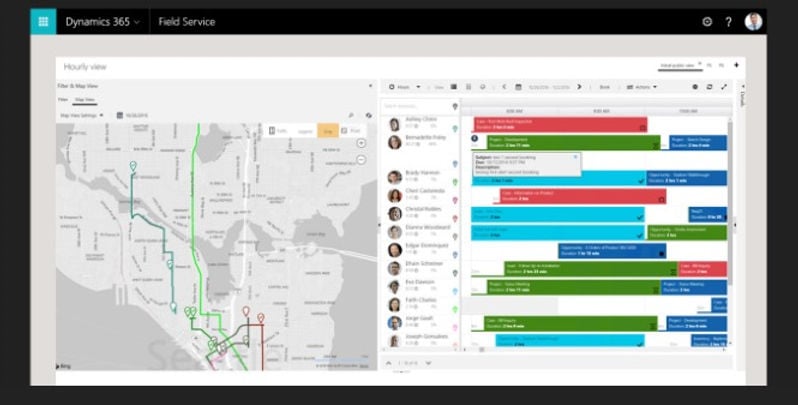
JourneyTeam and Protech built the Protech Connected Solution on Dynamics 365 Field Service, Azure and Cosmos DB. A portal standardized intake. An AI dispatch engine assigned work using location, availability and skill. A mobile app gave technicians live job details and inventory tools. Completing a job could trigger an invoice; Protech said 90 percent of invoices became automatic and technician productivity rose 30 percent.
Wiley|Wilson, an architecture and engineering firm, hit a different wall. Its Citrix and VMware environment struggled with graphics-heavy work and remote access. The first failure was reliability. The mind-changing event was commercial: Citrix presented a costly renewal based on the firm’s small machine count. JourneyTeam moved the workload to Azure Virtual Desktop, tuned GPU virtual machines for CAD and BIM, and added Azure Files, identity controls, monitoring and recovery. The firm reported a 40 percent reduction in IT costs, or $286,000 annually, while one task fell from 45 minutes to under four.
The differenceA consultancy that productized the handoff
JourneyTeam competes with global consultancies, Microsoft specialists such as Velosio and Western Computer, regional systems integrators, internal IT teams and the seductive option of doing nothing. Its breadth is useful, but breadth is common in partner directories. The more defensible distinction is the way it separates repeatable work from bespoke work.
Traditional implementation makes sense when integrations are tangled, workflows are unusual and nobody inside the client has time to become the product owner. JourneyTeam still sells that work. Sherpa is for the other case: a company knows Business Central or Copilot is a fit, has capable people, can accept core functionality first and wants guidance without paying consultants to perform every step.
Sherpa works when...
The scope is controlled, internal champions exist, leaders protect their time, users can attend workshops, and the company is willing to adopt proven processes before requesting custom code.
It breaks when...
The business needs heavy customization on day one, integrations are poorly understood, data ownership is unresolved, internal capacity is thin, or executives treat adoption as an IT department errand.
That distinction explains both the price and the limit. A cohort spreads expert time across customers. Standard sessions reduce discovery. The client configures and learns rather than waiting for a grand reveal. In return, the company builds people who understand the system after the consultants leave. But cheap guidance attached to an undisciplined organization is still an expensive failure.
The newer wagerAI after the plumbing
JourneyTeam is now extending the same practical posture into Copilot and agents. It calls itself “customer zero,” meaning it ran Microsoft’s AI tools inside its own business before packaging the lessons for customers. The four-week Copilot Sherpa format uses seven workshops and optional office hours to help teams define problems, build agents and create internal champions. Its Envision Sales Agent turns scattered email, meeting and CRM activity into a structured view for deal coaching and forecast discipline.
The company’s practical AI advice is notably short on fireworks: clean the data first. If customer history lives in one system, order details in another and every rep defines “resolved” differently, an agent merely encounters the same confusion faster. JourneyTeam recommends agreeing on data, standardizing definitions, reducing harmful tool sprawl and mapping five to ten common workflows before automating them.
The useful innovation is not the agent. It is the decision to make a messy process boring enough for an agent to follow.The lesson hiding inside JourneyTeam's data-first playbook
That conservatism is earned. In 2024, Microsoft named JourneyTeam its global Dynamics 365 Business Central Partner of the Year. In 2025, the company was a finalist in both Business Central and nonprofit categories. It holds all six Microsoft Solutions Partner designations and more than 15 advanced specializations. Awards do not guarantee a clean rollout, but they do show the depth of the vendor relationship and the quantity of certified practice behind the pitch.
The copyable moveSell the route, state the homework
The part worth copying is not the mountain name. Any services company can turn its repeatable knowledge into a guided product. Start by isolating the work that follows the same sequence across clients. Package that sequence. Publish what is included. State which tasks stay with the customer. Add office hours for judgment calls. Train internal champions. Measure the operational result, not the date the software switched on.
JourneyTeam’s case-study numbers make the last point with unusual clarity: 95 percent better data accuracy, 20 hours saved at close, 55 percent lower software costs, 30 percent more field productivity, $286,000 removed from an annual IT bill. The measurements differ because the businesses differ. “Implemented Dynamics 365” is not the result.
There is a cultural fit in the model, too. JourneyTeam describes itself as “big company capabilities; small company vibe,” a laid-back Utah firm whose clients should not feel intimidated to ask a question. That can sound like website oatmeal. In a cohort full of finance managers admitting they do not understand posting groups, approachability becomes operating infrastructure.
The company’s three-decade arc is less about reinvention than concentration. It merged with SharePoint and Office 365 specialist Soren Innovations in 2018. It stacked data, cloud, security and AI around business applications. In 2025, Biplab Mandal became COO and Eric Beins became CTO to tighten operations and push the technology portfolio forward. Microsoft changed; JourneyTeam kept making a broader practice inside the same ecosystem.
The $23,500 bet is therefore larger than one Business Central listing. It says expertise can be sold without turning the buyer into a permanent passenger. Under the right conditions, the shortcut is doing some of the work yourself.