BREAKING WAi Technologies turns Figma into production code //
AI Pundit claims up to 10x front-end acceleration //
Raaghu Design System is open source on GitHub //
Founded 2012 by four solution architects //
Motto: Build Once. Ship Right. Every Time. //
Microsoft partner across Azure, Dynamics 365 & Power Platform //
BREAKING WAi Technologies turns Figma into production code //
AI Pundit claims up to 10x front-end acceleration //
Raaghu Design System is open source on GitHub //
Founded 2012 by four solution architects //
Motto: Build Once. Ship Right. Every Time. //
Microsoft partner across Azure, Dynamics 365 & Power Platform //
Santa Clara, California · Digital Engineering & AI
WAi Technologies
The Microsoft partner that got tired of waiting on front-end code - so it taught AI to write it, and kept a human holding the spec.
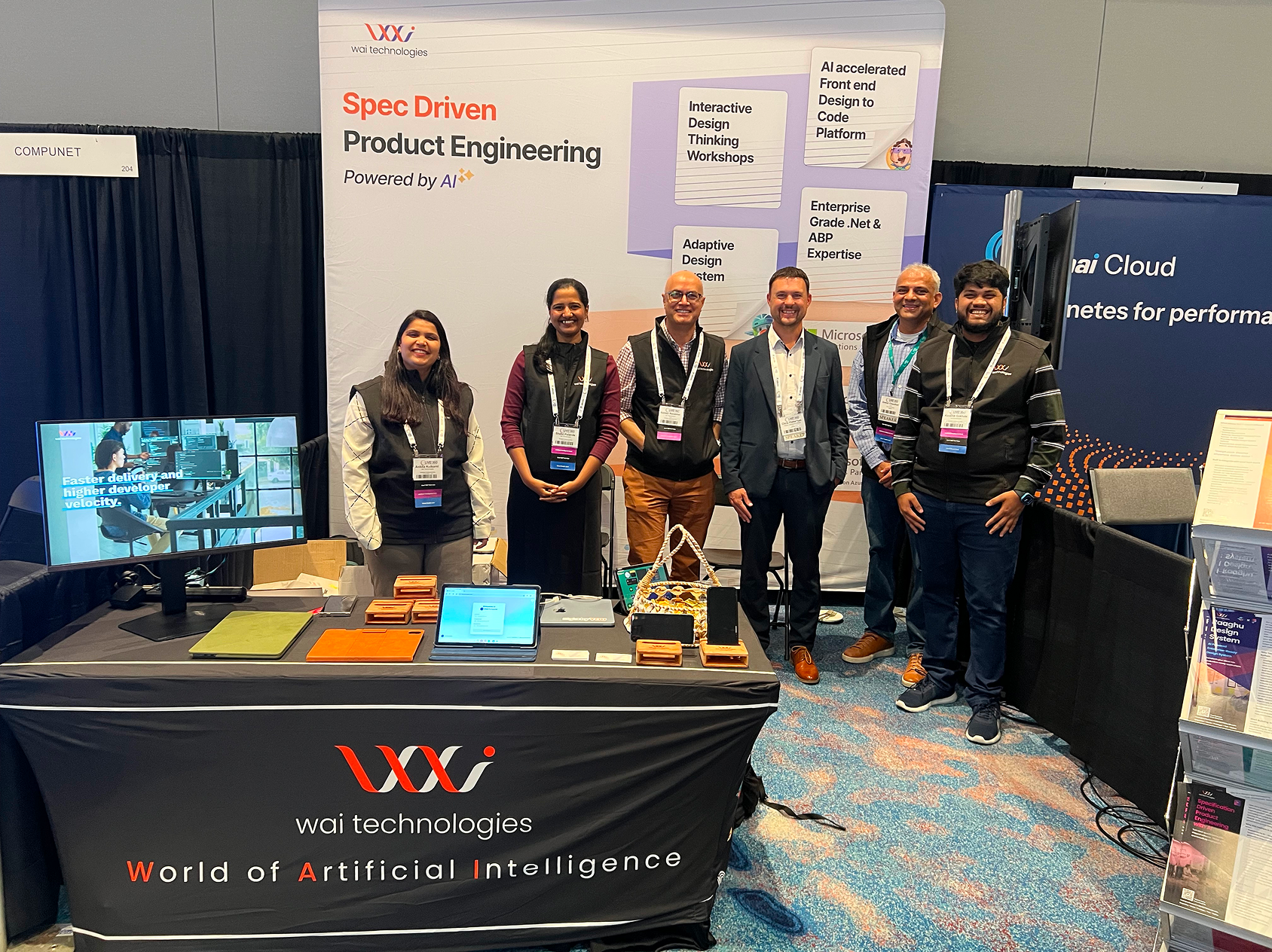
The whole pitch, packed into one trade-show booth: six people, a banner reading "Spec Driven Product Engineering," and a tablecloth spelling out what "WAi" actually stands for - World of Artificial Intelligence.
AI Pundit
Raaghu Design System
.NET Modernization
Azure & Dynamics 365
Figma to Code
Who they are now
A designer in Pune drags a frame in Figma. Minutes later a developer in Santa Clara is reviewing real, running React - not a screenshot, not a "handoff doc," actual code. That gap, the one every software team quietly hates, is the gap WAi Technologies built a company to close.
WAi is a roughly 250-person digital engineering firm with offices in Santa Clara, Pune and Ahilyanagar. On paper it is a Microsoft partner doing Azure, Dynamics 365, Power Platform and the kind of .NET modernization most consultancies will happily bill you for. In practice it has done something most consultancies never do: it built its own products and pointed them at its own bottleneck.
Build Once. Ship Right. Every Time.
WAi Technologies, company motto
The problem they saw
The front-end is where good software goes to wait.
Enterprise software has a dirty secret. The interesting work - the data model, the business logic, the deal that justified the budget - finishes early. Then everyone waits. They wait on pixel-pushing, on design handoffs that lose half their meaning in translation, on a front-end backlog that grows faster than anyone can clear it. Legacy .NET apps make it worse: the code that runs the business is often the code nobody dares to touch.
WAi's read on this was unglamorous and correct. The slowest, most expensive, least loved part of modern software delivery is the front-end. So that is where AI should earn its keep first - not by replacing the humans, but by deleting the wait.
When AI builds software, human-guided, spec-driven work ensures strategy, clarity and control.
WAi Technologies, on its design philosophy
The founders' bet
Four solution architects, one long game.
WAi was started in 2012 by four people who built software for a living - Kirti Kulkarni, Omkar Choudhari, Sameer Nair and Prashant. Not marketers, not financiers. Solution architects. The kind of people who name a company "World of Artificial Intelligence" a full decade before the rest of the industry decided AI was the only acceptable thing to talk about.
Their first shipped product was charmingly un-futuristic: a SharePoint app called Knowledge Exchange, on the Office Store in 2013. The through-line from that app to today's AI toolchain is consistency - a stubborn loyalty to the Microsoft stack, and a habit of building tools for the developers sitting next to them. In 2021, Rakesh Vartak, a 30-year IT veteran, took the CEO chair to scale the bet.
WAi was formed by solution architects who were passionate about providing solutions - and shipped their first app on the store in 2013.
Company history, waiin.com
The product
Two products doing one job: kill the handoff.
The first is Raaghu, an open-source, React-based design system for modern web and Power Apps. Reusable components, consistent experiences, and - this is the clever part - it extends into Microsoft's Power Apps Component Framework, so the same design can ship to the open web and to enterprise Power Platform apps. WAi markets it as building web apps three times faster, which is a polite way of saying "stop rebuilding the same button."
The second is AI Pundit, the toolchain that turns Figma designs into production-ready front-end code and plugs into the tools developers already live in: GitHub Copilot, VS Code, Storybook, Azure DevOps. Its Spec Kit is the philosophy made concrete - UI-aware specifications and spec-driven CI/CD, so the AI builds against a blueprint a human approved rather than a vibe it invented.
Flagship
AI Pundit
Converts Figma to production code and powers conversational AI. Integrates with Copilot, VS Code, Storybook and Azure DevOps.
Open Source
Raaghu Design System
React component system for web and Power Apps, extendable to Microsoft's PCF. Built to ship 3x faster.
Azure DevOps
AI Pundit Spec Kit
UI-aware specs, spec-driven CI/CD, native .NET templates and enterprise governance.
Services
Modernization & AI/Data
.NET + ABP modernization, Azure OpenAI copilots, analytics, ML Ops and LLM Ops with audit logs and drift monitoring.
Designs are turned into coded components by AI Pundit, connected through Figma Code Connect - so designers and developers hit 3x faster front-end delivery.
WAi Technologies, on the Raaghu + AI Pundit workflow
The proof
The numbers WAi is willing to put on a banner
Skeptics should note: these are the company's own performance claims, not an audited benchmark. But they are specific, repeated, and consistent across its marketplace listings - which is more than most AI pitches manage.
What WAi says spec-driven AI delivery buys you
// Source: WAi Technologies / AI Pundit marketing claims
The customer base reads like a tour of industries that cannot afford to ship the wrong thing: healthcare, finance, construction, retail, public safety, automotive, events and logistics. The partnerships are the foundation - a long-standing Microsoft relationship across Azure, Dynamics 365 and Power Platform, plus work with the ABP framework from Volosoft for modular .NET backends.
Industry-leading projects across healthcare, fintech, construction, retail, public safety, automotive, events and logistics.
WAi Technologies, on its work
The mission
Let AI build it. Keep a human on the blueprint.
There is a fashionable way to use AI for code, and it mostly involves crossing your fingers. WAi's position is the unfashionable one: AI should build the software, but a human-approved specification should govern what it builds. Strategy, clarity, control - in that order. The Spec Kit exists precisely so the speed never comes at the cost of knowing what you shipped.
It is a quietly contrarian bet. While much of the industry chases autonomous agents that decide for you, WAi is selling the opposite product: acceleration you can actually account for. For a hospital migrating an EHR or a bank modernizing a claims system, "fast" is worthless without "right."
Spec-driven clarity, consistency and control - to ensure trustworthy AI systems and accelerated development cycles.
WAi Technologies, mission
Why it matters tomorrow
The wait was never the hard part. Trust was.
Every company will soon let AI write some of its software. The open question is not speed - speed is coming for everyone. The question is whether anyone can explain, six months later, why the code does what it does. WAi's spec-first answer is a bet that the winners will be the teams who kept a paper trail while everyone else was busy being amazed.
Return to that booth in the hero photo. Six people, a banner, a tablecloth. The pitch hasn't changed since 2012 - build great software on the Microsoft stack. What changed is the gap between a designer's idea and a working screen. WAi spent a decade narrowing it from weeks to minutes, and then insisted the minutes still answer to a human. The designer drags the frame. The code appears. And somebody, somewhere, still signed off on the spec.
World of Artificial Intelligence.
What the "WAi" stood for, a decade before it was obvious
Watch & demo
Find them