On his first day in hospitality, Josh Ellis made a memorable entrance by making a terrible exit. He was about 16, working as a busser, carrying a tray down steps that faced a crowded bar. The tray pitched forward. Red wine hit the floor and sprayed the backs of perhaps 15 guests. In his memory, the accident still plays in slow motion, less a spill than a small crime scene.
His manager did not fire him. This was fortunate for Ellis and, years later, oddly useful for the hotel business. The teenager who learned that service can survive a calamity is now the co-founder and CEO of Abra Hospitality, a young software company concerned with a subtler class of failure: the anniversary mentioned to a bartender and forgotten by housekeeping; the favorite coffee known by one employee and nobody on tomorrow’s shift; the returning guest who must introduce herself all over again.
Ellis’s career has the tidy logic that biographies acquire only in reverse. He studied philosophy, helped open a meditation retreat, worked as a consultant, sold enterprise technology and married a luxury hotelier. Each episode looks like a detour until it becomes part of the destination. Abra, founded in 2025, is his attempt to give hotels what their software stacks conspicuously lack: a memory with manners.
A philosopher learns to stop thinking
Ellis grew up in Saratoga Springs, in upstate New York, where weekends in the Adirondacks supplied lakes, mountains and a durable appetite for being outside. As a child, he asked his parents “why” often enough to imagine becoming a scientist or philosopher. At Colgate University, he chose philosophy. It suited someone drawn to large questions and difficult problems.
Meditation arrived as a counterweight. His uncle taught mindfulness, so the practice was already familiar. Ellis later helped open Rocky Mountain Ecodharma Retreat Center, in the mountains west of Boulder, and ran it for a year. He trained to teach through a mindfulness certification program associated with UC Berkeley, Jack Kornfield and Tara Brach. His own summary is economical: philosophy helped him think deeply; meditation helped him not think quite so much.
On Maui, that interest became Maui Mindful Adventures, a donation-based group that paired contemplative practice with hiking. The group drew hundreds of members. Ellis described mindfulness without the incense fog: a curious, kind-hearted examination of experience. He preferred frequent, modest practice to occasional heroics. One minute every day, he argued, could build more than 20 minutes once a week.
“I started to get into meditation because I needed to teach myself to not think about those things so much.”Josh Ellis
There is a straight line from that idea to Abra, if one squints politely. Both mindfulness and hospitality reward attention. Both depend on noticing what is present before the moment passes. A hotel has many eyes and ears, but its institutional attention is poor. One person notices. Another person needs to act. Between them lie a shift change, three departments and a small republic of browser tabs.
The hotelier comes home
The romance at the center of the business story began at a restaurant in Saratoga Springs. Dana, newly arrived to help open an independent luxury hotel, met Josh on her first day in town. The steakhouse where he worked adjoined the hotel. She was, in her account, his boss. Ellis still accepts the arrangement. “She still is,” he has joked.
Dana’s career moved through The Peninsula New York and Four Seasons Maui, then into the Relais & Châteaux world at Hotel Wailea. In July 2019, the couple left Manhattan for Maui after she received the Four Seasons offer. Josh celebrated in their apartment with Hawaiian music and an improvised hula on the bed. They assured relatives the move would last a year or two. Seven years later, Maui was home.
At night, Dana brought home the practical absurdities of running a hotel. She knew what excellent service required. She also knew how easily information vanished. Reservation software held one fragment, a restaurant system another, a free-text note a third. The richest knowledge belonged to housekeepers, bell staff and bartenders, then walked out the door when they did.
Josh listened for roughly a decade. He jokes that this earned him an associate’s degree in hospitality management. The better credential was proximity to a problem that would not go away. Dana searched for software that could gather the scattered facts and make them useful to operations. She came back empty-handed. The couple decided to build it.
Software that knows when to leave the room
Before Abra, Ellis had moved through management consulting and into partnerships at Lyra Health. He describes selling six- and seven-figure enterprise agreements during a period of rapid expansion. The useful lesson was less about velocity than customer obsession: grow quickly, listen closely, and do not make the buyer carry the burden of your complexity.
Abra applies that lesson to hotel operations. It connects to the property-management system, customer database, restaurant reservations, spa records and messaging tools. Staff observations can be added too. The platform assembles those fragments into an evolving guest profile, then returns the useful piece to an employee inside the workflow already open. A browser extension is meant to spare a front-desk agent from touring ten systems to understand one arrival.
The distinction matters to Ellis. He argues that hotel personalization is fundamentally a data problem. A marketing platform can send an elegant pre-arrival message, yet the restaurant may still ask about a dietary preference already given at reception. Abra is built for the less glamorous handoff, where knowledge becomes service or quietly expires.
Its examples are deliberately small. A housekeeper notices that a guest drinks extra coffee each morning and records it before taking a day off. A bartender hears a guest complain that the room lacks a full-length mirror; one appears upstairs and is remembered for the next stay. An ice-bucket delivery arrives with enough context for the room attendant to wish the couple a happy anniversary. Luxury likes chandeliers. Loyalty is often hiding in the coffee.
Ellis is careful about AI’s role in this theater. Efficiency alone is an incomplete ambition. If automation frees an employee’s time, what should happen with the minutes returned? Abra’s answer is more human attention, informed by relevant context. The software should do its work backstage and let the staff member take the bow.
The year the pitch became a company
When Josh and Dana introduced Abra at Virtuoso Travel Week in August 2025, the company was the two of them. It had no paying customers, a vocabulary still under construction and perhaps five acquaintances among thousands of attendees. Selection as a featured startup gave the idea a stage. Blue Startups, the Hawaii accelerator, supplied another community around it. Technical co-founder Paul Dumais later joined, bringing a career in software and a childhood connection to inns.
A year altered the view. Abra signed hotel partners including Hotel Wailea, Inn at Hastings Park, Hotel Jackson, Tributary Hotel, Southall Farm & Inn and Auberge du Soleil. It announced a brand-wide relationship with Staypineapple. Ellis said the company had a team, paying customers and familiar faces in a once-unfamiliar industry. The honest phrase in his anniversary note was that Abra remained a little better at explaining itself. Founders are rarely so restrained about a new slide deck.
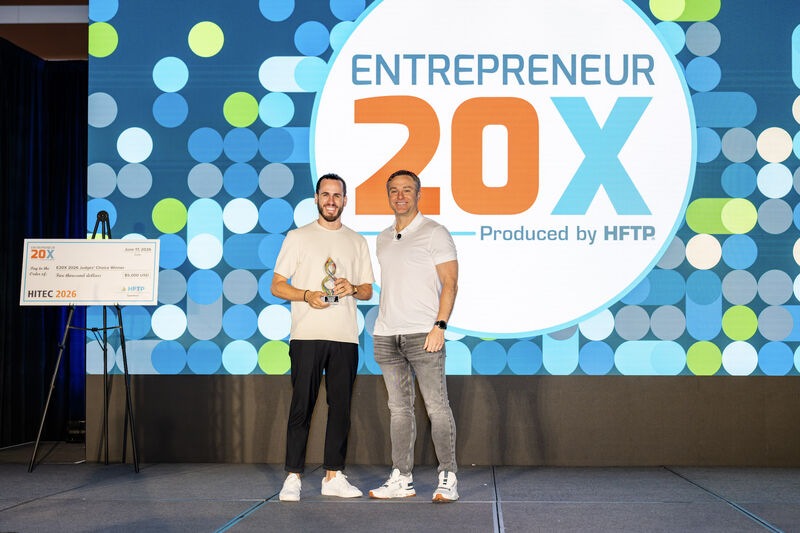
Hospitality technology professionals attended HITEC 2026, where the audience chose Abra for the E20X People’s Choice Award.
The award came in San Antonio after an application, a video and a four-minute pitch. Ellis had watched the competition the previous year and sought advice from past participants. He wanted the presentation to feel like a story about the part of hospitality people love: the thoughtful gesture delivered before a guest thinks to ask. The room voted for Abra.
The company kept experimenting in public. At a hospitality AI hackathon at Rosewood Sand Hill, Ellis and colleague Ross Ragsdale built a hands-free voice tool in hours. They called it SuiteTalk, launched it with a hotel partner during the event, reached the finalist group and began folding the concept into Abra. For staff whose hands are occupied and whose best observations arise in motion, voice is an obvious door. Obvious doors have a habit of becoming visible only after someone opens them.
A memory with a point of view
Ellis is now a familiar figure on the hospitality conference circuit, but the outline of his work remains personal. He and Dana are spouses, co-founders and translators between adjacent worlds. She understands the choreography of a property. He brings enterprise selling, strategy and the outsider’s willingness to ask why the choreography is so hard. Their CTO turns the answer into a product. It is a useful triangle: experience, inquiry, execution.
There is tension in their promise. A record of personal preference can feel attentive or invasive, depending on consent, security, accuracy and restraint. Abra’s task is not merely to remember more. It is to remember appropriately, correct mistakes and put information only where it serves the guest. Hospitality depends on discretion. A perfect memory without judgment is just surveillance in a nice jacket.
Ellis’s own future-facing claim is stark: hotels that organize their guest data will be able to use AI well; those that do not will produce mistakes and generic slop at greater speed. The dividing line, in his view, is infrastructure. His aspiration is to make Abra the intelligence layer beneath a hotel’s existing tools, not another island in the archipelago.
Away from the pitch deck, Japan sits at the top of his travel list. The choice feels apt for someone fascinated by the rituals that make attention visible. For now, he remains on Maui, a place first proposed as a temporary adventure and now woven into the company’s identity.
The spilled wine belongs here too. A young busser dropped everything in front of a room full of people; a manager noticed the person inside the mistake. Hospitality survived because memory and mercy briefly occupied the same system. Ellis has spent his varied career studying big questions, quieting the mind and listening to a hotelier. Abra is the practical question that emerged: can an entire property learn to pay attention together?