A fiber core is an unpromising place to begin a business story. It is the tube around which a coil of aluminum is wound. No one rings a bell when it performs properly. In 2004, Joseph Vidmar wrote an industrial-management paper about whether one particular aluminum-processing line could use a less costly version. The title concerned fiber-core conversion at Alcoa’s Warrick Operations. The question was small enough to fit inside a coil, and consequential enough to warrant a graduate research project.
That is a useful entry into Vidmar’s career. Long before his name appeared beside a private-equity acquisition, he was examining the relationship between a production process and its cost. Today, he is Amzak Capital Management’s operating partner of industrials and is listed as president and chief executive officer of AOC Metal Works. His working territory includes the financial decision and the machinery that must make the decision worthwhile.
There is a pleasing lack of glamour in the core. A company can buy a factory with an announcement. Finding out what belongs inside an aluminum coil requires a different sort of attention. Vidmar’s career brings those two scales into the same frame: the individual manufacturing problem and the organization built around thousands of them.
The economics inside a coil
Vidmar’s May 2004 paper considered coated aluminum produced for the Warrick Super Slitter. Its premise was practical. A fiber core poorly matched to the process could generate rework or scrap; a stronger core also carried a cost. The research examined whether the equipment’s winding behavior allowed a return to regular-strength cores, drawing on an earlier conversion to stronger cores for other slitters.
The technical distinction involved tension. The paper explained that a looping pit allowed the Super Slitter to achieve more consistent rewind tension across the mandrel. That consistency supported reducing the required core strength. For production from April 7 through December 31, 2003, the paper reported $40,130 in savings from the core-cost difference.
Read as a business problem, it asks an unusually sensible question: does a process still need the specification it inherited? The answer depends on how the equipment actually behaves. The appealing part is the connection between engineering and expenditure. A purchasing decision becomes intelligible through a description of the machine. The tube, briefly, gets its moment in the accounts.
Twenty-three years with the metal
Vidmar’s experience at Alcoa extended across 23 years and several stages of aluminum production. His responsibilities included casting, hot and cold rolling, slitting, power generation, smelting and finishing. He worked in rigid can sheet, flat-rolled products and architectural products. Before joining Amzak, he was general manager of Alcoa Architectural Products, North America.
His education ran alongside that industrial career. He earned a business-administration degree with a finance concentration from the University of Southern Indiana in 1997, followed by a master’s in industrial management in 2004. By summer 2012, the university’s alumni magazine was reporting his appointment as general manager in Eastman, Georgia. The sequence puts finance, production research and business leadership on the same résumé.
Earlier, Vidmar served in the U.S. Navy on submarines as a nuclear electrician’s mate and scuba diver. Those are concrete technical responsibilities, rather than the decorative military reference sometimes attached to executive biographies. They add another working environment to a career already filled with equipment, processes and operating systems.
It would be easy to turn that sequence into a tidy theory of character. The actual progression is interesting enough: submarine service, aluminum manufacturing, two university degrees and responsibility for a North American architectural-products business. Each entry supplies another piece of the professional preparation he brought to industrial investing.
- 1997Business administration degree, University of Southern Indiana
- 2004Master’s in industrial management; fiber-core research
- 2012Alcoa general-manager appointment reported by his university
- 2013Joined Amzak as operating partner and project manager
- 2018Interim CEO of the combined AOC and StampTech business
A deal with five factory doors
In January 2018, Amzak announced that it had acquired majority ownership of StampTech and merged its operations with AOC MetalWorks, already an Amzak portfolio company. The combined platform had five manufacturing facilities across the southeastern United States and revenue above $80 million. Vidmar was identified as Amzak’s operating partner and the combined company’s interim CEO.
Those figures describe the combination at announcement, a useful historical snapshot. Five factory doors are also five places where the promise of a transaction must enter daily work. The industrial vocabulary around this deal concerned broader product offerings, geographic reach and the experience of the people joining the business.
Vidmar’s statement put continuing capital investment and additional resources behind the growth plan. It also connected financial improvement to opportunities for employees as the organization developed. His phrase “strive to improve our operational excellence” captured the aspiration without pretending the transaction itself had completed the task.
The other participants made the operating argument explicit. AOC president Tom Collins emphasized the experience of StampTech’s four shareholders and the addition of capabilities and territory. StampTech shareholder Alan Pettigrew, responsible for new-customer sales, highlighted revenue diversification and a broader offering for customers. Fifth Third Bank supplied debt financing; Dominion Partners advised StampTech on the sale.
Put together, the announcement reads as a collection of complementary responsibilities. Ownership provided capital, experienced manufacturers brought knowledge, sales leadership described the customer opportunity, and Vidmar occupied the junction between the investor and the combined operating business. An acquisition has many signatures. Production has to continue after the ink dries.
“Strive to improve our operational excellence.”Joe Vidmar, on the AOC and StampTech combination, January 2018
What the platform actually makes
The products explain why an operating background matters here. AOC’s stamping division works with carbon steel, stainless steel, high-nickel alloys and aluminum. Its listed equipment includes more than 25 presses, with capacities from 50 to 800 tons, and ten coil-fed press lines. Progressive dies and both lower- and higher-volume production sit within that offering.
The customer relationship extends beyond the stamped part. AOC lists kitting, component assembly, warehousing and stock-and-release services, together with support for production launches. The specification on a drawing is one requirement; having the right components ready for the customer’s next manufacturing step is another. The business sells a set of connected capabilities.
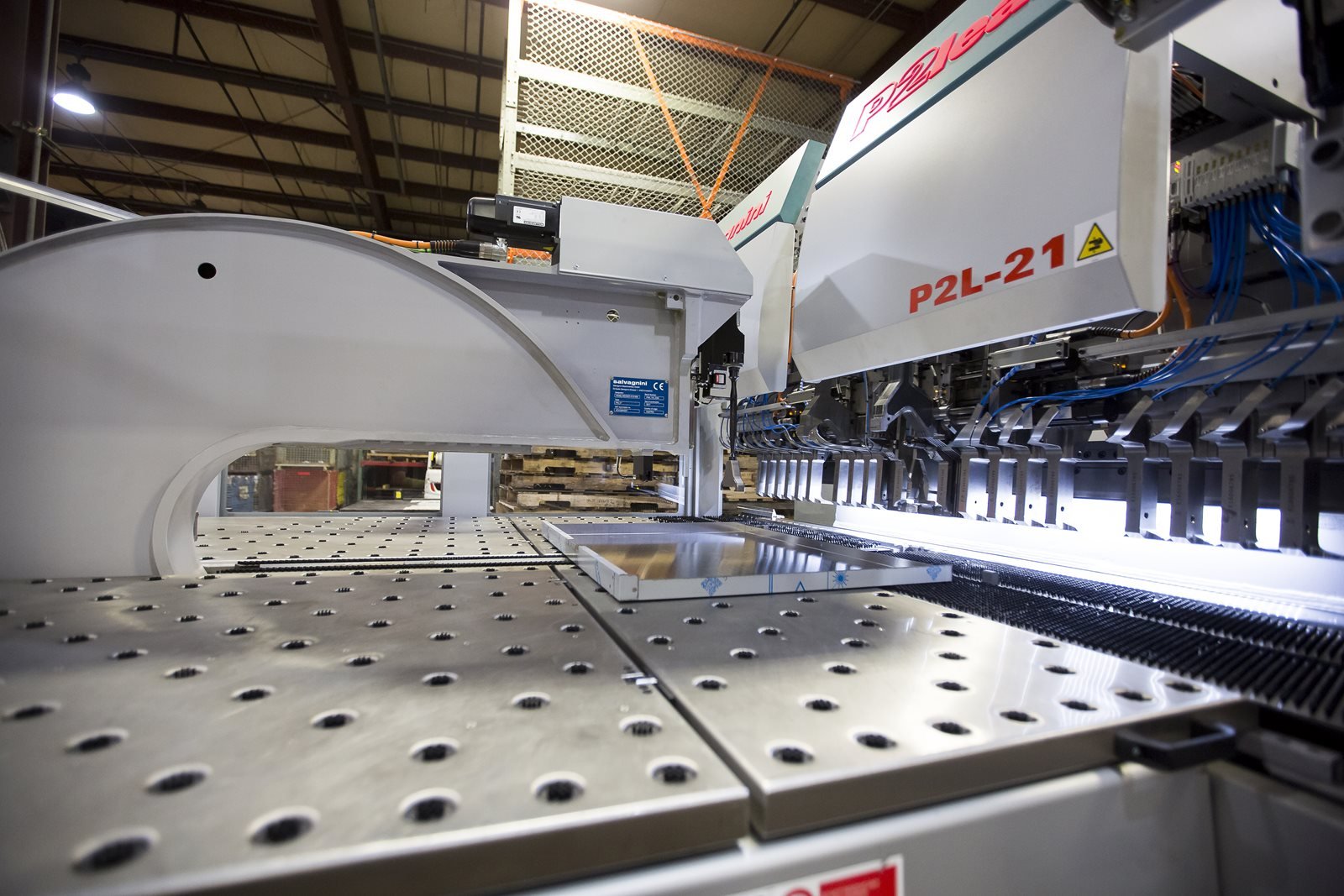
Metal fabrication adds another range of processes. AOC describes four facilities in the Southeast and Mid-Atlantic, serving original-equipment manufacturers in sectors including appliances, refrigeration, transportation, commercial equipment and recreational vehicles. Its equipment list includes nine CNC lasers, twelve turret punch presses, more than twenty press brakes, robotic welding cells and coating systems.
Those capabilities give some texture to the word “industrial.” Here it means cutting, punching, forming, joining and finishing physical material. The list also includes assembly stations and logistics support. A finished part moves through successive operations, and the commercial offering reaches across several of them. Counting machines is informative; understanding how their outputs connect is the more interesting exercise.
AOC’s returnable-racking division handles another uncelebrated necessity: protecting and moving components. It designs custom steel packaging and material-handling applications for parts that will go into larger assembled products. Its offering includes reusable and one-time-use packaging, storage and custom dunnage, the supports that keep a transported component properly positioned.
A carefully made component still has to survive the trip. Racking gives that mundane observation a business of its own. Across stamping, fabrication and packaging, AOC’s work covers both making a part and helping it arrive ready for the next operation. It is a useful view of the operating company behind Vidmar’s executive title.
Capital that stays for the operating work
Vidmar joined Amzak in 2013 as an operating partner and project manager. His remit covers finance, operations and business strategy for its industrial portfolio. Amzak is the Kazma family’s private investment firm, and its industrial approach emphasizes partnering with management teams and providing a flexible source of capital.
The firm describes support that continues after a transaction closes: business development, acquisitions, financing alternatives, legal matters and strategy, alongside efforts to improve operating performance. It also emphasizes flexibility beyond the fixed investment horizons common to many firms. That structure supplies the setting for an operating partner’s work.
The connection to Vidmar’s early research is an editorial one, but a concrete one. In the fiber-core project, the economic result depended on understanding a production process. In his later roles, the scope widened to manufacturing businesses and their strategy. The unit of attention grew from a consumable inside a coil to companies with multiple plants and capabilities.
There is room in that career for both a large transaction and a small specification. The 2018 combination made the scale visible. The 2004 paper makes the detail visible. Together, they offer a portrait of Joseph Vidmar through the work itself: someone whose executive responsibilities have remained connected to the physical business of manufacturing.