Joseph Fasone encountered the internet business from an awkward position: he needed it to work. In 2010, aged 16, he joined the newly launched WeWork. His job would put him in charge of information technology as the company opened shared offices. Each new location needed connectivity. Each connection required dealing with a provider. The building might be ready for its occupants while the internet remained somewhere in the ordering process. A desk without a connection has a certain antique charm, but rather limited appeal to a technology startup.
He left high school before his senior year to work full time. That detail has accompanied him through the profiles and award lists, understandably. Sixteen is early to exchange a classroom for responsibility for other people’s working day. Yet the more revealing detail is the work itself. Fasone was learning a business by buying from it repeatedly, across a growing collection of addresses. Repetition gave him a view that a single unhappy customer would struggle to obtain.
By early 2011, his colleague Kyle O’Keefe-Sally was already publicly singling him out for his work on WeLink, a division developing IT services for people inside and outside WeWork. Fasone’s remit was reaching beyond keeping one office online. He was working on technology that other businesses might buy. The future founder was acquiring two educations together: how networks functioned, and how customers experienced them.

A salesman mentions what the streets are hiding
A sales conversation at WeWork supplied an unexpected clue. A salesman told Fasone about unused fiber underneath New York. He investigated and found a more complicated city than the familiar collection of internet brands suggested. Multiple operators had laid cables. Some networks had been built for research or education. A cable could contain strands that were available even while other strands were carrying traffic.
The phrase “dark fiber” lends this discovery the atmosphere of a detective novel. Its practical meaning is plainer: fiber that has yet to be lit with the equipment that sends signals through it. The opportunity depended on using infrastructure already in place. Digging up a city is expensive. Finding a useful connection in what has already been installed changes the starting economics.
Fasone founded Pilot in 2014 after leaving WeWork. Buying or leasing available fiber let the new provider assemble routes without constructing every inch from scratch. The cleverness lay partly in knowing what was available, and partly in making the pieces useful to a business tenant. An unused strand under the street does little for a customer until someone can deliver service to the right floor.
That gap between an asset and a usable service became Pilot’s territory. New York had a hidden inventory. Fasone had accumulated experience of the people who wanted to use it. The company would have to bring those two things together, address by address.
The router gets a vote
Pilot joined the winter 2015 Techstars New York class. At its demo day, Fasone presented a provider that already had 150 customers in New York. The pitch combined fiber connectivity with software for managing the connection. Selling the service meant making a physical network feel easier to operate, without pretending that the physical network had ceased to matter.
An early engineering decision shows how Fasone approached that balance. Pilot tried running a virtualized routing platform on conventional servers. The attraction was cost. The difficulty was that the equipment could not provide the physical port density and packet throughput the business needed as it scaled. Pilot switched to Juniper MX routers for forwarding traffic while continuing to virtualize the routing intelligence.
There is an appealing lack of romance in that decision. The cheaper approach had limits; the company bought equipment that could do the work. A router is an unforgiving audience for a good theory. It must move packets, including the ones that arrive after the presentation has ended.
Fasone also described the less visible work behind automating a connection: checking for conflicts, handling exceptions and making hardware from different manufacturers behave together. In 2015, he said provisioning a new customer’s service triggered more than 40 tests. The customer would see an activated connection. Behind it sat a collection of checks designed to keep one apparently simple action from producing an expensive surprise.
A calendar full of people worth listening to
The accelerator supplied a different kind of network. When asked what he would change about the experience, Fasone wished he had made more time for mentors. His regret was specific: there were many people who could help, and too little time to work with them. A founder could be surrounded by useful advice and still fail to spend enough hours receiving it.
That admission adds some texture to a career easily reduced to its precocious beginning. Leaving school early can look, from a distance, like a declaration that instruction is unnecessary. Fasone’s own advice points toward a continuing appetite for it. Experience had made him aware of the value of other people’s judgment, and of how quickly access to that judgment could pass unused.
In September 2017, Foundry announced its participation in a $17 million financing for Pilot. Its investment argument included an unusually concrete detail: Pilot was building a geospatial database of unused fiber. Information about the infrastructure was becoming part of the infrastructure business. Knowing where a route existed could matter almost as much as the route itself.
Foundry joined a company with investors including Union Square Ventures and RRE. Forbes included Fasone in its 2018 Enterprise Technology 30 Under 30 list; he also appeared in Inc.’s 2018 young-founder coverage. These were public markers of progress. Underneath them remained the less photogenic activity of making an internet connection arrive where it had been promised.
“I’d engage more mentors.”Joseph Fasone, reflecting on Techstars, 2015
Who controls the arrival date?
Pilot connected its first building in October 2014. By the following February, it had developed its own outside construction capability. That choice brought more of the installation process inside the company. Fasone’s explanation kept returning to control over quality and timing. If the business promised a connection on a particular schedule, it helped to have the people responsible for the physical work on the same team.
His customer promises were similarly concrete: clear prices, no requirement to remain locked into a long contract, and accountability when service failed. He had been the customer confronting a delay or an unwelcome addition to a bill. The experience gave him a rather detailed list of things he wanted his own company to handle differently.
“We feel like we should earn your business,” he said in 2018. It is a modest sentence with operational consequences. Allowing customers to leave makes retention an ongoing task. Transparent pricing removes room for a later explanation. A fast installation promise ties sales directly to what construction and network teams can deliver.
By 2021, Pilot’s emphasis had narrowed geographically. It was focused on New York City, serving more than 2,000 businesses on its own network. Earlier coverage had described operations along the East Coast. The city focus gave the business a different shape: more attention to one dense market, where each additional building could sit near another potential customer. For a company whose work involved real streets and real access arrangements, geography remained an operating decision.
Joins WeWork at 16
Founds Pilot
Extenet deal closes
Across the Hudson, with a closing date
In August 2026, Pilot completed its purchase of Extenet Systems’ enterprise fiber business. The transaction took effect on August 15. The acquired assets included the former Hudson Fiber Network and Axiom Fiber Network, extending Pilot’s owned footprint into New Jersey and adding more than 20 data centers. Direct access to NASDAQ and NYSE was among the additions. Roughly 200 enterprise, carrier and institutional customers would join the network.
The names and customers had changed since the shared-office days. The underlying work still involved connecting places whose occupants could not afford much uncertainty. A financial-services connection makes the operational question particularly sharp: which route does the traffic take, and who is responsible for keeping it available?
October brought another step. Pilot announced an agreement to acquire Boldyn Networks’ New York and New Jersey metro fiber business. The proposed transaction is expected to close in the second quarter of 2027, subject to approvals and customary conditions. Its projected footprint exceeds 1,600 route miles, 1,200 buildings and 50 data centers. Those figures describe the planned combined network after closing.
Fengate’s investment would provide more than $330 million in new financing for the acquisition and continued growth. Fasone would continue to lead the business. The arrangement places the founder who once went hunting for available fiber at the center of a much larger infrastructure operation. More capital and more routes also bring a larger obligation to make the combined system work for its customers.
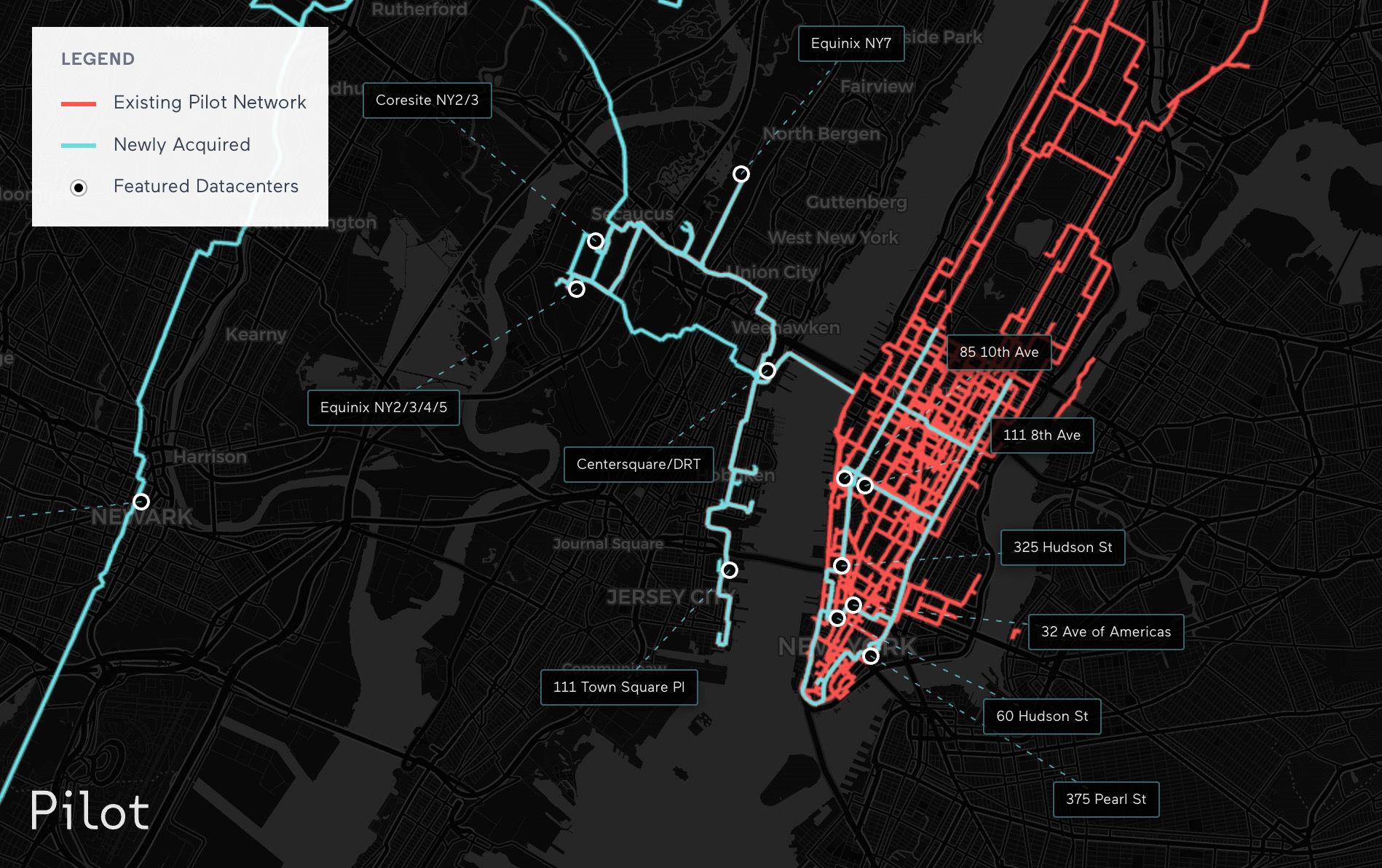
Projected combined network following the Boldyn acquisition. Expected close: Q2 2027, subject to approvals and customary conditions.
The office still has to open
The appeal of Fasone’s story lies in how stubbornly practical its original problem remains. A business needs a connection. A provider must arrange access, prepare the network, send the right people and turn the service on. Each acquisition expands the number of places where Pilot can attempt that sequence. The customer experiences its success at a single address.
There is a useful continuity between the teenager buying connectivity and the executive buying network assets. Fasone has spent his career on both sides of the same transaction. He knows the difference between a route that appears on a map and a connection that is ready for work. His expansion plans will be judged in that small distance, between the infrastructure on offer and the service that actually arrives.
New York’s underground inventory gave him an opening. What he has chosen to build above it is a company responsible for more of the journey. For all the financing, acquisitions and miles of fiber, the final test retains the scale of an office door: when someone opens it for business, can they get online?
Follow the connections
Public profiles, conversations and further reading.