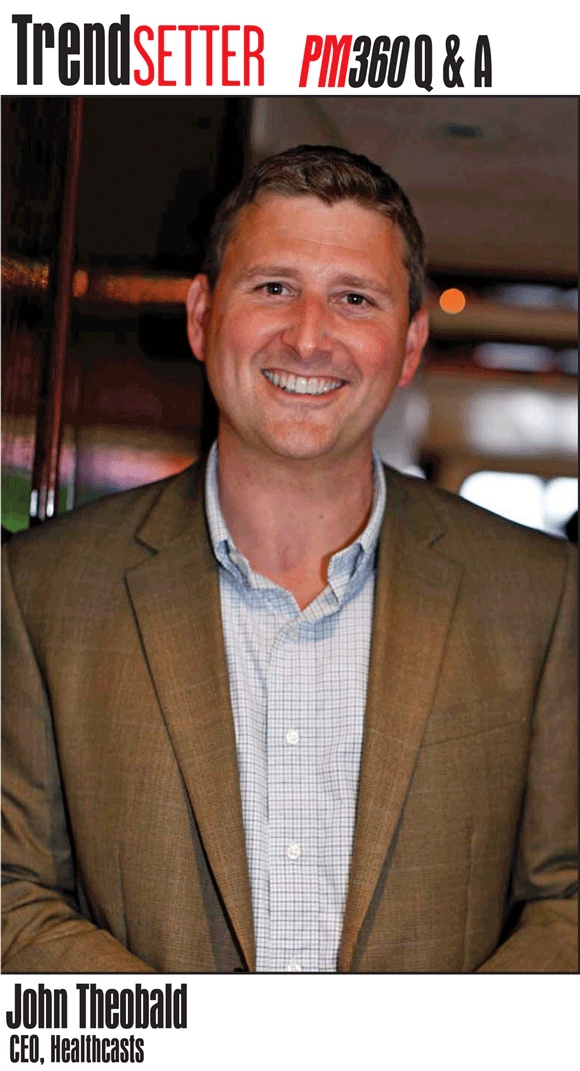
John Theobald began his entrepreneurial career in 1994. His first business was an internet-service provider, started with his brother and three other partners. Seven years later, he founded Healthcasts. The distance between those ventures is a useful place to begin: a business selling access to the internet preceded a business asking what people might actually want to do once they arrived.
The usual founder biography likes a straight line. A childhood obsession becomes a university project, which becomes a company, which makes the childhood obsession look wonderfully prescient. Theobald’s route has a more ordinary and more interesting shape. There were partners. There were potential customers already within reach. There was a technology becoming useful enough to build something around. A career can turn on that combination without requiring a prophecy.
His early company also built websites for commercial clients. Streaming subsequently opened another possibility: putting educational programming on the internet and television. Healthcasts launched in 2001. Its founding date places Theobald in an earlier chapter of online media, long before today’s expectation that almost any programme should be available whenever someone decides to watch it.
That chronology matters because it gives his career a particular texture. He has worked through successive changes in delivery rather than arriving with a single contemporary tool. Internet access, websites, broadcasts, on-demand programming and searchable exchanges belong to different product conversations. His professional history passes through all of them.
A schedule is a product decision
A broadcast has a small act of authority built into it. Someone else chooses the hour. The audience can accept the appointment or miss it. On-demand programming changes the arrangement: the viewer chooses. Healthcasts made that transition as its audience’s needs changed. There is a quiet transfer of power in that decision, from the organiser’s timetable to the individual’s calendar.
For a founder, that can be an awkward bargain. A scheduled event is easy to describe and easy to point to. An on-demand library needs to justify itself whenever a user opens it. The work moves toward relevance, organisation and repeat visits. A programme has to earn attention after the ceremonial moment of its release has passed. The ribbon-cutting gets shorter; the maintenance list gets longer.
By 2016, Theobald’s work had earned a PM360 ELITE Master Educator award. The same year, the company described its programming as accessible across computers, phones, tablets and televisions. Those devices are familiar enough to sound unremarkable now. Taken together, they describe a company trying to fit itself around its members rather than reserve one particular screen for them.
The award also supplies a useful midpoint in the story. Fifteen years after founding Healthcasts, Theobald was being recognised for the work of education. The venture had lasted long enough for its early technology to stop being the headline. That is an interesting place for a technology entrepreneur to arrive: the apparatus becomes familiar, and the service has to carry the argument.
The audience gets a vote
Healthcasts’ 2016 account of its business emphasised routine member feedback. The company’s offerings extended beyond video into interactive formats. The individual detail matters more than a broad declaration about listening: a user response could affect what the company made next. Feedback had a route into the product.
Every company can install a suggestion box. The harder question is what happens after somebody puts something in it. Does a comment reach a person who can change the service? Does a familiar format survive because it works, or because the organisation knows how to make it? These are useful questions to bring to Theobald’s record of format changes. They turn listening from a pleasant personality claim into an operational subject.
Consider how different the work becomes when an audience participates. A finished video has boundaries: a beginning, an ending, a running time. An exchange among members keeps generating material. It can be revisited, searched and connected with other exchanges. The company has to organise an accumulating body of contributions, rather than simply publish another item and move along.
Theobald’s career is interesting at precisely that junction. The founder who began in distribution now leads a business that also has to retrieve and organise participation. Those are different jobs. A bigger catalogue alone cannot settle questions about what deserves attention, which contribution answers a query, or how a returning member finds a useful thread.
2018: the next tool enters the conversation
At Healthcasts’ seventeenth anniversary in July 2018, Theobald was already discussing products that would use artificial intelligence. His stated direction was faster access to the company’s accumulated information. The date is worth keeping beside the idea. It puts AI in the company’s public product discussion several years before its 2023 launch announcement.
An anniversary can be an excuse for a company to admire its own photographs. This one also included a statement about what to build next. There is something revealing in the choice of subject. Access was still the problem under discussion, but its meaning had changed. At the beginning of his career, Theobald sold an internet connection. Now the business problem concerned finding something useful inside a growing collection.
In July 2023, Healthcasts introduced ConsensusAI. The launch described technology drawing on the company’s own verified member exchanges. In business terms, that made its accumulated material part of the product’s architecture. The service depended on a body of contributions assembled over time, alongside the software used to organise them.
That sequence gives the AI chapter a different starting point from a blank search box. A community had already been contributing. A company had already been operating. The new interface arrived inside an existing organisation with an existing audience. Whatever judgement one makes about the technology, those are concrete conditions under which Theobald’s next product was being built.
- ConnectInternet service
- DeliverDigital programming
- RetrieveSearch and synthesis
The less glamorous work of the next version
An August 2024 announcement described further changes to ConsensusMD, the company’s AI-powered research tool. Its features included more ways to retrieve relevant exchanges and organise the resulting information. The product story had moved into the detail of a search: what should be brought forward, how should it be arranged, and what context should accompany it?
These are editorial questions as well as engineering questions. Every results page makes choices about sequence and emphasis. Every summary has to decide what it can leave out. For a founder whose business began with delivering programmes, that is a considerable expansion of the job. Delivery ends when the material arrives. Organisation determines whether someone can use what arrived.
There is an appealing lack of ceremony to a product update. It rarely offers the neat dramatic ending a business profile would like. Instead, it presents another version, with another set of decisions. Theobald’s public career contains this sort of continuity: an established company returning to the problem of how its members find and use its material.
The current company description keeps member verification and shared experience central to its identity. Its stated approach assigns AI the work of synthesis while retaining human contribution at the centre of the service. That is the organisation’s declared direction. For Theobald, the founder’s task remains making that direction concrete in the product people encounter.
“Max is ushering in a new chapter as we relocate our headquarters to Florida.”John Theobald · October 2024
A new colleague, a new address
In October 2024, Healthcasts appointed Max Baumer as both chief operating officer and chief financial officer. Theobald welcomed him to the executive team and announced that the company was relocating its headquarters to Florida. He described Baumer as the company’s first Florida-based employee.
The combination of appointments and relocation brings the story back from interfaces to an organisation made of people. Finance, operations and a headquarters move are tangible responsibilities. They sit beside product development, even when product development gets the more interesting illustrations. A company that keeps changing its service also needs someone watching how the whole enterprise runs.
Theobald’s comment about the move was straightforward: “Max is ushering in a new chapter as we relocate our headquarters to Florida.” The sentence contains a colleague, a place and a next step. It is a useful glimpse of the chief executive’s job at that moment, more than two decades after the company began.
Look across that span and a pattern emerges from the chronology: Theobald has repeatedly worked on the distance between an audience and something it wants to reach. The first company provided a connection. Healthcasts delivered programming, broadened its formats and later added tools for navigating accumulated exchanges. Each stage changed the practical meaning of access.
A founder can become attached to the first successful version of a business. It provides a flattering photograph of a decision that worked. The more useful record is often the sequence of revisions that follows. In Theobald’s case, there are enough dated changes to make that sequence the story. The channel keeps changing. The work is to give people a reason to come back.
These milestones offer a way to judge continuity without assuming that longevity proves every decision correct. A company can keep its name while changing what it asks people to do. It can introduce a new tool while carrying forward older relationships. The useful questions concern the actual sequence: what existed before the announcement, what the company added, and how the new work related to what came earlier. In Theobald’s case, the dates provide that structure. They let the career unfold through observable changes, with the founder still responsible for the organisation that has to make the next version work.