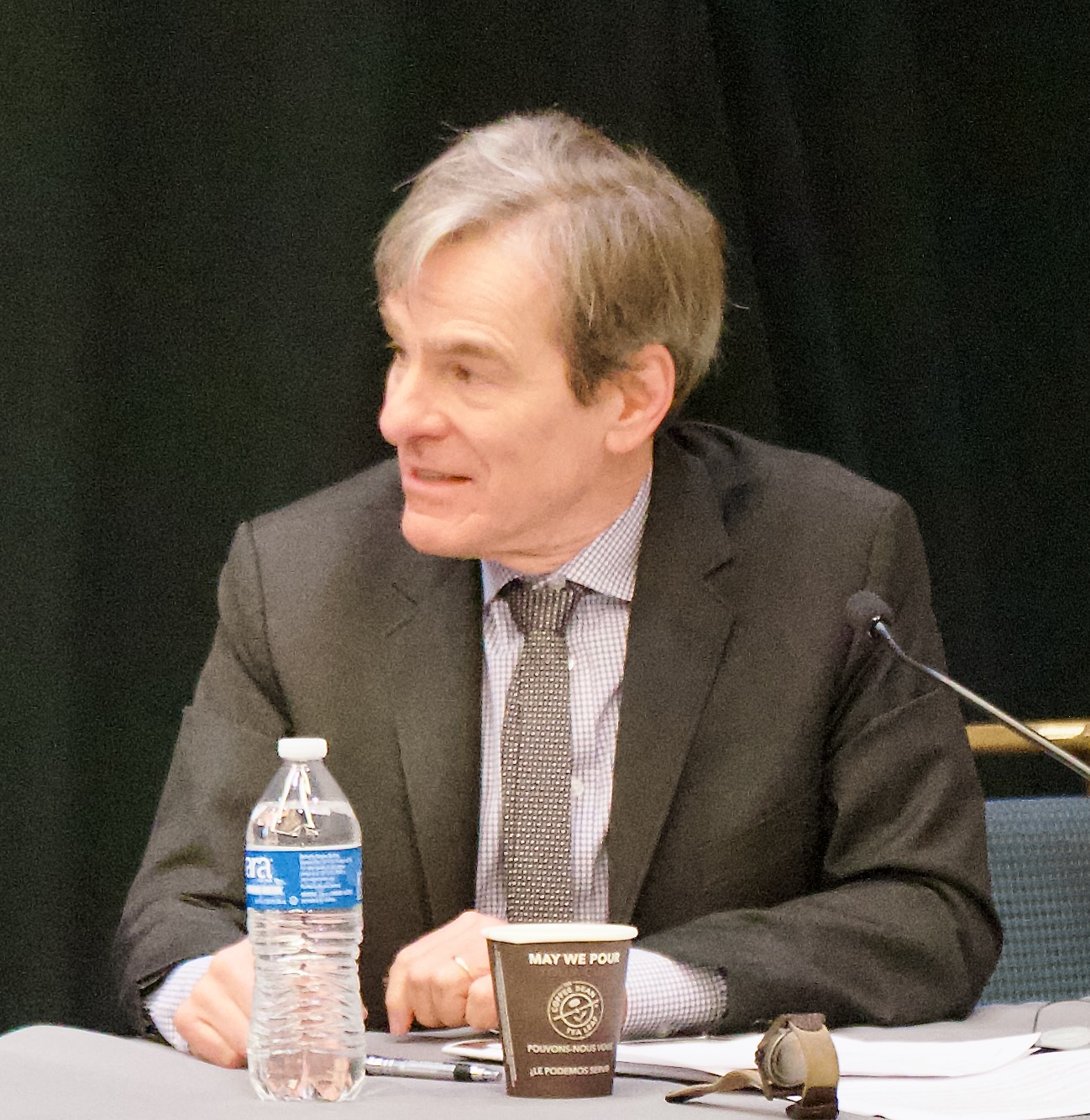
Cochrane at the AEA annual meeting, 2025. Still arguing.
His kids called him grumpy. He built a blog on it, a podcast around it, and a career out of asking the questions that make the rest of the room uncomfortable.
On any given week, John Cochrane is doing three things that have no business belonging to the same person. He is publishing a 4,000-word Substack post dismantling a Federal Reserve press release line by line. He is sitting between historian Niall Ferguson and a former National Security Advisor on a Hoover Institution broadcast called GoodFellows. And, weather permitting, he is several thousand feet over the California desert in a fiberglass glider with no engine, riding columns of warm air and calling it relaxation.
The Substack is The Grumpy Economist. The name was not his idea - his children handed it to him - but he took the nickname and made it a brand. It is now one of the most-read economics blogs written by a working academic, a place where free-market argument arrives with footnotes and a refusal to let a sloppy claim slide.
His day job, since 2015, is the Rose-Marie and Jack Anderson Senior Fellowship at the Hoover Institution at Stanford, with a courtesy professorship at the Graduate School of Business. The titles are long. The work is simple to state and hard to do: figure out why asset prices move, why inflation happens, and why so much of what governments do about both is wrong.
The headline project of his later career is the fiscal theory of the price level. In 2023, Princeton University Press published his 600-page synthesis of it - a book that argues inflation is not just a story about how much money a central bank prints, but about whether the public believes the government will ever pay back its debts. When confidence cracks, prices move. It is a heretical idea in some quarters and gospel in others, and Cochrane has spent decades sharpening it into something a graduate student can actually use.
The implication is uncomfortable for almost everyone. If inflation is fiscal at its root, then a central bank raising interest rates without a matching change in the government's budget is, in his phrase, running into "unpleasant interest rate arithmetic" - it can shuffle inflation through time but cannot make it disappear. That puts him at odds with the textbook story most policymakers tell, and it has made him a fixture in the arguments that follow every inflation scare. He has tangled publicly with Paul Krugman and a long list of others, always with the same move: show me the equation, then we can talk.
"Inflation is hard."
That is one of his favorite lines, and he means it as a warning to anyone selling a tidy answer. He will then spend the next several hundred pages, or several thousand words, showing you exactly how hard - which is the whole point. He treats economics the way a physicist treats a problem: assume nothing, write the equation, follow it even when it leads somewhere unpopular.
"News, views, and commentary from a humorous free-market point of view."- The masthead of The Grumpy Economist
Berkeley handed him a PhD in economics in 1986, but the wiring underneath was installed earlier, at MIT, where he studied physics. That background is not a footnote. It explains his whole style. Where many economists argue from intuition and ideology, Cochrane reaches for the structure of a problem first - the general equilibrium, the single governing equation - and lets the messy human conclusions fall out of the math.
His 2001 textbook Asset Pricing is the clearest expression of this instinct. Most finance courses throw a dozen disconnected models at students. Cochrane organized the entire field around one consumption-based equation and showed how everything else - stocks, bonds, options, exchange rates - is a special case of it. The book won the TIAA-CREF Paul A. Samuelson Award and became a standard text in PhD programs worldwide. He later filmed a free Coursera version so the global audience could take the course without the Chicago tuition.
Before the textbooks, there was a stint as a junior macroeconomist on the Council of Economic Advisers in the early 1980s - an early, formative look at how the sausage of policy actually gets made. He has been a skeptic of that sausage ever since.
The University of Chicago hired him in 1986 and kept him for nearly three decades. He started in the economics department, moved to the Booth School of Business in the early 1990s, and eventually held the AQR Capital Management Distinguished Service Professorship there. Along the way he ran the National Bureau of Economic Research's asset pricing program, edited the Journal of Political Economy - one of the most demanding posts in the profession - and was elected president of the American Finance Association. His research range is unusually wide: the volatility of exchange rates, the term structure of interest rates, the returns to venture capital, liquidity premiums in stock prices, option pricing when investors cannot perfectly hedge, and the deep link between stock prices and the business cycle. The common thread is the refusal to treat finance and macroeconomics as separate countries.
He has also spent serious time on subjects most asset-pricing theorists never touch - health insurance and financial regulation among them - usually arriving at the conclusion that the cure on offer is worse than the disease, and usually with a proposed alternative attached. He is not a man content to diagnose; he wants to prescribe, and he wants the prescription on paper where it can be checked.
The 2001 textbook that compressed an entire discipline into one equation. Samuelson Award winner, PhD-program staple, now a free Coursera course.
His 2023 Princeton magnum opus. Inflation, he argues, is a story about government debt and credibility - not just the money supply.
The blog his kids named for him. Moved to Substack in December 2023, where the free-market commentary keeps coming with the receipts attached.
There is a fiberglass glider parked somewhere with the contest callsign BB. It belongs to Cochrane. He is not a casual hobbyist - he flew for the United States team at the 2010 World Gliding Championships in Hungary, piloting an ASW 27. Soaring is the perfect sport for him: no engine, no shortcuts, just a pilot reading invisible structure in the atmosphere and converting it into altitude. It is asset pricing with weather.
The rest of the off-hours portfolio runs to cycling, windsurfing and skiing - a man who clearly prefers his physics applied. And there is the matter of family. He is married to Elizabeth Fama, a young-adult novelist who happens to be the daughter of Nobel laureate Eugene Fama, the father of the efficient markets hypothesis. Two generations of finance's most influential minds, one dinner table.
He grew up partly in Florence, Italy, the son of Renaissance historian Eric Cochrane and French translator Lydia Cochrane. He speaks Italian and French. It shows in the writing: he reads a central bank statement the way a translator reads a difficult text, hunting for what it is actually trying not to say.
Competition sailplane pilot. US team, 2010 World Gliding Championships, Hungary. Aircraft: ASW 27.
Married to novelist Elizabeth Fama, daughter of Nobel laureate Eugene Fama. Father was a noted Renaissance historian.
Spent part of his childhood in Italy. Fluent in Italian and French - and it sharpens how he reads policy text.
Came to economics through an MIT physics degree, which is why his work starts with the equation, not the opinion.
Every week, Cochrane joins Niall Ferguson and H.R. McMaster on GoodFellows, the Hoover Institution's roundtable on the issues of the moment. It is the public-facing version of what he does on the page: take the conventional wisdom, turn it over, and check whether it survives contact with the data. The Grumpy Economist podcast and Substack carry the same project at his own pace, on his own terms, free of the word limits an op-ed editor would impose.
Hoover's weekly broadcast with Niall Ferguson and H.R. McMaster. Watch on the Hoover Institution YouTube channel.
The long-form home base since December 2023. Free-market commentary, no editor's leash.
The full research archive: papers, books, courses and the back catalog of arguments.