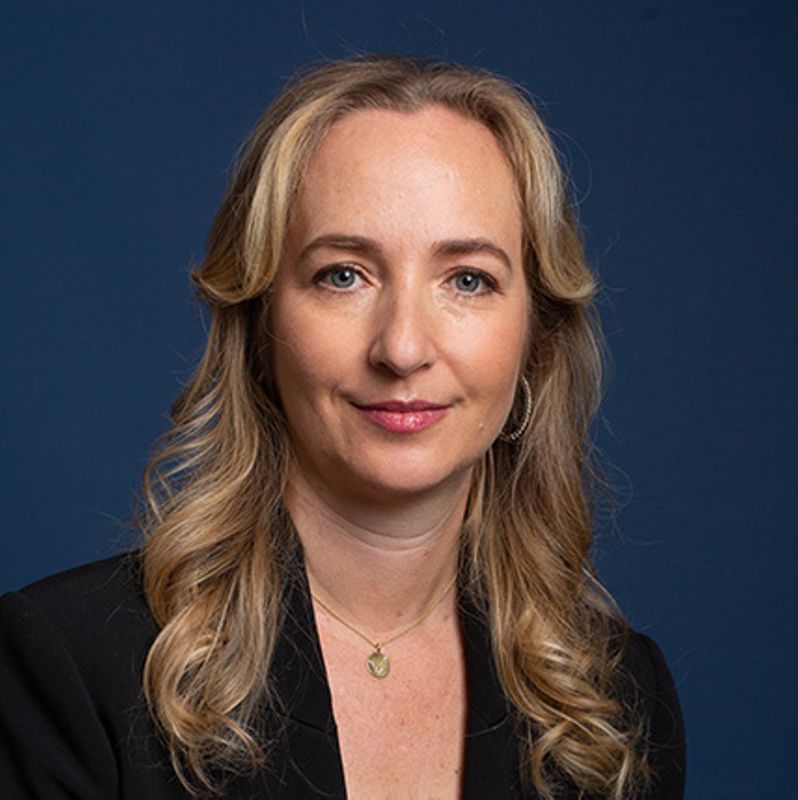
Today Schrager is a senior fellow at the Manhattan Institute, a Bloomberg Opinion columnist, and a contributing editor at City Journal. The shorthand is "risk economist," which undersells the strangeness of the job. She has interviewed big-wave surfers about wipeouts, paparazzi about the math of a single lucky shot, horse breeders about long-shot bloodlines, magicians, poker players, movie producers, and soldiers. The premise is simple and slightly subversive: the people who handle risk best rarely have economics degrees, and the people with economics degrees rarely have to bet their own lives on being right.
Her training is conventional even if her field reporting is not. An undergraduate degree from the University of Edinburgh, then a PhD in economics from Columbia. Early on she consulted for the OECD and the IMF, the kind of institutions that produce footnoted reports about pension solvency. Then she went to Dimensional Fund Advisors to lead retirement product innovation, where she worked alongside the Nobel laureate Robert Merton - one of the architects of modern options pricing. That collaboration matters: it is where the abstract machinery of financial risk met the very human problem of not running out of money before you die.
The pivot to journalism came at Quartz, where she covered economics for a general audience and discovered she was good at it. She could take a concept like the equity risk premium and make it land for a reader who would never use the phrase. The voice that emerged is dry, curious, and allergic to jargon. She has since written for the Economist, Reuters, Foreign Affairs, the Wall Street Journal, the New York Times, Wired, National Review - and Playboy, a byline range that is itself a small act of risk-taking.
The breakthrough was the 2018 book "An Economist Walks into a Brothel: And Other Unexpected Places to Understand Risk." It does what the title promises. Five principles for handling uncertainty, illustrated not by spreadsheets but by people whose livelihoods depend on pricing danger correctly. The book argues that risk is not the enemy of a good life - mismanaged risk is, and so is the refusal to take any. A surfer who never paddles out catches no waves. A saver who hides everything in cash quietly loses to inflation. The trick is knowing how much exposure is the right amount, and that question turns out to be the same whether you are at a card table or planning for old age.
Her current preoccupation is what she sees as a society quietly losing its nerve. Across her Bloomberg columns and her Substack newsletter "Known Unknowns," a thesis keeps surfacing: Americans are taking fewer risks - starting fewer companies, moving less, hedging more - at exactly the moment when the upside of a smart bet has rarely been larger. A too-safe economy, in her telling, is not a stable one. It is a stagnant one. That argument becomes a book of its own in September 2026, when Yale University Press publishes "Worth the Risk," a case against the creeping risk-aversion she believes is throttling personal and economic potential.
What makes her readable is that she never pretends risk is only a chart. She treats it as a fact of being alive that everyone is already managing, usually badly and usually without admitting it. The retirement saver, the founder, the person deciding whether to ask for the raise - all of them are running the same calculation the brothel taught her. The only question is whether they are honest about the odds.