On a utility drawing, the line is almost insulting in its simplicity. It begins at a pickup point, crosses a few rectangles, and ends at a property line. On the ground, that same line may run through dirt, asphalt, concrete, traffic, city paperwork, buried surprises, and four weeks of somebody's life.
A 2023 permit in Rancho Cucamonga describes one such job by JM Communications Inc. The crew would excavate 19 feet of dirt, 1,013 feet of asphalt, and 8 feet of concrete. It would place 425 feet of four-inch duct, reach a two-by-three-foot handhole, then place another 630 feet of duct to the property line. Total route: 1,055 feet. Permit fee: $3,958. Estimated working time: four weeks.
This is the useful correction to the company's name. JM Communications is not a public-relations shop. It does not polish messages. It builds the paths through which messages travel. The business now presents itself online as JM Utility Services, a name that better fits what its licenses, permits, bids, and crews have been saying for years.
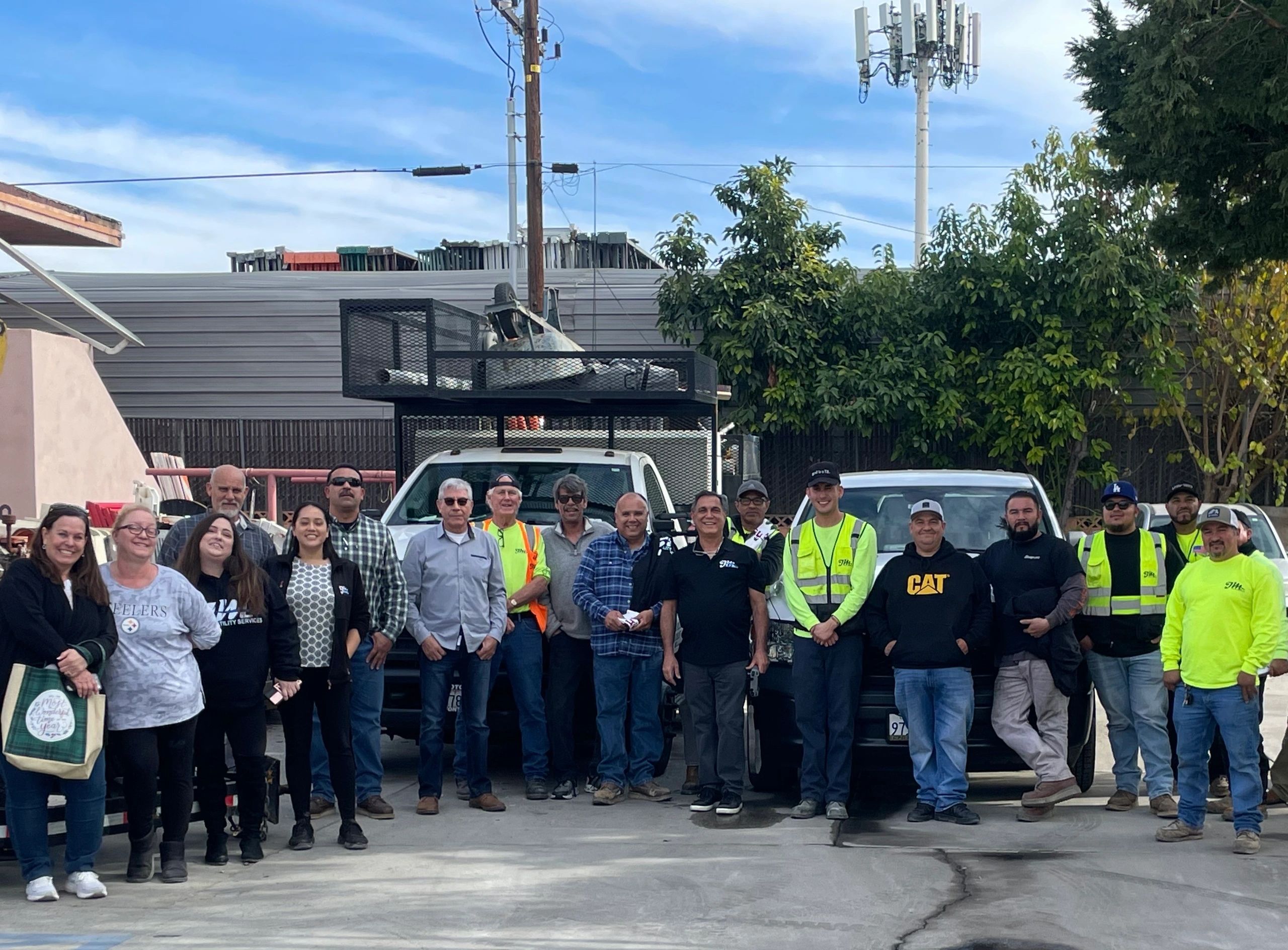
The internet begins with a hole
The modern network is described with weightless words: cloud, wireless, streaming. JM occupies the stubbornly physical layer beneath them. Its stated capabilities run from underground construction to aerial work, then onward to fiber splicing, testing, and electrical turn-ups. It is also a bonded sewer contractor for the City of Los Angeles and a registered vendor for LA County Public Works. In other words, the company operates where communications, power, water, streets, and bureaucracy meet.
One ordinary route, measured precisely
The customer is buying more than installed pipe. The customer is buying coordination: locating what is already underground, controlling traffic, sequencing subcontractors, satisfying inspectors, protecting a schedule, and returning a public street to something resembling its previous life. JM's own language is plain - communication is key, meet deadlines, provide status updates, complete work to specification. For this kind of contractor, those are not brochure flourishes. They are the product wrapped around the product.
“Our abilities and resources go from underground to aerial.”JM Utility Services
A bid is a small X-ray of the business
In July 2023, UC Santa Barbara opened bids for fiber communications utility improvements at Cabrillo Business Park. JM put forward a base bid of $146,538.26, added $22,250 for five compensable-delay days, and landed at $168,788.26 before a separate alternate. It named Cal Empire Engineering for directional drilling and Quality Locating for ground-penetrating radar. Tierra Contracting, at $166,915 including delay, was marked the apparent lowest responsible bidder.
That narrow miss is instructive. JM was only $1,873.26 above the apparent low bidder, less than the cost of many small field surprises. The public sheet does not show improvisation or charisma. It shows where risk gets priced: direct work, delay, alternates, specialists. In 2012, JM's $625,775 bid for cathodic protection along ten miles of Metropolitan Water District pipeline was much farther from the $309,682 low bid. A decade separates the two snapshots, but together they reveal a contractor learning the same lesson every estimator knows: a technically possible job and a competitively winnable job are different things.
The rebrand makes the hidden range visible
The old legal name still appears on Los Angeles work schedules. In March 2026, inspectors listed JM Communications for trenching at a commercial-building site on Normandie Avenue. The newer name, JM Utility Services, had already entered public procurement records by April 2025, when president Jack Massachi attended a Ventura Harbor pre-bid conference under that banner. The address and operating phone remained the same.
The shift is less a reinvention than a clarification. “Communications” describes the historic customer need. “Utility Services” describes the equipment and trade range. Public permits show JM installing AT&T pedestals in Inglewood in 2013 and energizing another AT&T service in 2014. Today's company site explicitly names AT&T as a trusted subcontracting customer, while also courting public and private entities across Los Angeles, Orange County, and the Inland Empire.
That geography matters. This is a regional operator, not a national platform. Local usefulness comes from repeated contact with the same classes of city departments, right-of-way rules, inspectors, carriers, soils, and subcontractors. A buyer does not use JM by downloading a product. A carrier, public agency, developer, or prime contractor gives it a defined scope, a site, specifications, and a deadline. JM supplies licenses, crews, machinery, field coordination, and closeout. Revenue arrives one project and change order at a time.
Trust is a field condition
The company puts “Built on Trust!” at the center of its pitch. Utility construction makes that phrase unusually testable. Every buried line is a promise about what lies below. Every traffic-control plan is a promise about what happens above. Every delay clause converts time into dollars.
It also converts safety from sentiment into record. In July 2017, OSHA opened a partial inspection connected to an accident at an Altadena site, using JM's Arminta Street address as the mailing address. The case closed in January 2018 with two other-than-serious violations and $670 in current penalties. It is a modest penalty, but an important reminder: the first thing that can fail in infrastructure work is not the fiber. It is the system around the crew.
The reusable lesson is operational. Narrow the promise to a territory and trade stack you know. Price delay explicitly. Name the specialist subcontractors before the work begins. Treat status communication as part of delivery. Keep the license visible. The approach fits projects where a buyer has a designed scope, permits can be secured, site access is controlled, and local coordination is valuable.
Defined regional utility scopes, public-right-of-way work, carrier subcontracting, and jobs that combine civil, electrical, locating, splicing, or testing.
National rollouts requiring one prime across many states, software-only network work, emergency scopes without reliable site information, or bids where price overwhelms local coordination value.
The amusing fact about JM Communications is that the closer you look, the less communicative it seems. There are few announcements, no funding rounds, and no grand founder mythology. The public story is scattered through bid tabs and permit logs. Yet that quietness suits the work. The signal gets the attention. The trench is supposed to disappear.