An expensive computer has a wonderful talent for making everyone around it feel underqualified. Jithin VG has spent the past few years asking a less deferential question: how much of the job could the computers we already own perform? For the Accubits co-founder, now founder and CEO of Bud Ecosystem, the question grew out of a practical inconvenience. His team wanted to work on generative AI. The price of the hardware was getting in the way.
There is something revealing about choosing that inconvenience as a business. The public spectacle of AI rewards the new model, the enormous machine, the number with an impressive procession of zeroes. Jithin’s recent work concerns the machinery underneath: running models, sharing computing resources and deciding when an expensive system really needs to be summoned. Even the future must eventually answer to a purchasing department.
Based in Thiruvananthapuram, Kerala, he has approached technology through several doors: software projects, enterprise services, investments and research papers. Accubits gave those interests a commercial home. Bud, which began as a research lab in early 2023, has brought them toward a narrower question with wide consequences: who gets to afford useful AI?
A game before the business
One early entry in his public project history is wonderfully unconcerned with enterprise procurement. In 2009, Jithin and Ditto worked on a first-person shooter built with Unreal Engine. Jithin lists modelling, rigging and animation among his contributions. Before the runtime came the game: a small reminder that a career in software can begin with the pleasure of making something move.
His later project list ranges across optical character recognition, a research search engine and a language identifier. These are his own descriptions of the work, and they reveal a recurring interest in the mechanics of getting computers to interpret information. The applications change; the appetite for building the underlying system is already visible.
In 2012, Accubits was founded with a group that included Jithin and Ditto PS. Its early AI products struggled to attract customers. The company subsequently developed a services business alongside its products, working on software problems for other organisations. That change matters to Jithin’s story because it introduced a demanding collaborator: the customer, who generally prefers a working answer to an interesting intention.
Accubits developed into a provider of software, AI and blockchain services. Its footprint extended beyond India, with headquarters in Virginia and offices in several countries. The distance between building a game and running an international services company is considerable. So is the difference between making something work once and making it work for someone else, on their timetable, with their money attached.
The schedule that wanted two weeks
A 2019 account of his work offers a useful miniature of his business instincts. A construction company needed to schedule resources and tools across multiple sites. Jithin described a process that could take twelve to fourteen days manually. His team used genetic algorithms to generate schedules, then turned the solution into a product for other industries.
The attraction of that example is its lack of glamour. Scheduling rarely receives a standing ovation. Yet it is precisely the sort of problem in which a software improvement can be understood without a lecture about the destiny of civilisation. People, equipment and deadlines must fit together. A better arrangement has immediate practical value.
Jithin also recalled an employee whose previous work involved watching network traffic and reporting problems. The employee went on to build an AI model that automated that work. In Jithin’s telling, the episode illustrated how technical ability could be redirected from repetitive monitoring toward building the system that performs it.
His ambition for Accubits was expressed in the phrase “7 Billion Creative Minds.” It is an enormous constituency for any company. The underlying wish is easier to grasp: let machines absorb routine work so people can devote more attention to creating things. His writing on generative AI later returned to that division of labour between human and machine.
Recognition, with the team in the frame
In 2022, Entrepreneur India included Jithin in its 35 Under 35 selection. He responded by crediting the Accubits team collectively. An individual’s name occupies the award listing; a company’s work is necessarily shared. His response kept that distinction in view without turning the occasion into a solo origin myth.
His connections also extend beyond the chief executive’s office. Climate intelligence company mistEO lists him as an advisory board member and investor. A 2023 Davos event biography identified him as a founding partner at Accubits Ventures. These roles place him on both sides of the founder’s conversation: building businesses and supporting other people who are building them.
That breadth helps explain the range of his public work. Enterprise software, research and investment are different occupations, but each asks which technical possibility deserves sustained effort. The interesting part of his career is how often he has returned to that decision, rather than settling permanently into one product category.
When the hardware bill became the brief
Bud Ecosystem began with Jithin and Ditto in early 2023, focused on AI research and model development. Its GenZ 70B model is publicly available on Hugging Face. The model card describes a fine-tuned model built on Llama 2, a concrete piece of work that developers can inspect rather than merely applaud.
But producing a model and paying to run it are separate problems. Jithin has described GPU costs as an early obstacle for the team. They began developing software to run smaller models on existing infrastructure. That internal response evolved into Bud Runtime, introduced publicly in 2025 as a way to deploy generative AI across a range of hardware.
The engineering aim is portability: making better use of CPUs and other processors while reducing dependence on a particular hardware supplier. It is an appealing proposition for a business with perfectly serviceable machines already installed. A new generation of software becomes rather less inviting when it arrives with instructions to replace the furniture.
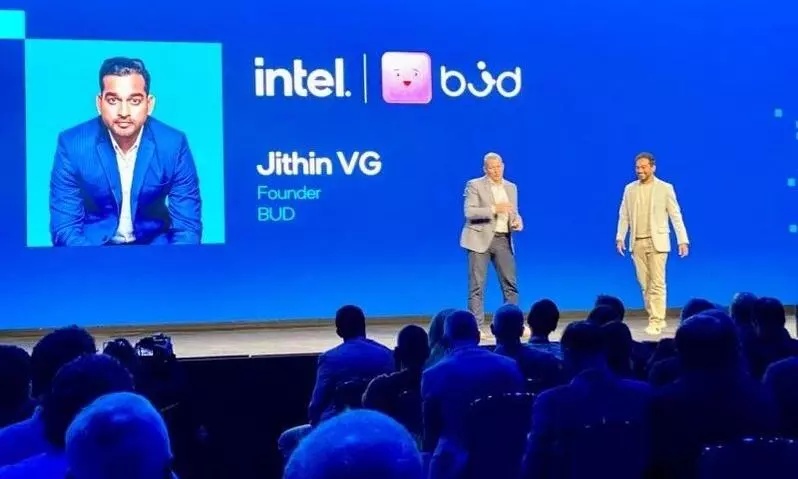
Intel’s own account of Intel Vision 2024 featured Jithin and Bud’s inference work. The relationship gives his infrastructure ambitions a tangible setting: an AI company working with a chip company on the question of what those chips can deliver. The work concerns inference, the stage at which a trained model generates an answer.
The papers behind the proposition
Jithin’s name appears alongside Ditto PS and Adarsh MS on a 2024 preprint about accelerating large language model inference on CPUs. The authors describe parallel processing and batching requests, reporting an eighteen-to-twenty-twofold improvement in generated tokens per second in their evaluation. Those results belong to the conditions of that study; they are not a promise about every model on every office computer.
A second 2024 preprint, co-authored with Adarsh and Ditto, explores a different economy. A smaller model generates text locally, while a reward-based mechanism decides when a cloud model should assist. Instead of sending every part of the job to the larger system, the method makes assistance selective at the token level.
The idea has a pleasingly ordinary logic: ask for help when help is useful. In computational terms, the paper investigates a trade-off between response quality and reliance on an expensive cloud model. It brings Jithin’s accessibility argument down to the scale of an individual generation decision.
Improvement in generated tokens per second reported in the authors’ 2024 CPU inference evaluation. Performance depends on the workload and configuration.
By late 2025, Jithin and Ditto were also writing about how to evaluate software that shares GPU resources. Their GPU-Virt-Bench preprint proposes a framework spanning fifty-six metrics across ten categories. The subjects include overhead, isolation and scheduling. These are the unromantic questions on which a production system’s usefulness can depend.
Together, the papers make his direction legible. Running AI affordably involves several decisions, from processor utilisation to selective cloud assistance and shared resources. None is as easy to advertise as a machine that appears to know everything. Each may matter when that machine must answer thousands of people and remain financially tolerable.
An ambition measured in access
With Aharsh MS, Jithin co-authored a sovereign AI framework for developing nations. The argument centres on software innovation, efficient architectures and alternative deployment models as ways to participate in AI despite infrastructure constraints. It connects his business problem to a national one: how to build capability when spending cannot simply match the largest players.
His interests also wander beyond the company brief. In a July 2025 essay, he considered infinity through philosophy, mathematics and computational limits. There is a certain charm in a founder concerned with reducing computing costs spending his writing time on infinity. Even abstraction, apparently, can be approached through finite resources.
In June 2026, Bud announced its selection for Microsoft’s AI First Movers programme for the financial year. Its public offering now encompasses a wider enterprise AI platform, including deployment and governance. Jithin continues to frame the business around lowering barriers to adoption.
“To democratize GenAI by commoditizing it.”Jithin VG · on Bud’s mission, June 2026
The next chapter therefore has a fairly practical test. Can organisations put useful models to work with less expense and less friction? That question leaves plenty of room for invention, and very little room for ceremonial computing. Jithin’s career has moved through games, services and research to reach it. The glamorous part of AI may be what an answer says. His attention keeps returning to what it takes to make the answer possible.