Jerry Li’s company began with a problem that would barely qualify as a startup pitch: he wanted to learn how to lead people without making every mistake himself. He had worked as an engineer, become a manager, and discovered that a promotion did not arrive with all the answers. Other leaders had useful experience. The trick was getting them into a conversation worth having, then giving that conversation a life beyond the evening.
In January 2016, he founded the San Francisco Engineering Leadership Community. ELC became a place where people responsible for engineering teams could compare notes. Years later, the tools built to support it became Gradual, the company he now leads as co-founder and CEO. The order is the interesting part. People gathered. Organizers found problems. Engineers wrote software. Only then did a separate business emerge.
The expensive education of a manager
Li’s earlier career had put him inside organizations where software had to work at scale. At Amazon, he was an engineer and later an engineering manager. At Groupon, he became a director of engineering overseeing payments engineering across distributed teams. Those jobs gave him experience with systems and with the people expected to maintain them.
The two responsibilities have different feedback loops. Code can produce a clear error message. A decision about a team can take considerably longer to reveal its consequences. The person making it still has to decide today. This is the practical difficulty behind Li’s interest in shared experience: someone else may already have worked through a version of your problem.
His public interviewing shows how often he returns to that difficulty. In a conversation with Shopify engineering leader Farhan Thawar, Li asks how hiring changes when the candidate will lead engineers. He presses on the greater consequences of an unsuccessful leadership hire. He then considers what individual contributors might learn about their own needs after experiencing a poor fit.
The questions are grounded in the working week. Hiring a manager means asking a team to accept a new relationship. The interview happens before that relationship exists. Li keeps the discussion close to the gap between what an employer can discover in advance and what people learn by working together.
“Try to create opportunity for yourself and for others to try different things.”
Jerry Li, in his Project AI+C conversation
He brings a similar curiosity to subjects outside engineering’s customary borders. Discussing sales with Maulie Dass, he remembers an office where the sales team occupied one side and the engineers the other. They rarely mixed. Engineers wanted quiet; salespeople were loud. It is a small recollection, with the recognizable geography of a workplace divided into separate little countries.
Rather than treating the separation as inevitable, he asks what engineering leaders can learn from sales. Elsewhere, in a conversation about product and engineering with Jeremy Henrickson, he raises leaders’ interest in learning more about product. Across these exchanges, the useful knowledge frequently belongs to somebody beyond the listener’s immediate team.
A room with a reason for existing
ELC gave that interest an organized form. Its founding invitation was for people interested in software engineering management to share experience, discuss questions, and build mentorship. Li’s premise was that learning only through your own mistakes could be slow and costly. A peer’s experience offered another route.
That is an unromantic reason to start a community, which is part of its appeal. Nobody needs another vague instruction to network. A manager needs help thinking through a decision. A useful group gives people enough shared context that they can begin somewhere more specific than explaining their job title.
Li founds ELC for engineering leaders.
Gradual grows from ELC’s internal software.
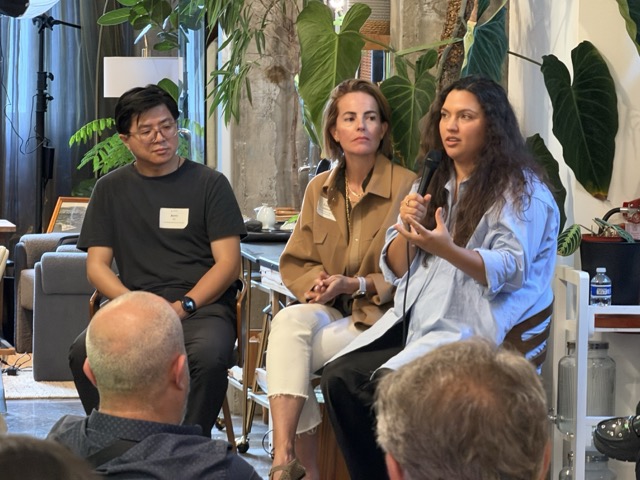
Li joins a customer engagement roundtable in San Francisco.
ELC’s programming illustrates the range of those decisions. An October 2019 dinner brought together people considering the move from established technology companies to founding a business. Greylock’s Saam Motamedi and Jason Risch joined the discussion. The invitation emphasized a small group and a confidential setting where participants could test ideas and meet potential collaborators.
In 2020, an ELC conversation with Discord’s Michael Greer offered a different kind of access: a discussion with the hiring manager about the company, his leadership approach, and what success in the role would require. Questions could be submitted anonymously. The design recognized that candidates also have decisions to make, and need more than the polished vocabulary of a job listing.
By March 2024, Li’s CMX speaker biography described ELC as a community of more than 10,000 members globally. That number establishes its reach. The smaller formats explain something about its purpose. A large membership can support intimate conversations, provided somebody does the work of putting the right people together.
The velvet rope has a job
In recounting ELC’s growth, Li has emphasized its focus on engineering leaders. Recruiters and marketers were kept out of those peer gatherings. Such a rule can sound inhospitable until you consider the conversation it protects. A leader discussing a difficult problem may speak differently when the room is also a prospecting opportunity.
A community has to decide whose needs govern the room. The decision becomes harder when a new participant brings money, attention, or an attractive connection. ELC’s approach put the peer exchange first. Membership was a promise about the setting, and admitting someone could alter that promise for everyone already inside.
Heather Holst-Knudsen’s account of ELC includes a neat example of word of mouth: a Slack employee attended, then invited 30 colleagues the following day. The anecdote is more revealing than a slogan about growth. An invitation to coworkers carries a little personal responsibility. You are recommending an experience and attaching your own judgment to it.
Not every community question produces such comfortable agreement. In 2023, consultant Brianna Leever asked Li and the Gradual team to host a debate about members who observe without participating. Should organizers leave them alone, encourage them, or remove them? Even the quiet people, it turns out, can produce a lively argument.
The software hiding in the housekeeping
Running ELC meant dealing with the practical work surrounding its gatherings. Its internal tools became the foundation for Gradual, founded in 2021. The company’s origin sits in that transition from solving one community’s operating problems to offering software other organizations could use.
Gradual brings events, recordings, written content, discussions, and member connections into a branded platform. For an organizer, these are connected jobs. For a participant, they can otherwise become a small expedition through separate accounts, inboxes, and links. A person who enjoyed a discussion still needs to locate its recording or find someone they met.
A schematic of Gradual’s connected features, not a measured growth funnel.
Scale provides a concrete example of the size this infrastructure can serve. Its marketing leader Marcel Santilli described using Gradual for a 23,000-person virtual conference, with an environment that also supported community activity afterward. The attendance is striking. For Li’s story, the second half of the description matters just as much: the place was useful after the event.
Software cannot ensure that two people will have something valuable to say to each other. It can make the next exchange easier to begin. That distinction keeps the product question practical. The organizer supplies a purpose and a setting; the platform helps preserve access to the people and material gathered there.
More intelligence, less wandering around
Li has also taken this problem into discussions about artificial intelligence. In May 2024, he joined Logan Kilpatrick and Nolan Fortman on Around the Prompt to explore how AI might change communities. The conversation considered personalized experiences, knowledge retrieval, and the effort required to help people find useful connections.
At a March 2024 CMX panel, the question was framed explicitly around community work: how useful are AI tools for activities involving creativity and empathy? Li appeared alongside Adele Bloch and Diana Spehar. The setting matters because administration and connection sit side by side in this job. Saving time on one does not automatically improve the other.
In his later Revenue Room interview, Li described an ambition for agents that could help members discover relevant events, insights, and people without requiring them to remain constantly present. It is an appealing possibility for anyone who has joined a professional group, missed a week, and returned to an unread count resembling a minor national debt.
The idea still has to earn its usefulness in the details. An introduction needs context. A recommendation needs a reason. For a community member, the desirable outcome is concrete: finding someone who understands a problem, or discovering information at the moment it can help. Li’s proposed use of AI follows that existing need.
Back in the room

On August 5, 2026, Li joined a fireside conversation at Gradual’s San Francisco office with Kenna Valdez of OpenAI and Ursula Llabres of Contentsquare. SuccessLab founder Omid Razavi moderated. The subject was customer engagement, a phrase that acquires different meanings depending on which department is speaking.
Li described engagement as something earned, shaped by a customer’s own circumstances. He also emphasized customers contributing ideas and seeing those ideas incorporated into products. His point about AI returned to the human experience of solving something difficult together. Faster access to information does not supply that shared experience on its own.
There is a pleasingly unsuitable detail in Li’s account of learning: he once learned to scuba dive in Bali before he could swim. In the same 2025 interview, he named Extreme Ownership as his favorite book. The combination gives the biography a little texture: responsibility on the bookshelf, a rather unusual order of operations in the water.
His business followed its own order of operations. First came an engineering leader’s questions. Then came other leaders, a community, and the tools needed to keep it working. Gradual emerged from years of attending to what happened around the conversation. The useful test remains close to where Li started: can the next person learn something without having to make every mistake alone?