The little bar on the supermarket conveyor belt has a modest job: keeping your groceries from becoming somebody else’s dinner. Jeffrey Rosenthal has found another use for it. Put an advertisement on its side, and an object people handle without much thought becomes a place for a neighborhood business to introduce itself. A carpet cleaner gets a few inches of real estate between the chocolate bars and the weekly shop. The bar, at least, has no ambitions to become a television commercial.
Rosenthal is the founder of the NALA and StarKart, and today the founder and CEO of STARSTIX. His career has repeatedly returned to the supermarket, where ordinary objects offer businesses a route to nearby customers. Shopping carts, receipts and checkout dividers occupy an unglamorous corner of advertising. They also sit remarkably close to the people a local business hopes to reach.
Follow that career beyond the grocery aisle and another pattern appears. Rosenthal has built connections among chief executives, linked local businesses with shoe collections, and accompanied veterans back to Pearl Harbor. The settings change considerably. The practical question connecting them is how to bring people into contact when an introduction would otherwise be unlikely.
A business on four small wheels
In 1984, Rosenthal acquired Fanfare Media. He sold it to a private equity fund in 2001. Those dates bracket seventeen years in a business that turned familiar surfaces into advertising inventory. The underlying proposition was easy enough to understand without a slide deck: someone was already going to the supermarket, and a nearby business wanted that person’s attention.
By 2003, his professional title had shifted to president and chairman of Rose Investments, a private investment firm. He had also become a director of Giant Group in 1997. Investment and board work broadened his professional life, but local advertising remained a recurring occupation. StarKart put that emphasis directly into its name. There was little danger of a prospective customer mistaking the product for a space program.
The significance of the grocery cart is its geography. A local advertiser can choose a place where potential customers already shop. That makes the store itself part of the pitch. For Rosenthal’s businesses, expansion therefore meant adding stores to an advertising network, with each location offering another set of local possibilities.
StarKart’s January 2016 announcement added approximately 1,000 locations across 20 states, following an earlier addition of 2,600 locations.
That January expansion included markets such as Charlotte, Knoxville, Virginia Beach and Jacksonville. The usefulness of a large network was that an advertiser could still choose a particular part of it. Scale supplied options. The campaign could remain concerned with a much smaller patch of the map.
The long wait for four letters
One of the more endearing episodes in Rosenthal’s business history concerns an internet address. In December 2014, StarKart announced a redesigned website and its arrival at starkart.com. It had previously used starkart.net because the dot-com address was unavailable when the business launched, roughly a decade earlier.
An advertising executive had spent years with a perfectly serviceable name and the less coveted ending. Even people who sell visibility have to wait for the right address. Rosenthal’s explanation was matter-of-fact: the preferred domain had simply been taken. By the end of 2014, the company could offer both addresses.
The redesigned site also explained StarKart’s cycle rotation program. Clients could select campaign length, store locations and how frequently advertisements changed. Those are useful details in this story because they show the actual work beneath the expansive word “marketing”: choosing where a message appears, deciding how long it stays, and arranging what happens next.
The NALA supplied a broader set of services, including websites, blogs, news releases and social media. In September 2015, parent company EBS Executive Business Services relaunched with a wider marketing offer of its own. Its proposed client process included an individual strategy implemented over at least twelve months. A business that had grown beyond its original operation could need a different mix of services.
“We understand local business.”
Jeffrey Rosenthal, 2015
That short statement was Rosenthal’s explanation of the team’s experience. It also described the common customer behind the changing products: an owner trying to become better known in the place where the business operates. A shopping-cart panel and a website address different moments in that effort. Both need someone to decide what belongs on them.
When a roomful of CEOs needs an introduction
Rosenthal joined Young Presidents’ Organization in 2001. At his first Global Leadership Conference, he saw possibilities in connecting members through shared interests. Being in the same organization supplied a starting point. Finding the person with a relevant interest required more deliberate arrangements.
His work included YPO’s International Board from 2006 to 2009 and chairing its International Network Committee. He helped develop a network platform that gave members ways to find one another beyond the local chapter. The common interest could be professional, personal or connected to social enterprise. A large membership becomes more useful when people have a reason to begin a conversation.
Sixty starting points for a conversation. Historical figures described in 2015.
In 2014, he served as host-city chair for YPO’s Los Angeles Global Leadership Conference. The program brought together chief executives from around the world and speakers including filmmaker James Cameron and swimmer Diana Nyad. The entertainment included Billy Idol and Ozzy Osbourne. Anyone imagining a leadership conference as an extended examination of spreadsheets may wish to reconsider the soundtrack.
Rosenthal received YPO’s Hickok Award in Australia in 2015. His other institutional commitments included service on the University of Southern California’s Board of Governors from 2006 to 2009 and membership of the USC Marshall School advisory board beginning in 2009. These roles placed him in settings where introductions, shared experience and organized participation mattered alongside a formal title.
The office becomes a shoe collection point
By September 2010, the NALA was making charitable participation part of its relationship with local businesses. It named Soles4Souls its featured charity that year. One campaign offered a dollar donation for each of the first 2,500 participants who liked the NALA’s Facebook page. The mechanics were small and specific, which made the invitation easy to understand.
The shoe collections gave the idea a physical address. In November 2015, NALA client Margaret Turner, a State Farm agent in Temecula, had collected more than 1,300 pairs. A twelve-year-old local girl helped; her team gathered 500 pairs. In Mobile, Alabama, another State Farm agent, Brandon Shreves, reached a 500-pair goal in his office’s first drive.
Those details give the program its scale in human terms. An insurance office has a front door, a staff and relationships in its neighborhood. Inviting people to bring shoes changes what that familiar office can do for an afternoon or a month. Rosenthal’s contribution was to help organize businesses around that invitation. The collecting itself belonged to the people who answered it.
There was a professional connection here, too. Buddy Teaster worked with Rosenthal at StarKart before moving into nonprofit management and leading Soles4Souls. Their careers crossed on the commercial side of the business before the shoe charity became the setting for Teaster’s work. It is a concrete example of how the people around Rosenthal’s companies connected with his charitable interests.
Thirty passengers, seventy-five years later
In December 2016, Rosenthal traveled to Pearl Harbor with thirty veterans who had been there during the attack on December 7, 1941. The trip marked its seventy-fifth anniversary and supported the NALA’s charity partner, The Greatest Generations Foundation. His involvement with the foundation extended back more than a decade.
“Many of these men have not been back since the war,” he said at the time. The sentence gives the journey its weight without requiring embellishment. For the travelers, the anniversary involved returning to a place in their own lives. For younger generations, it created an opportunity to encounter people whose experiences usually arrive through books, photographs and commemorations.
The foundation worked with more than twenty schools across Oahu for the anniversary. Its purpose included preserving veterans’ accounts and helping students learn from them. Rosenthal’s advertising career dealt in getting a message before an audience. Here, the people carrying the story could be present themselves, and the occasion asked the audience to listen.
Back at the checkout
Today, STARSTIX identifies Rosenthal as its founder and CEO. Its product is the advertising-bearing checkout divider, a small surface that stays with the customer through the last stage of a grocery trip. The former NALA web address now leads to STARSTIX. After websites, shopping carts, conferences and charitable collections, the conveyor belt is still part of the story.
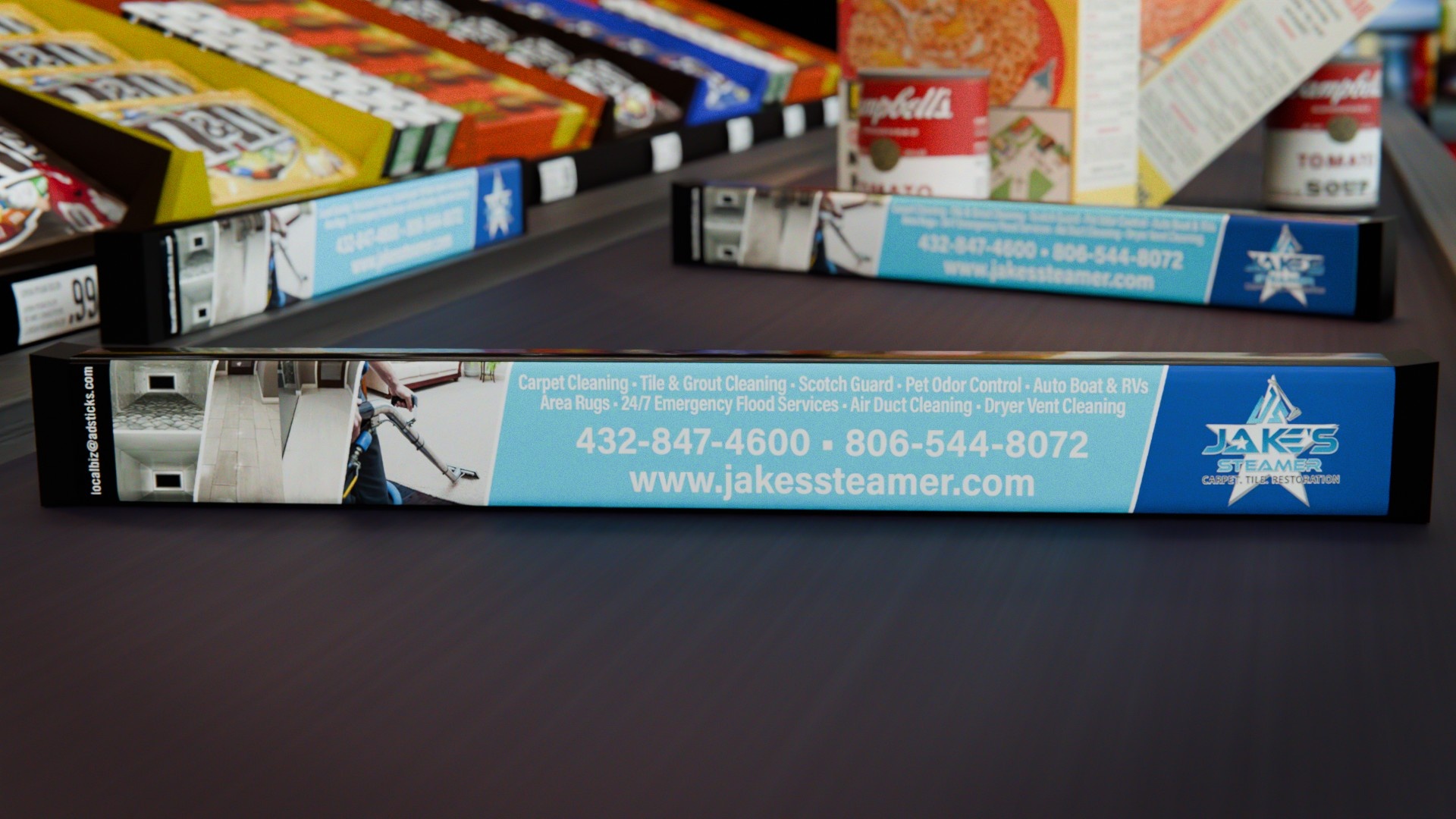
The business remains recognizable in that photograph. A local company’s name occupies an object that people already use. The campaign asks for a brief encounter in an ordinary setting. Rosenthal has spent decades finding commercial uses for those encounters, while his organizational work has given people other reasons to meet.
His career can be followed through acquisitions, company names and board appointments. It can also be followed through smaller things: an available domain, a box for donated shoes, a name on a cart. At the checkout, the advertisement has only a few inches to make its introduction. Rosenthal’s working life shows how much business can begin in that amount of space.