The rental problem followed Jason Okra out of college. It had already occupied part of his education: a housing search, a classroom assignment, a website built with fellow University of Michigan students. Years later, after running a property management business and working on products at WeWork, he returned to Y Combinator to build Wayline. The familiar nuisance had acquired a new interface. This time, it could answer the phone.
There is something pleasingly literal about his career. Renting produces a succession of questions: Where can I live? How do I apply? Who handles the repair? Okra’s companies have moved along that succession, from helping people locate a home to working on the machinery that keeps it usable. Viewed that way, Wayline belongs to a story that began well before conversational AI became a startup category.
A classroom assignment with an actual address
In Michigan-era accounts, he appears as Jason Okrasinski, a business student working alongside Tim Jones and Evan Dancer. The housing project had its beginnings in a marketing and entrepreneurship class. Their own search for off-campus accommodation supplied the material. Scattered property websites and the need to walk around looking for possibilities made the assignment rather less hypothetical than the usual classroom venture.
The first site, a2cribs.com, launched in November 2012. It became cribspot.com in March 2013, initially concentrating on sublets before expanding to full-year rentals. Okrasinski graduated from Michigan Ross with a BBA in 2013. The founders had a product that could continue beyond the semester, and a reason to spend their time on it.
Cribspot’s early ambition was deliberately narrow. In 2014, Okrasinski described a focus on off-campus housing in college towns. The company was working through Bizdom in Detroit and had reached campuses including Iowa, Michigan State and Wisconsin-Madison. A map could gather information that had previously required a scavenger hunt. It was a useful improvement to a process with an unreasonable appetite for shoe leather.
The search ends. The work begins.
The startup entered Y Combinator’s Winter 2015 batch. Michigan also supplied a network and practical support: Cribspot had taken second place in the Accelerate Michigan Innovation Competition, winning $100,000. By June 2015, Okrasinski described a seven-person team and a presence at 175 campuses. The business had offices in Ann Arbor and Detroit, and a recent $50,000 investment from the Michigan Pre-Seed Fund 2.0.
Those milestones explain how a student project gained room to grow. They also show that the story had several local institutions behind it before its later San Francisco chapter. A founder’s résumé tends to give accelerators tidy initials. The actual company still needs somewhere to work, people to hire and money to keep the operation going.
The founding team’s advice to other college entrepreneurs was correspondingly practical. They described four people sharing a 500-square-foot apartment for under $1,000 a month. Their early purchases included pens and stickers, expenses they later regarded as misplaced. They urged students to launch quickly, choose a focused market and keep the team small. The souvenirs of startup life, it seems, were easier to purchase than startup life itself.
Finding a rental, however, left plenty unresolved. Cribspot’s move into property management in 2015 extended its responsibility past the listing. Poor photographs, resistance to online leasing and awkward experiences after move-in were still part of the renter’s journey. The company began taking on the underlying service rather than leaving the customer at the landlord’s door.
That decision widened the problem considerably. A search business can help someone discover an address. A management business must keep answering for what happens there. The recurring work made the company responsible for the experience it had initially helped people find.
Student housing project
Search becomes operations
A property management business
Voice and text for operators
By 2017, Michigan’s engineering alumni coverage described Cribspot working with roughly 850 clients and opening offices in East Lansing and Columbus. Virtual tours, online leases and a tenant communication app were part of its approach. The app already incorporated AI to field questions and provide automated responses when possible. Software answering renters was on the agenda years before Wayline.
Michigan Ross’s account that year put Cribspot’s investment total at $2.9 million. It described tools that helped maintenance workers examine properties remotely and understand complaints. That is a telling detail: the value of the software was beginning to lie in what happened after somebody selected a listing. The map had led the founders into a much larger set of responsibilities.
A business on the other side of the phone
In 2018, the Cribspot team joined Apartment List. Okra also founded Baker Street, a property management business that he bootstrapped to $1 million in annual recurring revenue, according to his founder biography. He had gone from trying to help renters navigate an industry to building an operating business within it.
Baker Street supplies a concrete counterpart to the software story. Its team includes people responsible for maintenance and inspections, accounting, leasing, marketing and support. Each title represents work that someone has to finish. A tenant’s message may look like one item in an inbox; resolving it can involve several roles and a physical visit.
Today, Baker Street lists Okra on its advisory team and Andrea Roe as CEO, responsible for day-to-day operations. His relationship with the business continues, while its operating leadership has a name of its own. That distinction helps explain the experience behind Wayline without turning every subsequent Baker Street achievement into his personal accomplishment.
The operator’s perspective is central to his account of starting the new company. He describes learning how labor-intensive property management can be, with staff turnover, thin margins and disconnected workflows. He also credits better systems and renter-facing software with making Baker Street more efficient. These are lessons from a business he had to run, carried into a product he now wants others to use.
“Starting Wayline was a really personal decision for me.”
Jason Okra
The scale changes; the coordination remains
Okra joined WeLive in 2019, working on flexible housing within WeWork. His later work included the technology rollout for All-Access and On-Demand, products that let customers use workspace through membership and booking. He reports that those product lines grew from roughly zero to $110 million in annual revenue by 2022. That is a figure for the business, rather than a measure of his individual earnings.
The settings changed from student accommodation to coliving and commercial space. Yet the sequence of responsibilities has a recognizable continuity: a person wants access to a place, and an organization must coordinate the experience. That reading of his career helps connect jobs which otherwise appear as separate lines beneath different company names.
Product work at Jupe and Webflow followed. Okra describes work involving hardware operating systems, connected-device automations and AI content generation. The combination took him through hospitality hardware as well as software creation. It added different technical settings to a career already grounded in the practical operation of spaces.
Two pitches beside the same problem
His partnership with Eric Rowell had a prehistory. Rowell says Okra was an early user and angel investor in Uiflow, the enterprise software company he co-founded. They had known one another for several years when each began considering a new company. They exchanged pitches, and chose Okra’s property management idea.
It is an unusually economical founding anecdote. Two people with previous businesses behind them arrive with ideas; one makes the more persuasive case. Rowell’s account credits the idea directly, without disguising the fact that he had brought a different one. The new partnership grew from a relationship that had already involved using a product and backing its maker.
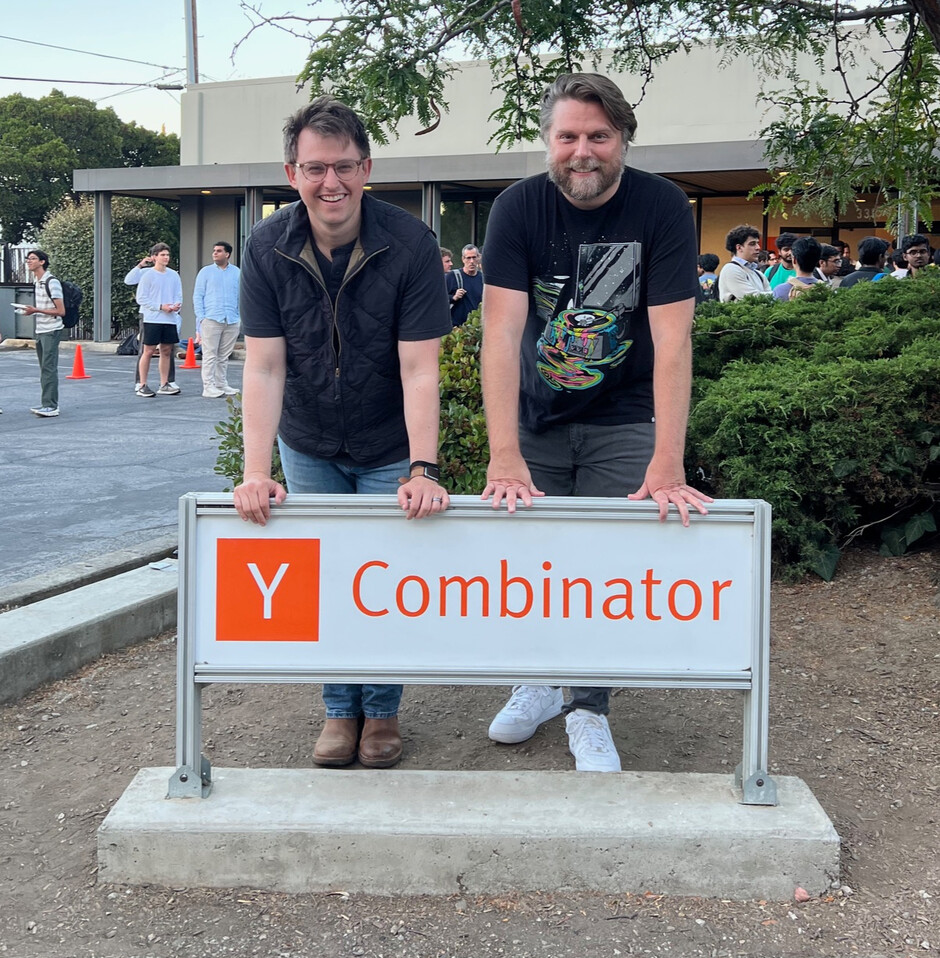
Rowell became Wayline’s CTO. His background includes Uiflow, Second, LinkedIn and Workday; Wayline is his third YC company. Okra brings the real estate operating history. Together they entered the Summer 2025 batch. In his announcement, Okra reported thousands of units under management after six weeks, a snapshot of the early business rather than a current portfolio count.
The building gets a voice
Wayline puts calls and text messages at the entrance to the service. Its launch proposition covers leasing inquiries, maintenance coordination and tenant support, with a knowledge base specific to the property. The ordinary action of contacting a building becomes the interface. Behind the conversation sit records, scheduling and follow-up.
In the company’s demonstration, a caller asks about a backed-up toilet, a renewal lease and a larger apartment. The assistant describes creating a work order, contacting a technician, sending a lease and offering a tour link. It is a demonstration, with the neatness demonstrations tend to enjoy. It also gives the product a concrete brief: handle several connected requests without asking the renter to navigate several separate systems.
Illustration of the company’s stated workflow, not a performance measurement.
The current company website describes AI backed by people and places communication alongside telephony, scheduling, a shared inbox and automation. That wider picture matters to the founder’s trajectory. His earlier companies taught him to follow the housing experience beyond discovery. Wayline brings that same interest to the movement of requests through an operation.
A return with more experience
There are ten years between Cribspot’s first YC batch and Wayline’s. The interval contains a property management business, housing and workspace products, and a working relationship that became a founding partnership. Okra’s return carries those specific experiences with it.
The student project began with the difficulty of getting useful information about a home. His current company asks what happens when the home’s operator can respond through a conversation. The distance between those two questions is the distance his career has traveled. A place to live comes with an address, a lease and, sooner or later, something that needs attention. He is still working on the attention.