A few weeks before Labour Day, Toronto begins speaking a familiar language. The vocabulary includes midway lights, food experiments, concerts, livestock, games and the Canadian International Air Show overhead. For some people, the Canadian National Exhibition is an outing. For others, it is a calendar marker: the loud, bright punctuation at the end of summer. Jane Matthews works inside that accumulation of feeling.
Matthews is the Chief Marketing Officer of the Canadian National Exhibition, the annual fair better known as the CNE or simply the Ex. Her assignment sounds straightforward until you look at the product. The CNE is not one product. It is rides and retail, agriculture and live music, exhibitions and food, family programming and public spectacle. It is also an institution founded in 1879, carrying more than a century of other people's memories into each new season.
That gives its marketer a peculiar burden. A new event has to explain what it is. The CNE has to explain why something so familiar is worth seeing again. Awareness is abundant. Relevance must be renewed.
The product is a feeling with a program attached
Matthews' public comments suggest where she locates the useful centre of this sprawling offer: connection. Discussing the 2025 edition of the fair, she described the recurring “Summer With Us” campaign as being aimed at building community connectivity while honouring visitor traditions. The phrase is almost a compact strategy document. Community is the present tense. Tradition is the accumulated past. “With us” turns a ticketed event into an invitation to belong.
This matters because the CNE's component parts do not naturally fit into one neat category. A roller coaster is not an agricultural career program. A heritage display is not a concert. A food vendor is not an air show. Yet visitors can accept all of them inside the same day because the fair's real unit is not the attraction. It is the shared excursion.
“We always go”
“This one is ours”
“What's new?”
The practical trick is to let novelty refresh the ritual without mocking it. Every season needs news, but the news lands because the setting is recognizable. This is why a campaign can foreground something new while still borrowing emotional weight from the Princes' Gates, the Midway and the annual family trip. The place supplies continuity. Programming supplies motion.
Put the visitor inside the story
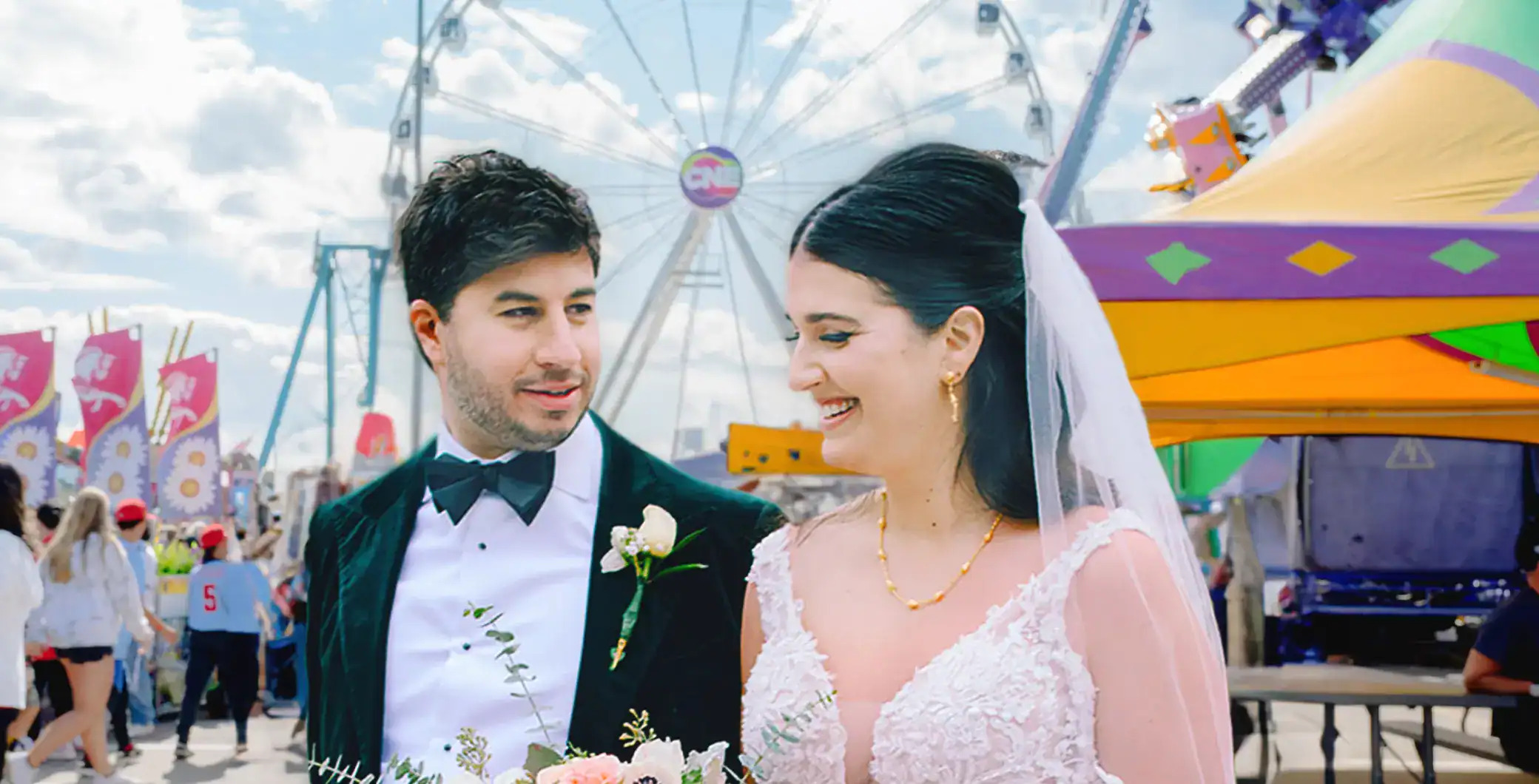
The 2025 Marriage on the Midway contest made that principle literal. Ontario couples were invited to submit a love story or describe their special connection to the fair. One selected couple would receive a symbolic vow ceremony below the SuperWheel, with a photographer, a locally made cake, unlimited rides, food vouchers and reserved seats for a concert by 98 Degrees.
On paper, it was a bundle of sponsor-friendly event elements. The part that gave it life was the premise Matthews articulated. The CNE, she said, regularly hears from visitors who had their first date there, met a partner during a summer job, or knew vendors whose relationships began at the fair and lasted more than 50 years. The campaign did not manufacture a romantic association. It noticed an existing one and handed it a stage.
“We've had wedding proposals at the CNE, so this year we thought, why not a wedding ceremony?!”Jane Matthews, CNE Marketing Director, 2025
There is a lesson in that cheerful escalation. The audience already carries a reservoir of stories. Rather than speaking over those stories, the institution can build a format that lets one of them become visible. A couple supplies the meaning; the fair supplies the scenery. The result feels specific to the CNE because it could not be moved to a generic conference room without losing the point.
This is also an operator's view of marketing. The idea is not confined to an advertisement. It touches programming, partnerships, food, entertainment, photography and the physical grounds. The promise has to survive contact with the actual day. A good activation becomes an experience before it becomes a social post.
A fair still has roots beneath the rides
The CNE's entertainment scale can obscure the second half of its name. It remains an exhibition with agricultural roots, and Matthews' recent public activity gives that part of the brief room. In 2026, she highlighted a Career Connect Day created with AgScape for Toronto District School Board students. The program invited young people to explore careers in agriculture and to connect with the sector's place in their lives.
Her short response distributed credit widely: the partner, the CNE Association team, the presenters and the participating students. It echoed the mechanics of a fair itself. Large public events are coordination machines. Visitors see a coherent day; behind it sits a network of exhibitors, operators, educators, performers, vendors and colleagues. Marketing at that scale is partly the work of making many contributions sound like one public promise.
Matthews holds a second vantage point on that network. The Canadian Association of Fairs and Exhibitions lists her as a director representing the CNE Association. CAFE describes a national sector whose members create gatherings, exhibitions and agricultural events across the country. Her board role places the Toronto fair within a wider community of organizations wrestling with the same durable questions: how to serve a place, how to bring generations together and how to keep a recurring gathering from becoming a museum piece.
Tradition is not a static asset. At a public event, it is a behaviour people choose to repeat.
Recognition, redirected
In 2018, Matthews received the Event Staff Canada / AuthentiGate Future Leaders Award at a CAFE gathering. Her public note about it is revealing less for the honour than for how quickly she redirected attention. She thanked the association, then-CNE chief executive Virginia Ludy and several colleagues by name. She wrote that she was “eternally grateful” to work for an innovative and collaborative organization.
Years later, the title beside her name has moved upward. Her professional profile identifies her as the CNE's Chief Marketing Officer, while current industry listings describe a marketing and communications remit. Yet her public language still tends toward the collective: partners, teams, presenters, students and visitors. That is appropriate for a job where the visible product is a crowd choosing to gather.
It would be easy to treat nostalgia as the entire CNE strategy. Nostalgia is powerful, but on its own it is a shrinking resource. It serves people who already possess the memory. Matthews' more interesting work uses memory as an entrance, then creates a role for the next visitor: submit your story, bring your class, meet us there, spend summer with us.
The value of a ritual that can still surprise you
The CNE's annual return creates a useful constraint. It cannot become unrecognizable, because recognition is part of what people buy. It cannot remain unchanged, because repetition without discovery turns an outing into an obligation. Somewhere between those poles is the marketing task: preserve the emotional architecture while moving the furniture.
Matthews' campaigns show a preference for ideas that join program and story. “Summer With Us” is broad enough to hold the fair's range, but personal enough to imply company. Marriage on the Midway converts recollection into ceremony. Career Connect Day uses the exhibition's agricultural inheritance to point students toward future work. Each idea travels across time: what this place was, what people already remember and what someone might do here next.
For marketers outside the fair business, that pattern is worth borrowing. An established brand does not need to choose between heritage and relevance. It needs to find the action that joins them. Ask what people already do with the institution. Identify the stories they tell without prompting. Then create a program that lets those habits move forward rather than merely placing them in an anniversary montage.
A fair makes this logic unusually visible. The lights go on, the gates open, and an abstract promise becomes physical. People arrive with children, friends, dates and appetites. They repeat a route or invent one. They take a picture beneath the same wheel that appears in thousands of other pictures, and it becomes theirs anyway.
The seasonal rhythm also changes what success looks like. A fair cannot quietly revise the experience every Tuesday. Months of planning resolve into a short public window, where weather, crowds and the unpredictable chemistry of live events all take over. The campaign must create enough expectation to move people toward the gates, yet leave enough space for discovery once they arrive. That makes restraint valuable. An invitation can establish the emotional frame without pretending to summarize every possible day.
It also explains why Matthews' language returns to “us.” The word does not specify an age, neighbourhood or preferred attraction. It can hold the teenager arriving for rides, the family studying an agricultural display, the longtime visitor following a familiar food route and the couple willing to put their vows beneath a Ferris wheel. For a program this broad, coherence does not come from sameness. It comes from a common posture: show up, look around and take part.
That is the asset Matthews is marketing. Not just a schedule of attractions, and not simply the warm blur of what happened before. The CNE is a machine for producing shared memories at public scale. Its chief marketer's job is to keep the machine recognizable, useful and open to another story.