A good marketing career can be read in job titles. A more revealing one can be read in the questions a person has learned to answer. In August 2010, James O’Connell-Cooper appeared on New Zealand public radio representing Mojo Coffee. The segment addressed two domestic mysteries: whether one brand of dried pasta was meaningfully different from another, and why a coffee made with soy milk cost more. It was hardly the Davos stage. It was better training. A real customer had spotted a small friction, and somebody had to explain the machinery behind the price without draining the pleasure from the cup.
Sixteen years later, O’Connell-Cooper is Chief Marketing Officer at PatientNow, a software company serving more than 5,000 aesthetics and wellness locations. The vocabulary has changed. There are workflows, retention programs, scheduling, payments, photography tools and marketing automation. The underlying assignment is familiar: translate a system most people never want to study into a benefit they can immediately understand.
This is the work behind the work. It is the till beneath the café, the ledger behind the small business, the billing system inside the law firm and the calendar that keeps a busy practice from becoming a thicket of tabs. O’Connell-Cooper has spent his career close to these unphotogenic mechanisms. His particular trade is making them visible without mistaking visibility for noise.
The counter was a classroom
O’Connell-Cooper is from New Zealand, where Mojo began before growing into a recognizable coffee business. Hospitality is a stern tutor of customer experience because the feedback loop is measured in seconds. The queue is visible. The complaint is audible. A regular either returns or does not. There is no quarterly slide deck between the promise and the verdict.
His later résumé ranges far beyond cafés, across direct-to-consumer, retail, wholesale, manufacturing and software. Yet the hospitality instinct remains legible. In his writing about business systems, the technology usually takes second place to what it gives back: a cleaner handoff, less juggling, a timely follow-up, more attention for the person in front of you. The feature list matters, but only after it has been translated into a day that runs better.
The route would eventually carry him through New Zealand, Australia, Japan, Canada and the United States. Geography matters here because software language rarely travels untouched. Small businesses may share frustrations, but metaphors, trust and buying habits keep their local accents. Leading marketing on both sides of the Pacific asks for something subtler than translation. It asks which parts of the story are universal and which need to be rebuilt on arrival.
That variety also explains why his career resists a neat industry label. Coffee shops, accountants, law firms and aesthetics practices look unrelated from the street. From the operator’s desk, each is a choreography of appointments, payments, records, follow-ups and reputation. The software differs; the wish is remarkably stable. People want the machinery to recede so they can do the work for which customers know them. A marketer who understands that desire can change categories without treating every move as a reinvention.
Making an elephant out of receipts
At Xero, O’Connell-Cooper found a company with an unusually cheerful proposition: accounting software could be beautiful. By 2016 he was credited as direct marketing manager on Xerogami, an Australian campaign that took the clutter of paper accounting literally. Receipts and invoices were folded into paper sculptures, including the financial elephant sitting in the room. Online video, radio and outdoor advertising carried the idea.
It is an economical bit of communication. A receipt is proof of a transaction and, in sufficient quantity, evidence of an administrative nuisance. Fold it into an animal and the nuisance becomes a picture. The cloud product itself can remain offstage while the relief it offers becomes tangible. Marketing technology is often tempted to add abstraction to abstraction. Xerogami went in the other direction and reached for scissors, folds and a familiar idiom.
“Data should serve as the lighthouse.”James O’Connell-Cooper on modern marketing
O’Connell-Cooper’s description of data as a lighthouse offers another concrete object for an abstract problem. He has argued that customer conversations matter but are difficult to gather at scale; large datasets reveal patterns, while anecdotes supply a point of view. A capable marketer combines what the numbers say with what the customer says. The metaphor is disciplined. A lighthouse provides a signal, not a destination. It can keep a ship from the rocks, but it does not choose the voyage.
During O’Connell-Cooper’s years at Xero, the company grew from 100,000 subscribers to 3.2 million, became the Australian market leader and widened its North American footprint. Those are company results, not a solo achievement, and the distinction matters. Marketing leadership in a scaling company is orchestral work. O’Connell-Cooper led teams in Australia and the Americas, and appeared at Xerocon Atlanta in 2018 as marketing director. His public credits show someone operating where local campaigns meet a global story.
A side door called Okay, Charlie
Alongside the corporate ascent sits a quieter strand. O’Connell-Cooper co-founded Okay, Charlie, a product and brand marketing agency working with experience-led businesses and emphasizing customer experience and insight. The name has the casual rhythm of a conversation rather than a consultancy, which feels appropriate. Agencies can test an operator’s convictions: the method has to work beyond a single logo, budget or category.
That breadth became useful when he moved from accounting technology to software for legal and accounting firms. In January 2023, AbacusNext appointed him senior vice president of marketing, with responsibility for marketing and partnerships. The portfolio included practice management, document automation and payments. It was another set of invisible tools with visible consequences, sold to professionals whose time is both scarce and billable.
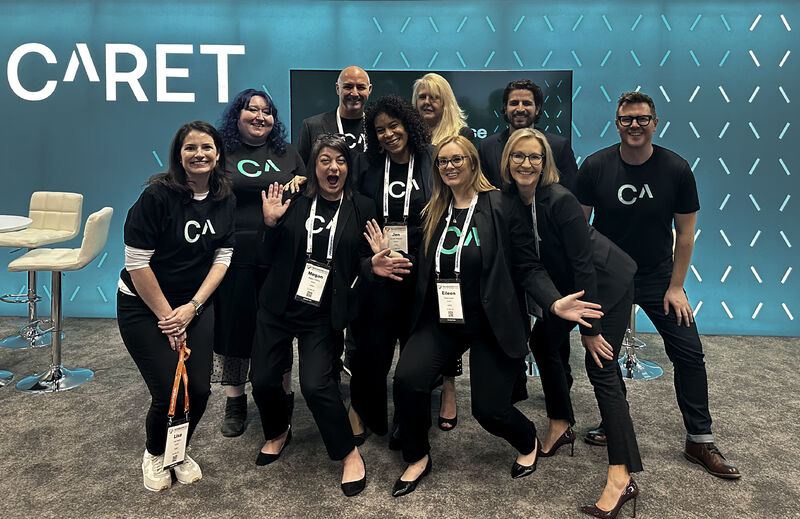
At ABA TECHSHOW in 2023, he appeared in a team photograph at the CARET booth, standing slightly apart at the far right with one hand in a pocket and the other behind a colleague. It is a pleasant corrective to the lone-genius version of executive life. Software gets sold, supported and explained by clusters of people in matching shirts, under conference lights, after someone has located the missing lanyard.
The following year he contributed to a Legalweek installment of the Reinventing Professionals podcast. The episode was a six-minute mixtape of voices from the show floor. Brief by design, it put executives into the hum of their market. O’Connell-Cooper’s CARET chapter connected him with Keri Gohman, then the company’s chief executive. That professional connection would continue into PatientNow.
Growth, with a human-sized unit
O’Connell-Cooper became PatientNow’s Chief Marketing Officer in 2025. The company’s audience includes med spas, plastic-surgery practices and wellness businesses, but its marketing challenge resembles his earlier ones. An integrated platform promises to replace an untidy collection of operational tools. The marketer must show how consolidation feels on Tuesday afternoon, when calls need returning, schedules have shifted and somebody is searching for the right record.
In a July 2025 post recruiting a Head of Marketing, he described PatientNow as supporting thousands of practices with workflows, retention and revenue growth. He wanted someone ready to build programs across the full funnel, shape strategy and move quickly with a team. The language was unabashedly growth-minded. It also made the work sound constructed rather than inherited: programs to build, a team to lead, a next chapter that required an author.
In early 2026, PatientNow unveiled a refreshed identity built around the phrase “Designed for Beauty. Built for Growth.” Chief executive Keri Gohman credited O’Connell-Cooper among the group that did the heavy lifting. The message divides the job neatly. Beauty speaks to the businesses PatientNow serves. Growth names the result the software is hired to produce. Between them sits the operational detail: fewer disconnected tools, clearer workflows and more time for the work customers actually came to do.
The number points. The customer explains. The marketer has to listen to both.
There is a modest lesson in O’Connell-Cooper’s path. Industry expertise can be valuable, but a durable method travels farther. He has moved from a coffee company to accounting SaaS, then legal technology and practice-management software without pretending those categories are identical. What travels is the habit of looking for the customer’s friction, finding the concrete image and checking the story against evidence.
The price of soy milk, the origami receipt, the crowded conference booth and the software dashboard all belong to the same education. Marketing begins where a system touches a person. O’Connell-Cooper’s career has simply kept changing the system.