Marketing Windows in the age of AI
Woodinville is wine country. Twenty miles northeast of Microsoft's Redmond campus, tucked between the Cascades and the suburbs, it is where James Howell lives - and where the VP of Windows Marketing presumably goes home after a day of figuring out how to explain to a billion people why they need an AI chip in their laptop.
The job has always been unusual. Windows is ubiquitous by definition. You do not discover Windows; it is simply there. Marketing something that everyone already has requires a different muscle than launching a new product. You are not creating desire from nothing - you are reshaping what people think they already know. Howell has been doing exactly that at Microsoft for years, and in the Copilot+ PC era, the stakes got considerably higher.
When Microsoft unveiled the Copilot+ PC category in 2024, it was a genuine bet on the future of personal computing. The idea: a new tier of Windows machines with dedicated neural processing units (NPUs) capable of running AI workloads locally, on-device, without sending every request to a cloud server. The pitch was part hardware story, part privacy story, part performance story. Howell's team had to stitch all three together into something that a mainstream buyer at Best Buy would actually care about.
The fastest adoption he'd ever seen
Howell has not been shy about his view of how the launch went. In a conversation with Engadget published in December 2025, he was characteristically direct: "This is the fastest adoption I've seen of a new category of hardware, and we've done it faster than the normal generational shift of silicon."
"This is the fastest adoption I've seen of a new category of hardware, and we've done it faster than the normal generational shift of silicon."
- James Howell, VP Windows Marketing, Microsoft • Engadget, December 2025The quote is worth sitting with. Not because it is wrong - Microsoft's figures on Windows business growth in late 2025 did trend positive - but because of what it reveals about the marketing challenge itself. Howell is a man who measures hardware adoption in terms of category creation speed, not just unit volumes. That framing matters: the Copilot+ PC was never meant to replace every laptop immediately. It was meant to define the category that all laptops would eventually become.
That is a long game. And Howell is playing it.
The evangelist's dilemma
Every new platform needs an evangelist who believes the vision before the evidence fully arrives. Howell occupies that role for Windows AI. "Copilot+ PCs continue to be a transition that we are pushing for and prioritizing," he told Engadget - careful, measured language that nonetheless signals genuine conviction.
The numbers from third-party analysts told a more complicated story. Copilot+ systems were less than 10 percent of Windows shipments in Q3 2024 and around 2.3 percent of Windows machines sold in Q1 2025. That gap between Howell's optimism and the IDC data is not hypocrisy; it is the structural condition of anyone trying to move a market. You have to say the future is here before it technically is. The pitch precedes the reality.
Microsoft eventually shifted strategy - pivoting from a premium Copilot+ story to a broader "every Windows 11 PC becomes an AI PC" message. Howell's team leaned into cloud-powered AI features available on existing hardware, democratizing the pitch without abandoning the premium tier. It was a deft adjustment - the kind of mid-race pivot that requires both strategic flexibility and message discipline.
From Provo to Redmond
Howell studied at Brigham Young University in Provo, Utah - an institution known for producing unusually disciplined graduates who are good at working within systems while pushing them forward. He earned his Bachelor of Science there, graduating in 2005, before making the journey northwest to the Pacific Northwest tech corridor.
BYU's business culture - structured, analytical, long-horizon thinking - maps naturally onto the cadence of Microsoft's marketing organization. Product marketing at a company like Microsoft is not about viral moments; it is about maintaining narrative coherence across multiple product cycles, OEM relationships, retail partners, and enterprise sales motions simultaneously. Howell's career arc at Microsoft reflects that kind of sustained, methodical climb.
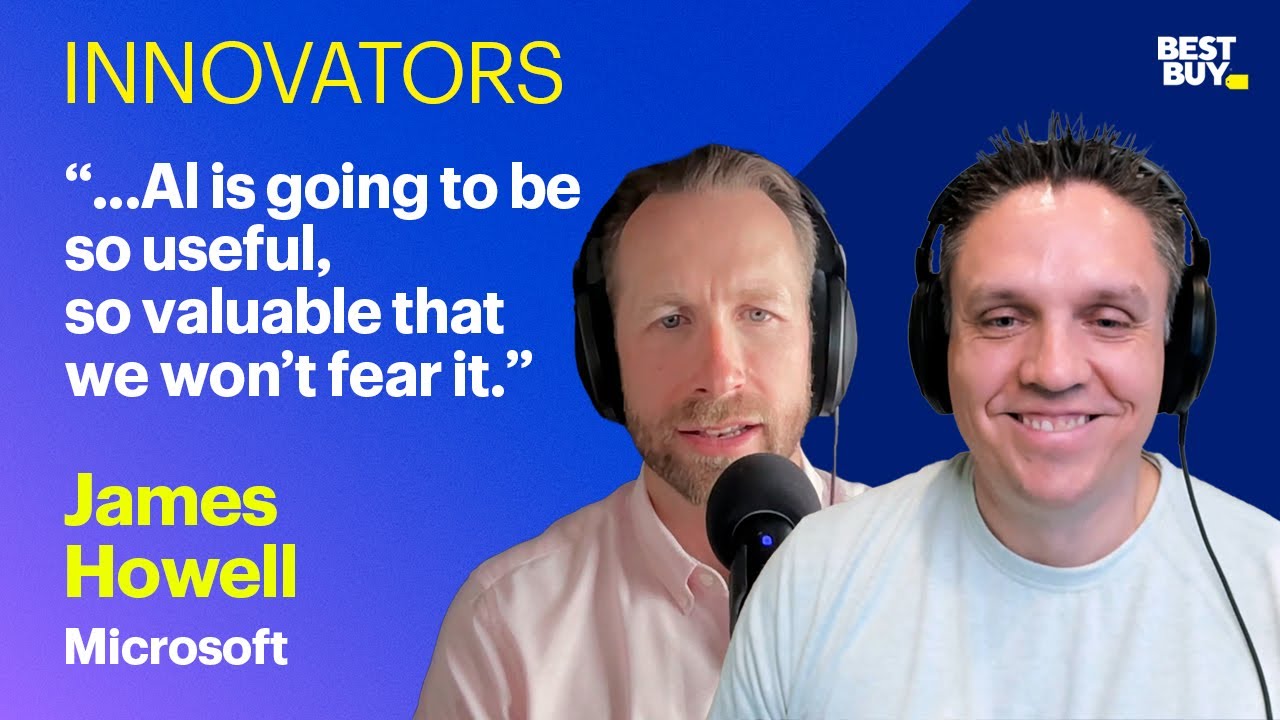
By 2024, he was appearing in Best Buy's "Innovators" video series - a retail-facing YouTube production hosted by Bradley Hasemeyer - explaining to mainstream audiences what AI could actually do on their PC. The choice of venue was deliberate. Best Buy is where mainstream Windows happens: not at enterprise IT conferences, not at developer summits, but on a Saturday afternoon when someone needs a new laptop. Reaching that audience required Howell to translate a technically dense hardware story into something a casual buyer could grasp in two minutes.
Marketing the invisible
The hardest thing about Howell's job is that the core technology - an NPU running AI inference locally - is invisible. You cannot hold it. You cannot see it. The feature it enables, at launch, was primarily Recall: a Windows capability that creates a searchable timeline of everything you've done on your PC. Useful, in concept. Complicated, in practice. Privacy-sensitive enough that Microsoft delayed its rollout multiple times before shipping it.
Marketing Copilot+ PCs required selling not the current features but the trajectory. Howell essentially asked consumers to buy a platform rather than a product: trust that the NPU you're paying a premium for today will be worth it when the software ecosystem fills in around it. It is a sophisticated ask. Most people who are in the market for a laptop are thinking about price, screen size, and battery life - not silicon roadmaps.
The fact that Howell kept his conviction public through 2025 - continuing to characterize the Copilot+ transition as a priority, declining to sound the retreat - suggests a willingness to stay attached to a long-term narrative even when quarterly data creates noise around it. That is either discipline or stubbornness. Often the two are the same thing.
The man behind the message
Howell lives in Woodinville, Washington - a detail that tells you something. Woodinville is not a tech-industry status address. It is suburban, practical, occasionally prone to traffic on Highway 202. People who live there choose it for the schools, the space, the relative quiet. Howell's professional footprint is almost entirely directed outward - toward the audience he needs to reach - rather than toward the internal visibility that drives many careers at large technology companies.
His LinkedIn profile sits at over 500 connections. His public presence is almost entirely in trade press and product launches rather than in the pundit ecosystem. He is not a conference-circuit figure who gets profiled for his opinions on the future of work. He is, instead, someone who works for a living - executing one of the most complex ongoing marketing challenges in the technology industry.
Windows 11 ships on machines from Dell, HP, Lenovo, ASUS, Samsung, and dozens of other OEMs. Each one has its own marketing priorities. Each one tells the Windows story slightly differently. Howell's job is to provide a coherent narrative underneath all of that, one that makes sense whether you're buying a $400 entry-level laptop or a $2,000 Copilot+ Surface Pro. That coordination problem is enormous. The fact that the Copilot+ message landed as consistently as it did across the industry in 2024 reflects the discipline of the team he leads.
What comes next
By February 2026, Microsoft's messaging had crystallized: this was going to be the year AI PCs broke through. Third-party researchers agreed directionally - Omdia projected that AI PCs would represent 55 percent of total PC shipments in 2026, rising to 75 percent by 2029. The market was moving, if on a longer timeline than the most bullish projections had suggested.
Howell's task remains what it has been since the Copilot+ launch: maintain the narrative, educate the mainstream market, and keep OEM partners aligned around a shared story about what Windows means in an AI world. It is quieter work than a product launch, and less legible from the outside. But it is the work that determines whether a platform bet becomes a category - or just a footnote in a 10-K.
He said it plainly in December 2025: "Just for the last two or three months, we've been doing pretty well with year-on-year growth in the Windows business." Not a boast. Not a retreat. A measured update from someone who has decided that this transition is real, that his team is on the right side of it, and that the work is still in progress.
In Woodinville, the harvest comes in October. You plant in spring, tend through summer, and wait. Some years are better than others. But the vines keep growing.