Jack Azagury’s first consulting career plan had a modest time horizon: two or three years. Join, learn, move on. He arrived at Andersen Consulting in London in 1996 with the possibility of returning to industry or becoming an entrepreneur. Twenty-nine years later, he finally left. A temporary educational arrangement had acquired the dimensions of a working life.
In April 2026, he became president and chief executive officer of Insight Enterprises. By August, he was discussing another three-year plan, this time for a global technology business. The symmetry is pleasing. The stakes have changed considerably. A career detour can be extended by personal choice; a public company’s operating plan comes with rather more interested spectators.
His assignment has a particular tension. For years, Azagury helped executives think about how technology could change their companies. Now he leads a company that must change itself while helping its customers do the same. Every promise about simpler processes, better skills and measurable results has an internal audience as well as an external one.
Two degrees, and an extended stay
Azagury’s preparation straddled two disciplines: a master’s degree in software engineering from Imperial College London and an MBA from INSEAD. Before consulting, he worked in software, including strategy and business development. His international experience eventually encompassed the United Kingdom, France, Japan and the United States. The combination gave him reasons to ask both whether a system could work and whether a business should pay for it.
He became a managing director at Accenture in 2003. His later responsibilities moved through industry practices and regional leadership before reaching the global consulting business. That progression matters because it supplied different kinds of accountability. An industry practice must understand its customers’ economics. A regional operation must bring people and services together. Global leadership adds the problem of doing both across borders.
When he announced his departure in 2025, Azagury thanked Julie Sweet for more than a decade of mentorship and leadership. He also recalled watching the organization expand from fewer than 40,000 colleagues to almost 800,000. The numbers convey the scale of the institution in which he learned to operate, and the amount of change he had watched from inside.
There is a human detail in that farewell: alongside large profit-and-loss responsibilities and complex client programs, he mentioned lifelong friendships. An executive biography usually preserves the promotions and discards the reasons someone might have enjoyed staying. His own account left room for both.
- 1996Joins consulting
in London - 2003Becomes managing
director - 2022Leads global
Strategy & Consulting - 2026Takes charge
of Insight
The electricity before the artificial intelligence
Before AI became the center of his public agenda, electricity occupied a considerable part of it. Azagury led Accenture’s Smart Grid Services business globally and its Resources business in North America. The latter covered energy, utilities, chemicals, forest products, metals and mining. These are industries where technology has to live alongside physical assets, established processes and investment decisions with long consequences.
His work included digital transformations, operational improvement, energy transition and transactions. He spoke and wrote about renewable energy and the move toward a distributed, digitally enabled grid. That earlier chapter provides useful context for the current one: he had been considering how digital systems interact with existing infrastructure long before the latest race to deploy AI.
In June 2022, Accenture appointed him group chief executive of Strategy & Consulting, a service then described as a $15 billion business. The appointment followed his leadership of the U.S. Northeast market unit. His remit now included industry expertise, enterprise functions, applied intelligence, innovation and corporate strategy. The technical questions had become inseparable from organizational ones.
Talking with Fortune’s Alan Murray in Davos, he argued that technology knowledge needed to extend from the executive suite through the organization. Employees needed enough understanding to recognize opportunities and use new tools. This is a demanding proposition for leaders: buying access is relatively straightforward; building shared understanding takes time, attention and repetition.
“Look at talent up front.”
Jack Azagury, on enterprise reinvention
A whiteboard full of sad faces
At the World Economic Forum’s April 2024 meeting in Riyadh, Azagury offered an unusually accessible account of identifying AI opportunities. People wrote their daily tasks on a whiteboard, then added a smiling face beside work they enjoyed and a sad face beside work they did not. The unhappy expressions became a guide to where generative AI might help.
It is an appealingly inexpensive diagnostic for a technology associated with expensive computing. Office irritation had become usable information. The exercise also gave employees a part in defining the problem before a solution arrived.
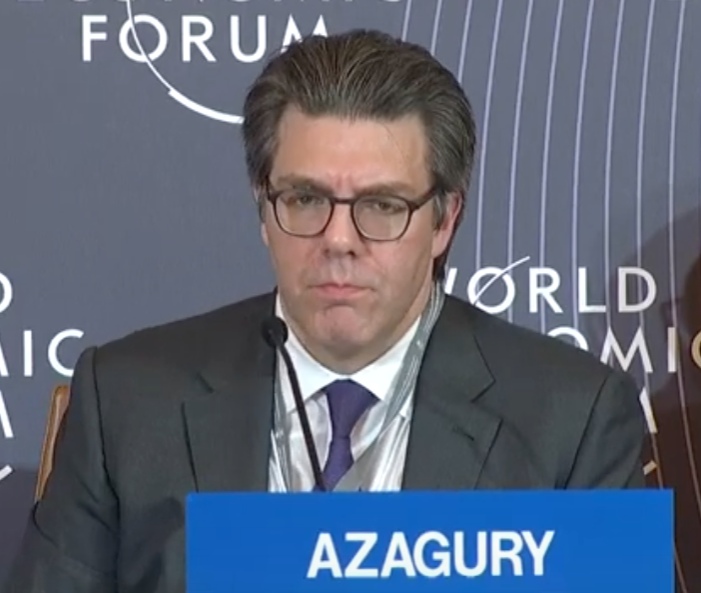

He also urged attention to responsible AI: recognizing bias, understanding where answers come from and spotting errors. The practical and ethical questions sat together. A tool that removes routine work still requires someone able to judge what it produces. That makes education part of deployment from the beginning.
His published thinking gives learning a competitive role. In a 2024 article coauthored with Michael Moore, he described companies competing through their data, technology foundations, rate of learning, redesigned capabilities, partnerships and trust. The list reaches well beyond model selection. It asks how a whole organization acquires an advantage that others cannot obtain simply by subscribing to the same software.
A brief visit to the other side of the boardroom
After Accenture, Azagury joined TowerBrook as a senior advisor in September 2025. The assignment concerned business services portfolio companies and evaluating future opportunities. It also brought the chair of BRG’s board and a seat on CBTS’s board. In October, he was named chair of Eisner Advisory Group, part of the EisnerAmper business.
The move placed him closer to the ownership and governance side of professional services. The problems remained recognizable: growth, people, technology and the organization required to bring them together. The vantage point changed. A board can challenge management’s assumptions and support its decisions; executives must turn the agreed priorities into daily work.
That chapter was short before Insight arrived. It nevertheless adds something to the career beyond another title. He had moved from a large consulting organization into a portfolio of businesses where operating choices and investment decisions meet. In April 2026, a TowerBrook podcast featuring Azagury examined accounting and professional services partnerships, including culture, infrastructure, acquisitions and AI’s effect on service delivery.
His commitments also extend beyond commercial services. Hillel International lists him as a vice chair of its board, based in Phoenix. Earlier civic involvement included the Partnership for New York City. These roles give his interest in future leaders an institutional setting outside the employer-employee relationship.
The adviser gets the operating keys
Insight announced Azagury’s appointment on March 23, 2026, with an April 13 start date. He succeeded Joyce Mullen, who would assist in an advisory capacity. Chairman and cofounder Tim Crown’s brief for the incoming chief centered on accelerating the company’s AI transformation. Insight had already been investing in the area, including its Insight AI offering and the acquisition of business transformation firm Inspire11.
The business he inherited combines hardware, software and services. Insight has more than 14,000 teammates operating in 19 countries, including more than 6,000 consulting and service delivery professionals. Those figures make integration a practical management problem: a customer’s needs must travel across capabilities, teams and geographies without becoming somebody else’s responsibility at each handoff.
Azagury’s first-day message emphasized the company’s entrepreneurial culture and its values of hunger, heart and harmony. Culture had also figured in his explanation for staying at Accenture. Across two employers, his public account of choosing a workplace gives the character of the organization considerable weight.
In July, Insight announced a Microsoft 365 E7 launch-partner agreement and its own enterprise-wide deployment. Using the offering internally would give its teams experience to bring to customers. There is a useful discipline in that arrangement: a technology partner encounters the implementation questions inside its own business before discussing them across a client’s table.
One Insight, several difficult decisions
By August, Azagury had attached an operating agenda to the appointment. His three-year One Insight plan emphasized growth, operational excellence and talent. He identified incomplete integration and inconsistent investment in parts of the organic business as areas requiring attention. A common operating model, more repeatable services and training were among the proposed responses.
He was also keeping acquisitions paused. For an executive with transaction experience, this was a consequential choice about sequence. The businesses already inside Insight would receive attention before another purchase expanded the task. Acquisitions can enlarge a capability; getting the organization to use that capability across its customer base is a separate job.
The second-quarter results supplied an early picture of the business: net sales of $2.4 billion, up 15% from a year earlier, and gross profit of $521.6 million, up 18%. Cloud gross profit rose 39%. These are company results spanning a period in which he had only recently arrived. They establish a starting point for judging the plan, rather than settling its outcome.
Insight’s second quarter, 2026
By September, the changes had a more personal consequence for some employees. Insight confirmed a voluntary separation program for eligible back-office roles in the United States, United Kingdom and Canada. The company said it had designed the program to preserve business continuity. Simplification on an operating diagram becomes a set of choices about people when implemented.
That is where Azagury’s next chapter will be judged. The work joins things that executive presentations can place on separate slides: skills and costs, customer relationships and common processes, technical ambition and the ability to deliver. His original short stay in consulting kept lengthening because the learning continued. At Insight, the three-year horizon asks him to demonstrate what those lessons can produce.
Read, watch, follow
- Jack Azagury at Insight
- Follow Jack on LinkedIn
- Watch: Is Education Ready for AI? - World Economic Forum
- Watch: Azagury on DisrupTV, episode 311
- The Intersection of Business and Technology - interview
- Competitive Advantage in the Age of AI - coauthored essay
- Listen: Partnership in Practice - TowerBrook
- Insight’s second-quarter 2026 results
- The One Insight organic growth plan
- September operating changes