A one-bedroom flat is an awkward place to separate work from life. For Irfan Sharief, it was where the two shared an address. In the early months of iCert Global, the flat served as home and office, with friends and family helping finance the beginning. Before the certification courses, international customers, and awards, there was a small space with rather a lot expected of it.
There was also a reason for being there. Sharief had worked to fund his own education. He knew what it meant to want to study while having to earn the money that made studying possible. His later interest in affordable, accessible learning had a personal history. The customer problem had once been his own.
The fees came before the founder title
Sharief describes an early inclination toward self-reliance. His phrase is physical and plain: “the resolve to live on my own legs.” It gives his origin story a different emphasis from the familiar entrepreneurial appetite for an impressive title. The concern was being able to support himself, and education was part of that effort.
He attended Brindavan College. Working alongside his studies meant encountering the expense of education firsthand, rather than as an item in someone else’s market analysis. After graduating, he worked in the education sector. The experience left him considering alternatives to the conventional college model and the part the internet could play in making knowledge available.
There is a practical tension in that ambition. A person may want another qualification and still need the salary from their existing job. A course can be attractive on paper while proving inconvenient in a calendar. For anyone working through that calculation, the time and arrangement of a lesson matter alongside its content.
That is the useful context for Sharief’s business. His stated aim was to make education affordable and accessible through the internet. It was an ambition concerned with the circumstances of learning: how someone gets into a class, where they can attend, and how study can sit beside work.
“the resolve to live on my own legs”
Irfan Sharief, recalling his early self-reliance
Before founding iCert Global, Sharief worked in sales and management. His career includes a senior sales management position at JBTC from 2007 to 2010, followed by a management role at First Source from 2010 to 2011. The founder title came after experience with the work of reaching customers and managing a business relationship.
A company with a domestic address
I-Cert Global Learning Private Limited was incorporated on 8 April 2013. The company became operational by the middle of that year. Sharief was among its founding directors, and the early enterprise had a small team and financial help from people close to him. The flat provided the office as well as the place to live.
Friends-and-family backing gives the beginning a human scale. The first support came through existing relationships. The premises were equally modest. A home doing double duty as an office may lack the grandeur of a headquarters, but it does make the commute admirably difficult to complain about.
The initial offering concentrated on selected certification courses. Over time, the catalogue widened. Project management, IT service management, quality management, and Agile became part of the business. These are subjects connected to the everyday running of organisations: planning work, managing services, improving processes, and coordinating teams.
Sharief’s own base is Bengaluru. The company identifies Houston as its United States headquarters and serves international markets. Those locations belong to different parts of the same story: the founder’s working base and the company’s reach. The beginning remained a small domestic space; the intended audience extended well beyond it.
Let the learner choose the room
One of Sharief’s clearest positions concerns who chooses how a course is taught. When discussing iCert Global’s approach, he has placed that choice with the customer. Classroom teaching remained available alongside self-paced learning and instructor-led live virtual sessions. Technology widened the arrangements a learner could choose from.
The three formats have different attractions. A classroom offers a shared physical setting with an instructor. Live virtual instruction allows people to join a scheduled lesson online. Self-paced material lets the learner decide when to work through it. Each changes the relationship between the course and the rest of the week.
For Sharief, this choice connects back to access. A lesson delivered online can reach someone who cannot readily travel to a classroom. Self-paced study offers another arrangement for someone whose available time varies. The format is part of what the business sells, because it helps determine whether the person can participate.
THE SAME AMBITION, THREE ARRANGEMENTS
Classroom sessions with an instructor.
Live virtual teaching at a scheduled time.
E-learning material for independent study.
His approach also includes support around the lesson itself. The company’s early account described revision sessions, career counselling, and help with examination applications. A certification course involves preparation, paperwork, and decisions as well as teaching. An examination form is a remarkably effective reminder that ambition occasionally requires administrative assistance.
There is a recognisable consistency here. The founder who had to arrange earning around education later built a business offering different arrangements for learning. His emphasis on affordability, outcomes, and support follows the student beyond the moment of purchase. The relationship has work to do after the course has been sold.
The business serves individual customers and organisations purchasing training. Those are two routes into the same enterprise. One person may be considering a qualification for their own career; a company is arranging learning for its workforce. Sharief has discussed adapting the offering to the customer’s circumstances, rather than assuming everyone arriving at the same course has arrived for the same reason. The course title supplies only part of the brief.
An award, then back to the customer
A photograph of a framed certificate supplies a dated milestone. The Arch of Excellence Award names Irfan Sharief of Icert Global Learning Pvt. Ltd., Bengaluru, in the Education & Training category. It is dated 3 December 2016, at the 81st National Seminar on Individual Achievement and Nation Building in New Delhi.
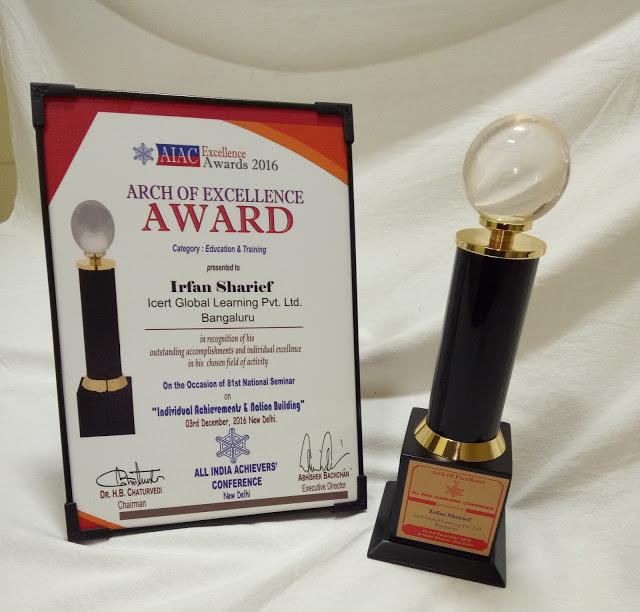
In April 2017, iCert Global announced a Business Leadership Award at the International Achievers Summit. Sharief’s comments on the occasion returned to customer choice, competitive pricing, and the need to keep adapting. The ceremony provided a pause in the company’s story; the work he described was continuous.
He spoke about changing customer expectations and the danger of complacency. His view allowed room for newcomers with ambitions resembling his own. Having entered the market himself, he understood that other founders would do the same. Competition was part of the setting in which the company had to keep earning attention.
His explanation of service extended to the period before a sale. Customers needed confidence in the company’s capabilities before moving forward together. It is a fairly sober thought to bring to an awards occasion. A trophy can be placed on a shelf. A prospective learner still has questions.
The emphasis suits the nature of the offering. Training asks someone to commit time as well as money. Clear explanations and an appropriate learning format are part of that decision. Sharief’s public comments repeatedly bring the discussion back to the person making it, even when the occasion invites talk about the company.
The catalogue keeps moving
Sharief’s public work includes writing on professional learning and career development. His company author page carries articles about automated project workflows, cloud-based business analytics, and cybersecurity. The subjects sit alongside the established certification areas associated with iCert Global, including project management, PRINCE2, ITIL, Lean Six Sigma, Agile, and ethical hacking.
In July 2026, the company’s cybersecurity blog carried further articles under his name. One, dated 20 July, addressed a career path from information systems auditor toward executive roles. Two dated 21 July examined information systems audits and data privacy compliance. The subjects connect technical practice with professional progression, bringing the discussion back to what someone might learn next and how that knowledge relates to their work.
That combination reflects the range of the business he leads. Some learners are looking to formalise experience through a recognised qualification. Others are exploring skills in a changing technical field. A professional training catalogue has to speak to those different intentions while making the offering understandable to the person considering it.
There is a small personal detail in his LinkedIn profile: it lists English, Hindi, Urdu, and Kannada. A recommendation from Orlando Moreno describes a colleague willing to share ideas and able to make technical subjects easier to understand. It is a glimpse of how one professional connection experienced working with him.
Neither a catalogue nor an award tells the entire story of a founder. The more revealing thread here is the recurring attention to access: the cost of his own education, the decision to start small, and the choice of ways to attend a lesson. Those details give the enterprise a coherent beginning without requiring a grand speech.
What the flat explains
The one-bedroom office is memorable because it keeps the scale of the beginning visible. Sharief started with a limited space, a small team, and backing from friends and family. The business then had to turn an intention about education into courses people could actually take.
That remains the interesting question in his story. The learner has a life already in progress. Work does not politely disappear when study begins. Sharief’s answer has been to offer several ways into the classroom and support around the qualification. The founder once arranged his own education around earning a living. His company gives other working people arrangements to consider.
Follow the work
Explore iCert Global, read Sharief’s articles, or visit his LinkedIn profile.
From the company: YouTube lessons and videos · Instagram · Facebook.
Further reading: The beginnings of iCert Global · The 2017 award announcement.