Consider three people preparing for the same professional examination. One wants a library of lessons and the freedom to disappear into it after work. Another needs a teacher who will answer an awkward question. The third wants to leave the office, sit in a room, and finally concentrate. Their destination is identical. Their purchases are quite different.
- Professional certification prep for individuals and teams.
- Choose a classroom, live online teaching, or self-paced study.
- Buy the level of guidance that fits your working week.
iCert Global has built its offer around that difference. It provides professional certification training through self-paced courses, live virtual sessions, classroom workshops, and corporate programs. The useful question is how much structure a learner needs. A course can contain the right information and still be the wrong purchase if nobody has reserved the time to use it.
01One exam. Three price tags.
Look at the company’s PMP training page for Amarillo, Texas. At the time of review, its advertised promotional prices were $199 for e-learning, $899 for a live online class, and $1,999 for classroom training. These are specific course offers, subject to change. They make the business easier to understand than a catalogue of certification acronyms.
The self-paced offer includes 180-day access to an exam-preparation engine. The live online option adds 35 hours of interactive teaching, recordings, and application support. The classroom option is a four-day boot camp with study materials and bonus e-learning access. Much of the price difference buys the conditions surrounding study: someone to ask, somewhere to go, a date that has been set.
That is a revealing way to sell education. Information has a price, but so does attention. The self-directed learner saves money by supplying more of the organizing effort. The classroom buyer pays for a timetable and an environment. Neither choice can supply the experience or judgment a professional must bring to the eventual examination.
Different ways to study.
Advertised promotional PMP training prices, Amarillo page.
Reviewed October 24, 2026. Offers and inclusions can change.
02A founder, a network, a room
The company identifies Irfan Sharief as its founder and CEO. Its sixth-anniversary post, dated April 8, 2019, places the beginning in 2013. In that post, iCert Global reported more than 150 courses, engagement with 1,000 instructors, and operations across three continents and 150 locations. Those were the company’s figures at that moment, rather than a current audited tally.
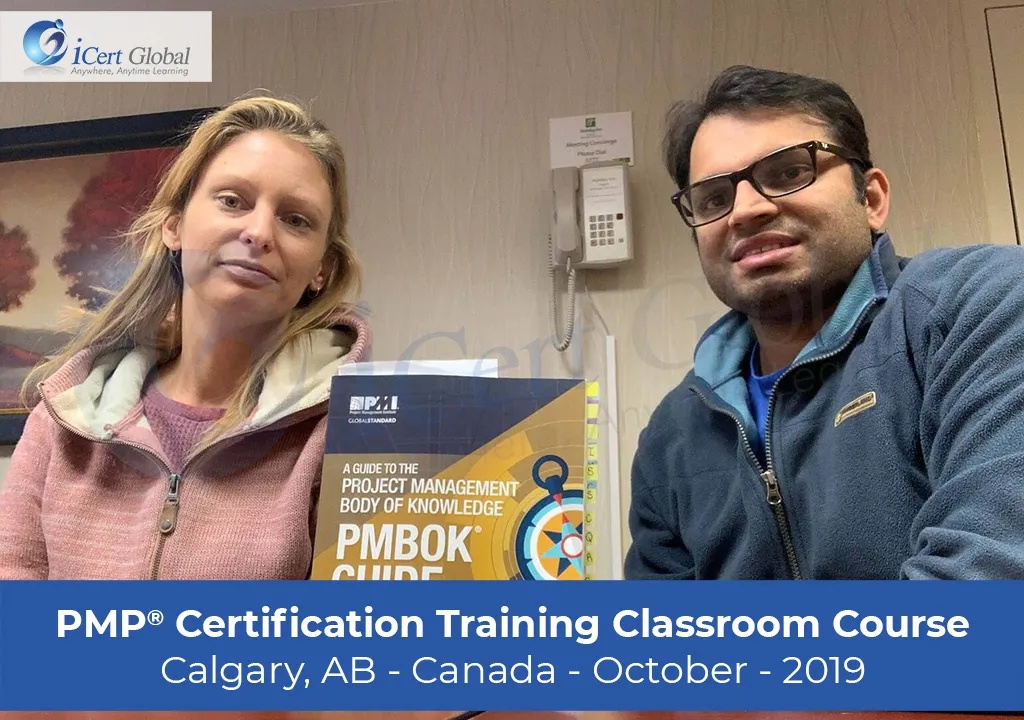
The operating idea is visible in the company’s public classroom gallery: small groups, conference tables, training rooms. A Calgary photograph identified as October 2019 shows the physical version of the service. The company’s expertise has to travel through an instructor and a lesson plan before it becomes useful to the person who bought a seat.
Its corporate profile describes practitioner-led teaching and case studies. The founder’s published biography emphasizes affordability and support after training. Together, those statements describe the teaching approach the business wants to sell: recognizable professional frameworks made usable by people who have worked with them.

03The letters belong to somebody else
There is a distinction hiding inside the certification business. A training provider prepares a learner; the relevant credentialing organization sets its own rules. iCert Global’s PMP page links to a Credly badge issued by the Project Management Institute to I-Cert Global Learning Private Limited. The badge identifies it as an Authorized Training Partner and describes access to licensed PMI exam-preparation materials.
That relationship matters because buyers are purchasing preparation for an external standard. It also explains iCert Global’s position in the market. The company packages instruction, practice, and support around qualifications that already have professional recognition. Its commercial task is to make that preparation convenient and credible.
The catalogue extends beyond project management. Its Lean Six Sigma Green Belt course teaches DMAIC: Define, Measure, Analyze, Improve, Control. The ScrumMaster offer describes a two-day workshop and includes examination attempts and a two-year Scrum Alliance membership. AWS Solutions Architect training advertises practical labs and architecture exercises. These are distinct products; their inclusions should be compared separately.
04The buyer changes. The problem rhymes.
For an individual, the problem may be fitting professional development around a job. For an employer, it may be coordinating a whole team. iCert Global’s enterprise offer describes customized curricula, volume discounts, and progress tracking. Those features address a manager’s scheduling and oversight problem as much as an employee’s need to learn.
The revenue model follows those buyers: fees for individual courses and arrangements for corporate groups. The website names learning formats and lets prospects request a corporate demo. This puts iCert Global among professional training providers, with alternatives ranging from other instructor-led certification specialists to self-paced courses and study directly from credentialing bodies.
The transferable idea is to sell a useful level of support around a shared destination. A business can let customers choose how much guidance they buy without pretending every customer studies the same way. For a training manager, the corresponding move is to buy around the team’s actual constraints: availability, prior knowledge, and the work people must perform afterward.
“Freedom and flexibility are the founding pillars of iCertGlobal’s e-Learning.”
iCert Global · its stated learning philosophy
05The lesson before the lesson
Public feedback adds a necessary complication. Trustpilot reviewers praise clear materials and knowledgeable teaching. Other reviews raise communication concerns. In a January 2026 review, a prospective instructor described receiving materials and then losing contact with the company. That is an individual account, not a finding about every course. It does expose the importance of coordination in a service built around scheduled teaching.
The refund policy makes that dependency explicit. It reserves the right to cancel or postpone events for insufficient enrolment, instructor illness, and other circumstances, and says company-cancelled events receive a full refund. It also describes different cancellation windows and usage limits, alongside course-specific terms. The practical move is to settle the applicable terms before reserving study leave.
This model makes sense when a learner values guided preparation and can commit to the chosen format. It is less useful when the goal is an academic degree, when self-study already works, or when an unpredictable calendar makes a fixed class difficult. The credential may appear on a résumé as a few tidy letters. Getting there requires a much less tidy resource: time that somebody has made available.
Follow the learning
Explore the courses, the people, and the company’s own explanations.