In 1987, a computer needed fingers. Timber Hill, the trading firm built by Thomas Peterffy, had automated its Nasdaq trading. Then came a requirement to operate through a keyboard. The firm’s response was wonderfully literal: build a computer-driven mechanism that punched the keys. The machine could do the thinking. Apparently, it also needed to do the typing.
That little episode contains the operating logic of Interactive Brokers, the brokerage that grew out of Peterffy’s business. Find the repeated task. Write the software. Deal with whatever stands between the software and the market. Keep going until customers can buy the result.
- The invention: turn a trading firm’s internal machinery into a brokerage other people can use.
- The appeal: global markets, multiple asset classes and detailed controls in one account.
- The bargain: low published commissions, with complexity and extra costs worth understanding.
The machine with fingers
Peterffy’s first problem was people. In a retrospective Motley Fool interview, he described hiring traders and keeping 70% of their profits while giving them 30%. Winners received their share. Losers left him holding the entire loss. In aggregate, he said, he made no money. His response was to computerize more of the process.
The interesting part is what changed his mind. A formula for pricing options was insufficient if the business around it distributed rewards badly. Automation promised more control over how the formula reached the trading floor. By 1983, Timber Hill traders were using handheld computers to track positions and update options prices while other traders consulted printed sheets.
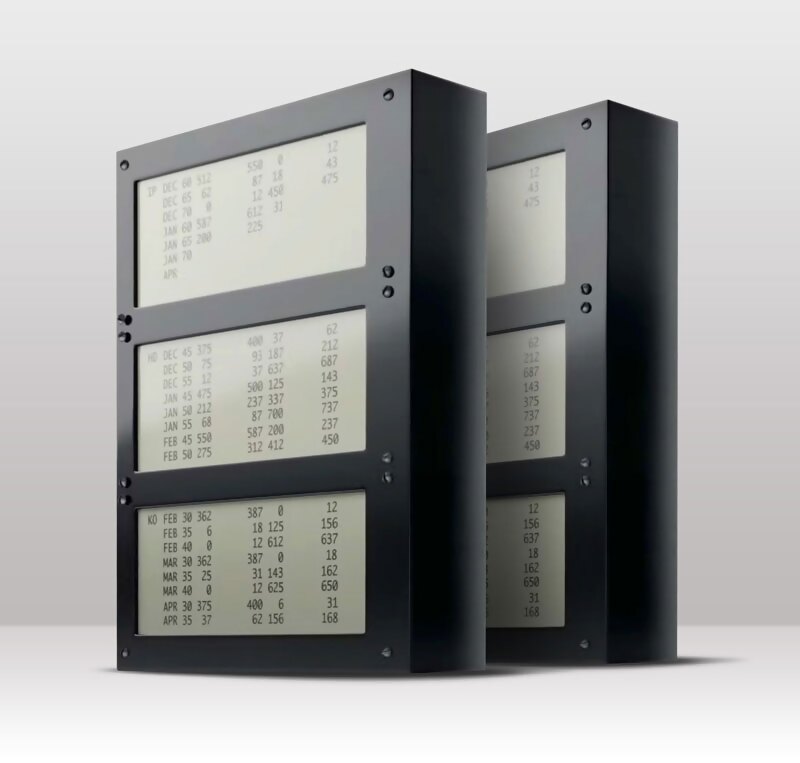
The keyboard contraption followed. Then came a more consequential change: in 1993, Interactive Brokers was incorporated as a US broker-dealer, opening the network to clients. Infrastructure built to help the firm trade could help other people trade, too. The customer no longer needed to build the connections.
The trading desk becomes the product
Today, IBKR executes and clears trades for individuals, advisors, hedge funds, proprietary trading groups and introducing brokers. Its menu stretches across stocks, options, futures, currencies, bonds and funds. Eligible customers can also access cryptocurrency through outside providers. Product availability depends on where customers live and what their accounts are permitted to do.
Consider an investor researching overseas shares, converting currency and monitoring the resulting exposure. Or an advisor managing several clients. Or a developer sending orders from software. These are different jobs, but they share plumbing: market connections, account records, execution and reporting. IBKR sells access to that plumbing through several interfaces.
Trader Workstation is the detailed control room: scanners, advanced orders, algorithms and risk analysis. IBKR Desktop, introduced in 2024, offers another route through charts, customizable panels and portfolio monitoring. Mobile and browser tools handle other workflows. APIs let developers integrate trading and account information into their own systems; PortfolioAnalyst brings supported external financial accounts into the picture.
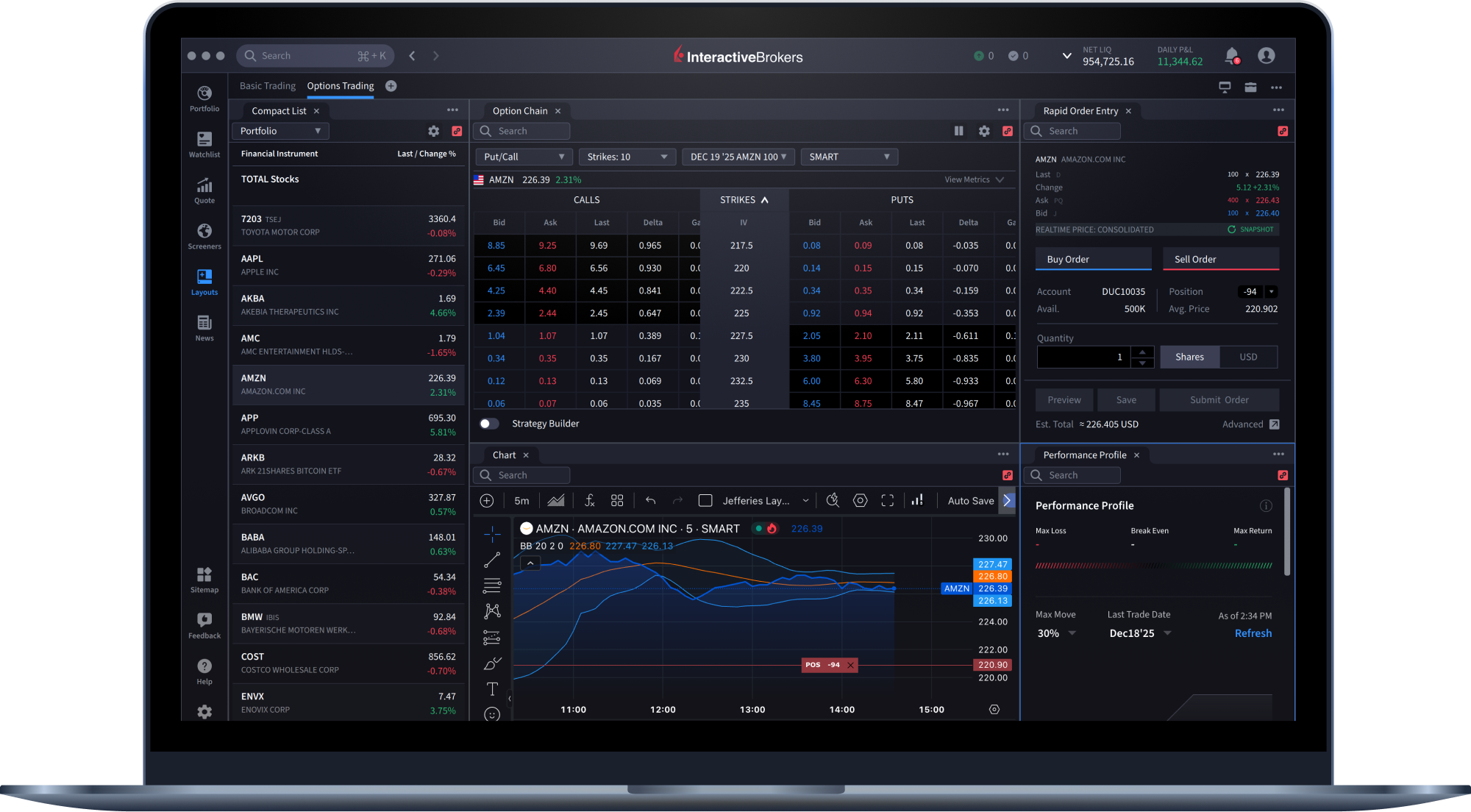
Connections extend beyond IBKR’s own screens. The TradingView integration lets customers connect accounts with both services. Paxos and Zero Hash provide cryptocurrency services for eligible customers, with those assets held outside IB securities accounts. Even inside a consolidated interface, the provider doing the work can change. The screen is a meeting place for several businesses.
This positions IBKR between familiar alternatives. Schwab and Fidelity serve US brokerage customers; Robinhood competes for retail investors; Saxo offers international multi-asset access. The useful comparison is the customer’s actual workflow. Someone buying one domestic fund has different requirements from someone managing positions across currencies and exchanges.
Cheap has a price list
For US stocks, Pro’s first tiered band starts at $0.0035 per share, with a $0.35 order minimum and applicable external charges. Fixed pricing is $0.005 per share, with a $1 minimum. For a straightforward 100-share order, that means a $0.35 base commission under tiered pricing versus $1 under fixed pricing, before any additional applicable charges.
Illustrative order only. Tiered external fees, applicable regulatory charges, routing and other conditions can affect the final cost.
Lite offers commission-free eligible US stock and ETF trades for eligible customers. That still leaves a shopping list to read. Live market data can require subscriptions. Currency conversions and borrowing have their own economics. Individual accounts have no general account minimum or inactivity fee, but particular products and services have requirements. A commission is one line on the bill.
The money behind the machinery
The business earns commissions, net interest and other fees. The surprise is the balance between them. In the third quarter of 2026, IBKR reported $602 million in commissions and approximately $1.15 billion in net interest income. Financing and customer balances matter enormously to a company people encounter through a trading screen.
Selected components, not total revenue. Bar lengths compare the two reported amounts.
Total reported quarterly net revenues were approximately $1.91 billion. Customer accounts reached 5.58 million, up 35% from a year earlier. Those are accounts, not necessarily distinct people. The scale gives the automation story a business consequence: an expensive network can support a growing customer base without rebuilding the machinery for each arrival.
The leadership offers another clue to the company’s habits. Milan Galik joined in 1990 as a software developer and became CEO in 2019. Peterffy remains chairman. Its careers material emphasizes technical problem-solving; the succession gives that description a concrete example. Here, knowing how the machinery works can be a route to running the business.
A powerful tool still needs a driver
There is a cost paid in attention, too. Peterffy once acknowledged that “unfortunately the system has to be complex.” Newer interfaces address presentation; international markets, permissions and derivatives retain their complications. An investor seeking someone to make decisions for them is asking for a different service.
“unfortunately the system has to be complex”Thomas Peterffy · historical Motley Fool interview
Automation also enforces limits. IBKR’s real-time margin system can liquidate positions when requirements are breached. Leverage can produce losses beyond the initial investment. Convenient execution does not remove investment risk, and a financing bargain can become unpleasant when collateral falls.
The useful lesson for a builder is concrete: identify a recurring internal expense, improve the machinery, then ask who else needs it. For an investor, start with the job and calculate the whole cost. Peterffy’s keyboard machine is funny because it takes a rule so literally. The brokerage that followed asks customers to be just as literal about what they need.
Open a few more windows
Explore the tools, the people and the moving parts.