The warning was only $10,000. Intelligent Audit had spotted a spike in a return service that a global eyewear manufacturer had not used before. According to its case study, the customer did not act on that first signal. The fraud expanded, eventually exceeding $1 million. An unfamiliar line in the shipping data had been an invitation to investigate. By the time the investigation became unavoidable, the lesson had become considerably more expensive.
- Checks freight and parcel bills, recovers money, and helps manage carrier payments.
- Uses shipment data to expose unusual costs and test better shipping decisions.
- Pairs software with specialists. Someone still has to act on the findings.
That episode gets closer to explaining Intelligent Audit than a catalogue of software features. Its subject is the space between a shipment and a payment: what happened, what was promised, what was charged, and whether anybody noticed the difference. For logistics and finance teams, that space can contain both recoverable cash and evidence of a process quietly going wrong.
01 The bill has two questions
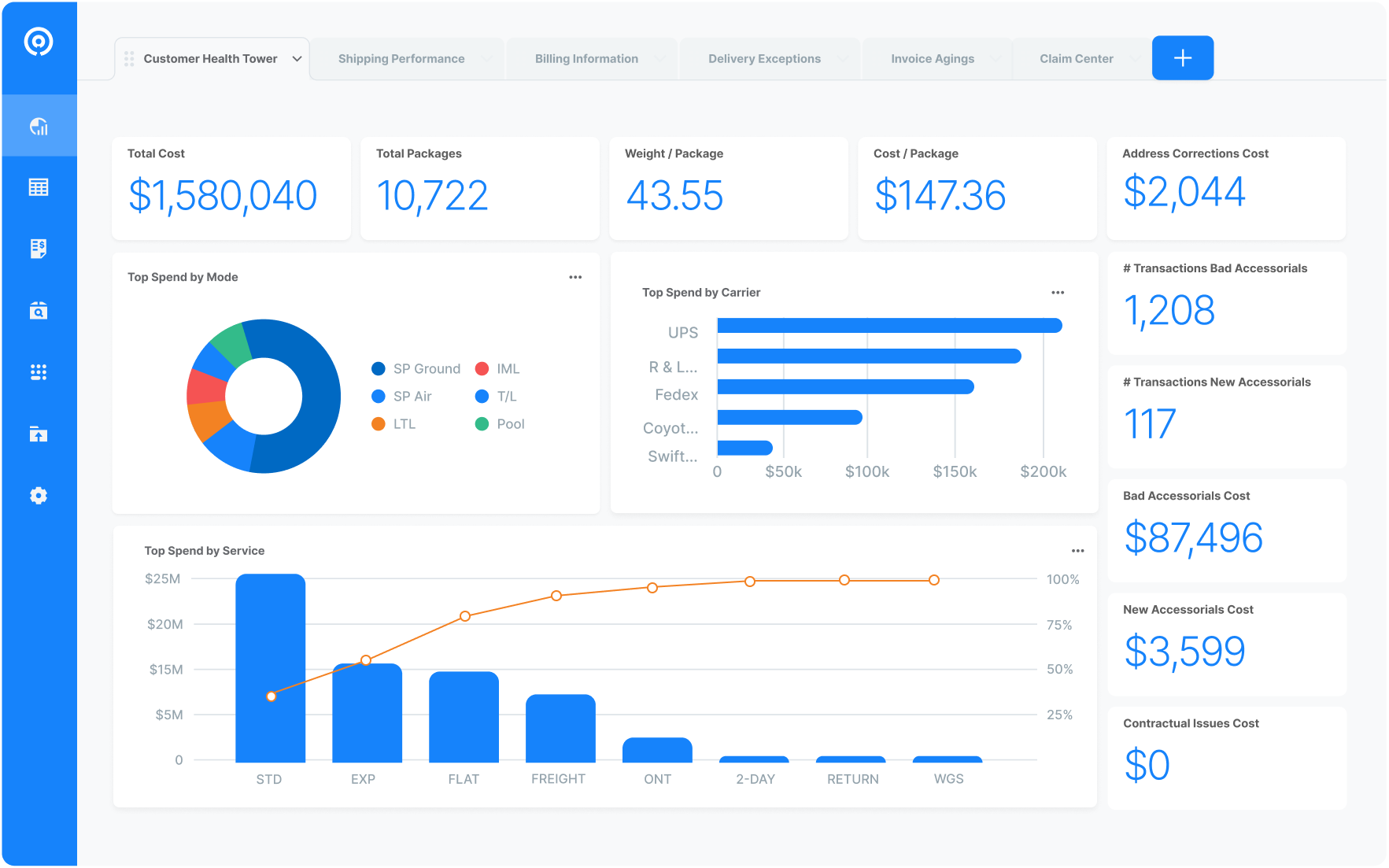
Freight audit starts with a straightforward test: does the carrier’s invoice match the agreement? Intelligent Audit says its platform checks more than 150 audit points across transportation modes. It combines contractual validation with claims, cost allocation, reporting, and standardized data across carriers. The practical benefit is less manual checking and a clearer view of what each shipment actually cost.
But a correct charge can still describe an expensive mistake. In one published example, an internal misconfiguration generated $305,000 in UPS Early AM spending. Elsewhere, missing shipping attributes and incorrect rate-shopping logic produced $48,100 in USPS dimensional fees. The carrier’s arithmetic was only part of the inquiry. The shipping team needed to examine the choices and settings upstream.
A correct invoice can be an accurate record of a bad decision.THE QUESTION BEHIND THE AUDIT
DeepDetectAI, the company’s anomaly-detection product, addresses that second question. It looks for unusual patterns that deserve investigation, including possible fraud, service misuse, and operational errors. An alert supplies a starting point. Establishing what caused it requires context.
02 First, watch somebody work
The business began with a smaller irritation. Yosie Lebovich founded a warehouse software company in 1996. Two years later, he observed someone entering UPS tracking numbers individually to retrieve delivery confirmations. He automated the task. Shipment tracking led to late-delivery claims; a customer’s electronic-invoice pilot in 2002 opened a route into connected billing data.
The interesting choice was to follow the work beyond its original brief. Information gathered for delivery confirmation could also answer questions about payment, service, and cost. Parcel shipping made that possibility demanding: thousands of small transactions needed attention without losing their individual details. Today, the same concern runs through the company’s multimodal audit and analytics offering.
03 A refund is a different number
Consider a prescription fulfillment provider with $405 million in annual small-parcel spending. Intelligent Audit reports that claims had been reactive, often beginning with customer complaints. It introduced shipment monitoring, automatic filing, and carrier follow-up. The provider recovered more than $1.3 million in lost-and-damaged claims over 15 months, according to the company’s case study.
Company-reported recovered funds. One prescription fulfillment provider.
Recovery is distinct from identifying waste. Those Early AM charges and dimensional fees describe costs flagged for investigation, rather than guaranteed refunds. Likewise, a network model can identify a savings opportunity before anyone changes a warehouse or carrier contract. Keeping these categories separate makes a business case more credible: money returned, spending prevented, and possible improvements each need their own accounting.
04 The cheaper route may already exist
Petco illustrates the optimization side. Its stores were not designed for large e-commerce order volumes. Intelligent Audit’s account describes analyzing store capacity, redirecting orders at capacity limits, and testing fulfillment scenarios. Ground service could be used where it met the delivery requirement; faster options remained available where needed. Existing stores became part of the shipping calculation.
This places Intelligent Audit between freight audit, financial operations, and transportation planning. Its modeling tools compare networks, parcel sourcing options, and contracts. Specialists support sourcing and strategy. Buyers can also consider providers such as Cass, nVision Global, and Trax. Intelligent Audit’s pitch combines parcel experience, multimodal data, and expert interpretation; those capabilities should be assessed against the buyer’s actual shipments.
05 Software, service, and the monthly bill
The commercial model is a monthly subscription based on shipment volume, modes, and carrier count. Catalyst serves growing parcel shippers, with a 90-day trial and three plans. Premium adds contractual audit and financial workflows; Pro adds professional services. Carrier payments operate through a TriumphPay partnership. A useful buying conversation begins with shipment data, required integrations, and the work the customer expects the provider to handle.
The capital story has two chapters. The founder describes bootstrapping the early business. Triumph later disclosed an $8 million minority investment in 2019 and a $23 million purchase of an additional stake in 2022. These are investment transaction amounts, separate from what customers pay for the service.

06 Give the warning an owner
CEO Hannah Testani, Lebovich’s daughter, leads a business now experimenting with a conversational interface. Its September 2026 announcement introduced Yosi, an upcoming AI guide named after the founder, intended to help users question their transportation data. The company’s published culture includes the line, “We work to live, not live to work.” Removing repetitive investigation fits that ambition.
Readers can copy a simpler discipline immediately: reconcile invoices, investigate unusual service use, and assign every material exception to a person. The eyewear case shows the limit of automation clearly. Without reliable shipment data, configured agreements, and a team willing to intervene, another alert can remain another unread message. The valuable moment is the one when somebody decides to look.