A peculiar thing can happen inside a modern company. The annual survey says employees are engaged. The town hall is full. The chief executive's email earns a respectable open rate. On the dashboard, everything is green. Then the reorganization stalls, the new tool sits unused, the best people leave and everyone acts surprised.
Integral, a New York employee-experience agency, has built its business in that sliver between a message arriving and anything actually happening. The company advises the people responsible for communications, HR, marketing and technology at large employers. Its work ranges from change strategy and executive coaching to channel design, creative campaigns, employee research and the unglamorous mechanics of making an operating plan comprehensible to the people expected to carry it out.
The firm was founded in 2018 by Ethan McCarty, after leadership roles in employee and innovation communications at Bloomberg and social strategy at IBM. Taylor Shawver helped build Integral from the ground up and remains a co-founder and board member. Their premise was not that companies needed more communication. Companies already had email. They had intranets, town halls, Slack, Teams, videos, newsletters and enough PowerPoint to tile a regional airport. The problem was the distance between information and belief.

The open rate is not the outcome
Integral's 2026 argument is bluntly titled The Engagement Fallacy. Its annual Integral Index, conducted with The Harris Poll, surveyed 2,006 full-time American employees at organizations with at least 100 workers. The research distinguishes engagement from commitment and from what it calls job lock - staying because leaving feels too risky. Those conditions can look identical in a headcount report. They are not identical in a crisis.
This is also Integral's competitive wedge. Large consultancies can design transformations. Survey platforms can measure sentiment. Internal communications agencies can make polished campaigns. Integral tries to sit where those disciplines overlap: behavioral science to diagnose the problem, creative strategy to make the change legible, and measurement to see whether it stuck. It sells bespoke projects and ongoing support, not a software subscription. Its public research and cost calculator are free; the consulting is scoped to the client.
“A 47% open rate tells you a finger moved and a screen loaded. It does not tell you whether anyone believed what they read.”Carolina Mata, Integral SVP of Employee Communications
Three assignments explain the company
At IBM in 2021, the first failure was not a botched slogan. It was the risk that a vast marketing reorganization would be understood as an abstraction. Integral interviewed cohorts of managers and consolidated the voices of more than 600 people around the world into an action-oriented plan. The change in approach is revealing: instead of beginning with what leadership wanted to announce, the team began with what employees needed to understand and what managers were hearing.
At MetLife, the problem was employee social media. Tens of thousands of people represented the company in public, but a policy built only from prohibitions would make employees cautious rather than capable. Integral audited the existing governance program, compared it with competitors, and brought together customer service, marketing, communications, HR and legal. The resulting playbook still described limits, but it also showed how social media could support the brand, careers and sales. Governance became instruction.
PVH presented the opposite problem. The enthusiasm already existed. Employees liked the company and wanted to advocate for it, but leadership lacked a structure for turning that energy into a program. Integral designed a phased pilot, events, measurement and iteration for an ambassador program called PVH Power Players. After four months, nearly 70 percent of invited associates were active in the internal channel and about 45 percent had created content for Instagram, LinkedIn or internal networks. The pilot continued to expand.
The manager in the middle
Integral's most useful observation may be its least glamorous. Companies like to imagine culture radiating from the chief executive. Employees usually experience it through the person who assigns Tuesday's work. In the firm's 2026 research, 98 percent of top and senior managers said they felt confident delivering organizational messages, and 61 percent said they were often given enough information. Among frontline managers, confidence was still high at 87 percent, but only 49 percent said they often received enough information.
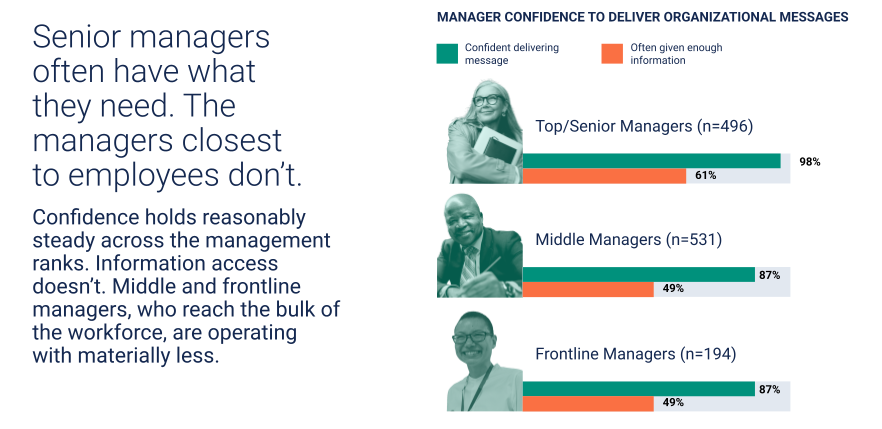
That 12-point information gap is where strategy turns into rumor. It is also where Integral's three service lines meet. Communication aligns content, channels and leaders. Transformation handles readiness, narratives, stakeholder groups, governance and coaching. Intelligence audits what employees receive, listens to what they say and connects those findings with what they do. The firm packages each practice in three levels, from diagnosis and foundation to execution and embedded partnership.
The model works best when senior leaders are willing to hear inconvenient evidence, managers have time to translate it, and a client will change systems as well as language. A campaign cannot repair a broken promotion process. A survey cannot create trust after leaders ignore the answers. An ambassador program cannot manufacture genuine affection. Integral's own case studies succeed for a reason: IBM allowed broad listening, MetLife put rival functions in one workshop, and PVH began with real employee enthusiasm.
What another company can borrow
Before the next campaign, write down the behavior that should change. Interview frontline managers before drafting the message. Ask what evidence would prove belief, not merely receipt. Then report that evidence beside the open rate.
A consultancy with a research habit
Integral remains a small agency - roughly two dozen people - working with organizations whose employee populations can number in the tens of thousands. Publicly documented clients include IBM, MetLife, PVH and Lam Research; team biographies also name work with Johnson & Johnson, AmeriHealth and PepsiCo. Its 2025 expansion of transformational-change leadership made explicit what the client work already suggested: internal communications cannot be separated neatly from operating change.
The firm has collected the expected cabinet of industry honors, including six consecutive appearances on the PRNEWS Agency Elite 100 through 2026 and a 2025 Ragan Zenith Agency of the Year award. The more interesting achievement is that its research has become a product in its own right. Since 2021, the Index has given the agency a recurring body of evidence, a language for its methods and a reason to revise its own assumptions. In consulting, where a framework can survive long after the world that produced it, that is a useful discipline.
Integral's bet is ultimately modest. Work improves when leaders stop confusing transmission with communication, sentiment with commitment and activity with consequence. The annual survey may still have its place. The town hall may still be full. But the consequential question arrives the next morning, when a manager explains what any of it means. Did the message land? Perhaps. Did anything move? Now we are talking.