Professional Billing Management Solutions had already bought the promise. The medical billing company wanted faster patient payments and less administrative work. Its first attempt at modernizing the process delivered difficult onboarding and software that complicated the job. Then someone on its integration team found Inbox Health on a practice management vendor’s partner list. The detail that persuaded PBMS to switch was wonderfully unglamorous: information could travel in both directions.
- Inbox Health combines patient statements, payments and billing support.
- Its customers include billing companies, practices and larger provider groups.
- The useful idea: answer the patient’s question at the point of payment.
That episode, described in an Inbox Health case study, offers a useful entrance into the company. Buying a nicer way to send a bill is easy to understand. Making it work with the machinery already inside a medical practice is where things get interesting. A payment needs to arrive in the right ledger. A changed balance needs to appear in the next message. Otherwise, automation can reproduce confusion at impressive speed.
The question before the payment
Inbox Health’s founders came at that confusion from different directions. Blake Walker worked in patient financing and saw providers struggling to collect balances. Simon Kaluza worked in healthcare software and encountered the billing system while caring for a seriously ill family member. Their company’s origin story describes an industry attentive to processing insurance claims, with much less attention paid to the person receiving the remaining bill.
The gap became their business. Founded in 2014, Inbox Health builds the communication and payment experience around patient responsibility. A statement can explain the service charge, insurance payment and amount still owed. Patients can receive messages through email, text or paper, ask for help, and choose among available payment options. Billing staff get a shared workspace for following the account.
“While we primarily speak to billers, Inbox Health in many ways is really built to support, inform and empower the patient.”Simon Kaluza · Co-founder
There is a small but consequential product decision here. The statement includes a route to support. A patient wondering whether insurance has paid can ask before committing money. The commercial argument is that understanding helps a balance move. The human argument is that a bill deserves an explanation.
A ledger that talks back
Return to PBMS. At the time of the published case study, it managed 60 practices across multiple practice management platforms. Inbox Health’s two-way integration mattered because the billing company needed its new payment workflow connected to its existing systems. The case study reports a 25% increase in patient payments in one month and a 90% reduction in phone calls. Those are vendor-published customer results, tied to that deployment.
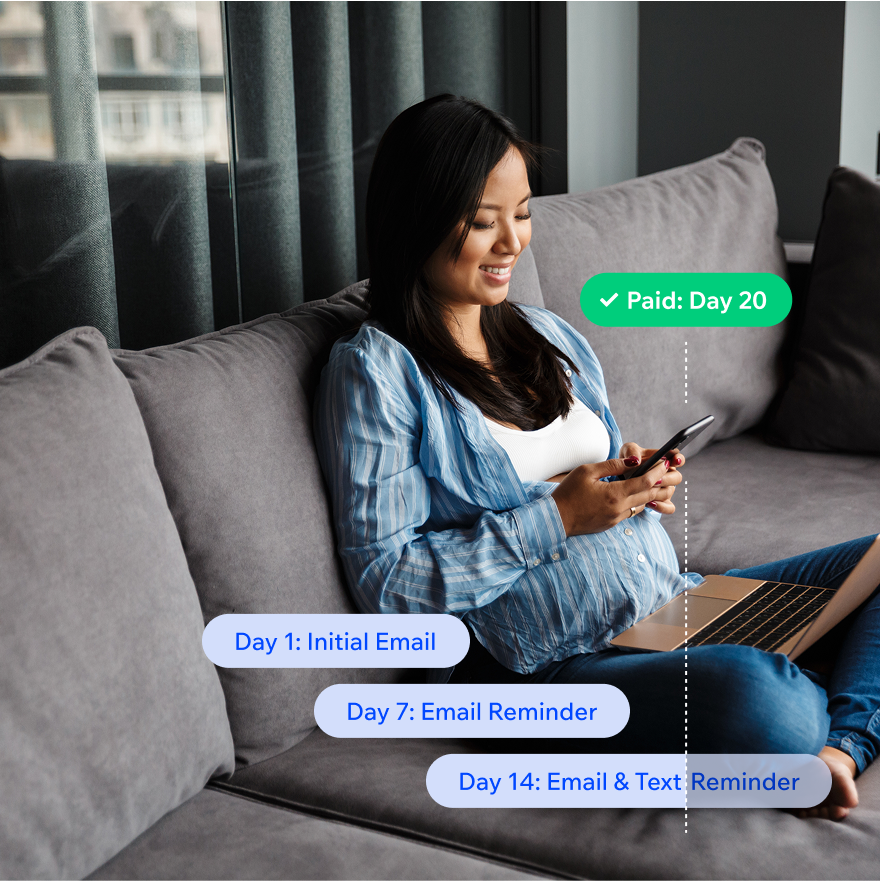
This helps explain the audience. A third-party billing company serves many practices, each with its own patients and operating rules. Inbox Health offers practice-branded statements, configurable outreach and a dashboard for managing the work. Its integration layer connects that activity to practice management software. The product sits inside the revenue cycle, concentrating on the patient-facing portion.
Digital delivery alone is hardly a private invention. Collectly offers patient billing automation and AI assistance; Cedar offers personalized financial engagement for hospitals and health systems. Inbox Health’s positioning rests on the combination of billing-team workflows, integrations and patient support. Buyers still have to inspect how that combination fits their own systems.
Seven questions out of ten
In July 2025, Inbox Health launched an AI billing assistant after piloting it for much of the year. The company said the pilot resolved over 70% of patient billing questions without call-center intervention. Its product documentation describes an assistant that can resend statements, answer balance and service-date questions, verify identifying information and explain how to pay.
Billing questions resolved without call-center intervention.
The handoff is part of the design. Questions beyond the assistant’s capabilities, or requests for a person, go to a live agent. Complex insurance explanations and disputes still require attention. Conversations and actions are visible in the application, according to the company. The attractive measure is how much routine work disappears; the operational test is what happens to the difficult question that remains.
Self-service also predates the chatbot. Twilio’s customer story describes Inbox Health building an automated phone-payment flow, reaching a proof of concept in about three months. It records one payment completed in 94 seconds. The lesson is pleasantly ordinary: some people simply want to finish the transaction without waiting for another person.
The business behind the conversation
Inbox Health sells software and support to organizations doing the billing. Its partner program offers flexible licensing, branded statements and API integrations. A sensible purchase comparison therefore includes the required support scope, payment workflow and integration work, alongside the software proposal.
In September 2025, it announced $20 million in combined growth equity and debt, led by Ten Coves Capital, with debt financing from Silicon Valley Bank, a division of First Citizens Bank. The company said the funding would primarily support AI research and development. At that point, it reported serving more than 3,500 practices and 2.8 million patients annually.

Distribution has expanded through partners. AdvancedCare announced access for its 350-practice network in November 2025. Encoda paired its insurance revenue expertise with Inbox Health’s patient billing that December. In February 2026, UrgentIQ selected Inbox Health as a preferred patient payments partner. Each relationship puts the product closer to workflows providers already use.
Copy the sequence
The transferable idea is the order of operations: explain the charge, make a question easy, then make payment convenient. Test the integration before expanding the rollout. Keep an effective route to a person. Preserve channel choice. Those choices matter because clearer communication cannot correct a wrong underlying balance or supply money a household does not have. Inbox Health’s proposition depends on making the administrative part easier, one understandable exchange at a time.