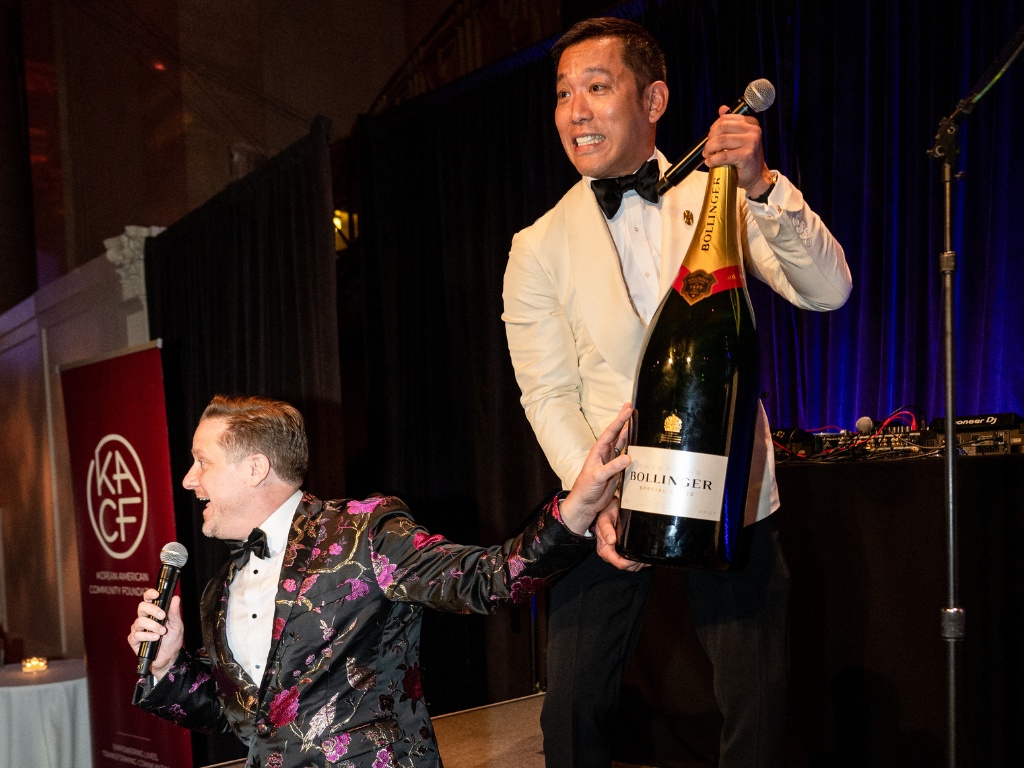
At a Korean American Community Foundation gala in 2024, In Seon Hwang stood onstage in a white dinner jacket holding a microphone and an enormous bottle of champagne. The photograph offers a cheerful interruption to the usual vocabulary of private equity: capital commitments, investment committees, portfolio construction. Here is an investor with his hands rather full. The evening honored Hwang alongside the musicians Tiger JK and Yoon Mirae, and raised more than $2.6 million for the foundation. Finance and celebration had found a common address.
Another image of Hwang is harder to frame. He remembers arriving in the United States at seven, in the early 1980s, with his parents and three sisters. His account begins with material insecurity: a birthplace without indoor plumbing, a family without English, and the fear of falling behind on bills. The adult investor remembers the child’s shame. That memory gives his professional story a question more interesting than how much money he has raised: what allows a family, or a business, to move beyond survival?
Today he is Managing Partner and Co-Founder of Ascend Partners, based in New York. His working life has taken him through consulting, investment banking, energy investments, and the creation of his own firm. There is plenty of institutional polish in the résumé. The personal account underneath it is unusually attentive to the help that success requires.
“In so many ways, I shouldn’t even be here.”
In Seon Hwang, on his beginnings
Seoul, Hong Kong, New York
Hwang earned a bachelor’s degree in economics at the University of Pennsylvania’s Wharton School and an MBA at Harvard Business School. His early employers formed a recognizable sequence in finance: Boston Consulting Group, Goldman Sachs, GSC Partners. The geography makes the sequence more interesting. He worked for BCG in Seoul, for Goldman’s mergers and acquisitions group in Hong Kong, and for GSC in New York. These were three different settings for learning how organizations work and how ownership changes.
The dates put some edges on that journey. His BCG period ran from 1997 to 1998, Goldman from 1998 to 2000, and GSC from 2002 to 2004. He joined Warburg Pincus in 2004 and became a partner in 2009. A career that now reads as an orderly progression was assembled across firms, cities, and different kinds of financial work. Consulting studies the machinery; mergers and acquisitions rearrange it; investing commits money to what it might become.
The sequence matters because Hwang would eventually put operational support near the center of his investment approach. Capital and management expertise are different resources. A growing organization can require both at once. His background gave him experience on several sides of that problem, before he had a firm of his own in which to combine them.
Before Ascend, the machinery was literal
At Warburg Pincus, Hwang began in the energy group. His deal history includes Targa Resources, Navitas Midstream, Zenith Energy, Competitive Power Ventures, and APT Power. These names add a useful complication to a tidy founder narrative. His experience extends to businesses involving physical assets, infrastructure, and projects whose construction takes more than a pitch and a persuasive spreadsheet.
In May 2006, he became a director of Targa. The board appointment placed him inside a business as a representative of its investment backing. A board seat carries a different relationship to a company from advising on a transaction. Decisions continue after the announcement, and the investor remains involved in overseeing the enterprise. Hwang’s career has included approximately 30 such board roles.
In June 2014, a Warburg affiliate agreed to lead an investment of up to $500 million in Navitas Midstream. That figure described the financing arrangement, rather than a personal investment by Hwang. He spoke about developing a business alongside an experienced management team. In August of that year, Warburg also announced a commitment of up to $600 million to Zenith Energy, led by Jeff Armstrong. Zenith was pursuing international terminal opportunities.
The common element was partnership with people who knew how to build and operate the underlying business. Money could help those teams work at a different scale. The recurring interest in management capability is visible well before Ascend’s founding. Pipelines and terminals make an unsentimental backdrop for an investor’s education: an asset still has to function after everybody has admired the financing.
A college friendship becomes a firm
Richard Park enters Hwang’s account through college. Hwang has described becoming friends there with Park, who later founded CityMD. Their careers subsequently met through an investment: Warburg Pincus announced its backing of Park’s company in April 2017, with Hwang speaking for the firm. The relationship therefore had both a personal history and a business history before the pair started Ascend.
Ascend was founded in 2019. Its two co-founders brought different experience to the partnership: Hwang had spent years investing and serving on boards; Park had built and led a company. The firm’s origin joins those two perspectives. Someone who allocates capital and someone who has run a growing enterprise can look at the same expansion plan and see different practical demands.
It is tempting to treat a long friendship as the explanation for everything that follows. The more useful detail is that the friendship had already encountered a real investment relationship. The two had worked on a business before attaching their names to a new one. Ascend turned that combination into an institution, with obligations to outside investors as well as ambitions of its own.
The work after the cheque
Hwang describes an approach that pairs capital with the systems and people needed to manage growth. In a 2024 discussion, he said Ascend often provided the first institutional investment to businesses still led by their founders. He also described a substantially larger operational team than core investment team at that time. The point was the amount of work required once the money arrived.
His concise instruction was to “overbuild your operating team.” It is an unusually practical phrase for an industry fond of abstract promises. A business receiving its first institutional backing is also entering a new relationship with reporting, governance, and planning. Growing the enterprise changes what management has to keep track of. The firm’s structure is meant to anticipate that additional work.
This provides a concrete way to read Hwang’s interest in mentorship. Help has to reach the organization’s daily decisions. A founder may know a business intimately and still need additional capabilities as it expands. Hwang’s emphasis puts the investor’s own preparedness into the picture: if the strategy requires substantial operating support, the firm has to organize itself to supply it.
“Overbuild your operating team.”
In Seon Hwang, 2024
Two funds, and a larger obligation
Ascend’s first fund closed in December 2021 with $570 million in commitments. Its second reached a final close in February 2026 with $791 million, including parallel vehicles, against an initial $700 million target. The second pool was $221 million larger than the first, an increase of about 39 percent. Together, the announced commitments add to $1.361 billion.
These figures describe money committed to the funds by investors. They are a measure of the firm’s fundraising, with a future job attached: investing the capital. Fund II drew backing from investors including pension funds, foundations, endowments, family offices, and funds of funds. The first fund’s capital had been fully deployed across eight investments by the time of the second fund’s announcement.
The distinction between raising money and producing results is especially useful in a personal profile. A closing announcement is a milestone, and the funds belong to a partnership. Hwang’s achievement here is part of a team effort, supported by institutions that have their own responsibilities. More commitments mean more resources available for the strategy and a larger obligation to put those resources to work.
Over his career, Hwang has invested approximately $5 billion of equity across approximately 40 companies. Those are career investment figures, a different measure from Ascend’s two fund sizes. Read together, the numbers show a veteran investor building a newer institution. The second fund gives that institution a longer next chapter; the ending still depends on the work.
Fund II includes parallel vehicles.
A second ledger, kept in New York
Hwang’s community involvement predates Ascend. Hope for New York’s fiscal 2017 annual report listed him as vice-chair of its board. Its current board roster also includes him. The organization connects financial and volunteer resources with nonprofit partners in the city. Board service here places his experience in another setting, where stewardship is directed toward a charitable mission.
In 2018, he was among the co-chairs of KACF’s Golf Classic, an event supporting the foundation’s work on economic security. In July 2019, he took part in the Lessons Learned series hosted by The Korea Society and Korea Finance Society. Andrew Kim moderated the program, which invited finance professionals to share career experience with a younger audience. The event sits neatly beside Hwang’s stated interest in operational mentorship: experience becomes useful when someone else can draw on it.
The 2024 gala brought that longer community connection into public view. More than 750 guests attended the sold-out evening. Hwang reflected on what would define the community beyond individual success, while his fellow honorees spoke about belonging and culture. The foundation’s account put the collective effort at the center. An award can briefly make one person the subject; a fundraising evening succeeds through a roomful of people.
The champagne photograph catches the lighter side of that arrangement. Hwang holds both bottle and microphone while another participant reaches toward the bottle. The prop is gloriously oversized. Nobody needs a valuation model to appreciate the logistics. The image gives the formal biography a moment of human scale, even if the champagne stubbornly refuses to follow suit.
Who gets to move ahead?
Hwang’s life invites a familiar account of upward mobility: an immigrant child goes to Wharton and Harvard, joins established financial firms, and eventually launches his own. The facts support that arc. His own explanation gives help a substantial place within it. He credits hard work while remembering the need for capital and guidance that his family could not simply produce for itself.
That emphasis offers a useful way to connect the different parts of his public life. Investment partnerships, nonprofit boards, and a conversation with younger professionals all involve resources passing between people. Their purposes differ, but each raises a question about what the recipient needs in order to make progress. Hwang has repeatedly put expertise alongside money in answering it.
Ascend’s name suggests movement upward. The more revealing word in the firm’s name may be Partners. Hwang’s story keeps returning to relationships: a college friend, experienced management teams, institutional backers, and organizations serving his city. His career has expanded the scale at which he can participate. The childhood question remains close enough to give that scale a purpose.