A car shopper fills out a form at 11:47 p.m. The sedan is still on the lot, the store is dark, and the salesperson who knows the trim package is asleep. In the old choreography of automotive retail, the shopper waits. By morning, enthusiasm has cooled, another tab has opened and the lead has become one more name in a queue.
Impel has built a sizeable business around that awkward pause. Its software can answer the vehicle question, keep the conversation moving by text or email, schedule a visit and remember the exchange when the customer comes back for service. The company calls the whole arrangement an Automotive AI Operating System. The phrase is grander than “chatbot,” but it describes a real distinction: Impel is trying to coordinate the work between the dealership's many systems, not merely install a chat bubble on its website.
Today the company says it serves more than 8,000 retailers and vehicle manufacturers in 51 countries. Its customers include single rooftops, large dealer groups, OEM programs, marketplaces and specialty dealers selling RVs, motorcycles and marine craft. Impel says its systems have delivered 40 billion shopper interactions and influenced more than $10 billion in sales and service revenue. Those are company figures, but they suggest the unusual scale of an enterprise that began with a spinning car picture.
The useful little door
Impel started in 2014 as SpinCar. The original product let dealerships turn ordinary vehicle photos into interactive 360-degree WalkArounds. Planet Honda was the first user. The proposition was easy to see: a shopper could inspect a vehicle from the sofa, while the dealer could make a used-car listing feel less like a classified ad and more like a visit to the lot.
That narrow entry point mattered. Vehicle merchandising sits close to inventory data, dealer websites, marketplaces and the moment a buyer declares interest. By 2019, the company said it had delivered 200 million WalkArounds. It added feature tours, vehicle-specific retargeting, video, image enhancement and syndication. A better listing had quietly become a distribution network.
The company then bought its way into conversation. Pulsar AI, acquired in 2021, added automotive-specific conversational technology and a research team in Tbilisi, Georgia. Los Angeles-based CarLabs.ai followed in 2022. The SpinCar name no longer fit; the business became Impel. In 2024 it paid more than $100 million in cash and equity for Outsell, a Minneapolis company with first-party customer data, predictive marketing and automated outreach. The sequence reads like a deliberate expansion: see the car, discuss the car, follow the lead, remember the owner.
“General-purpose AI can't meet the demands of a high-stakes, high-context industry like automotive.”Devin Daly, co-founder and CEO
Five jobs, one memory
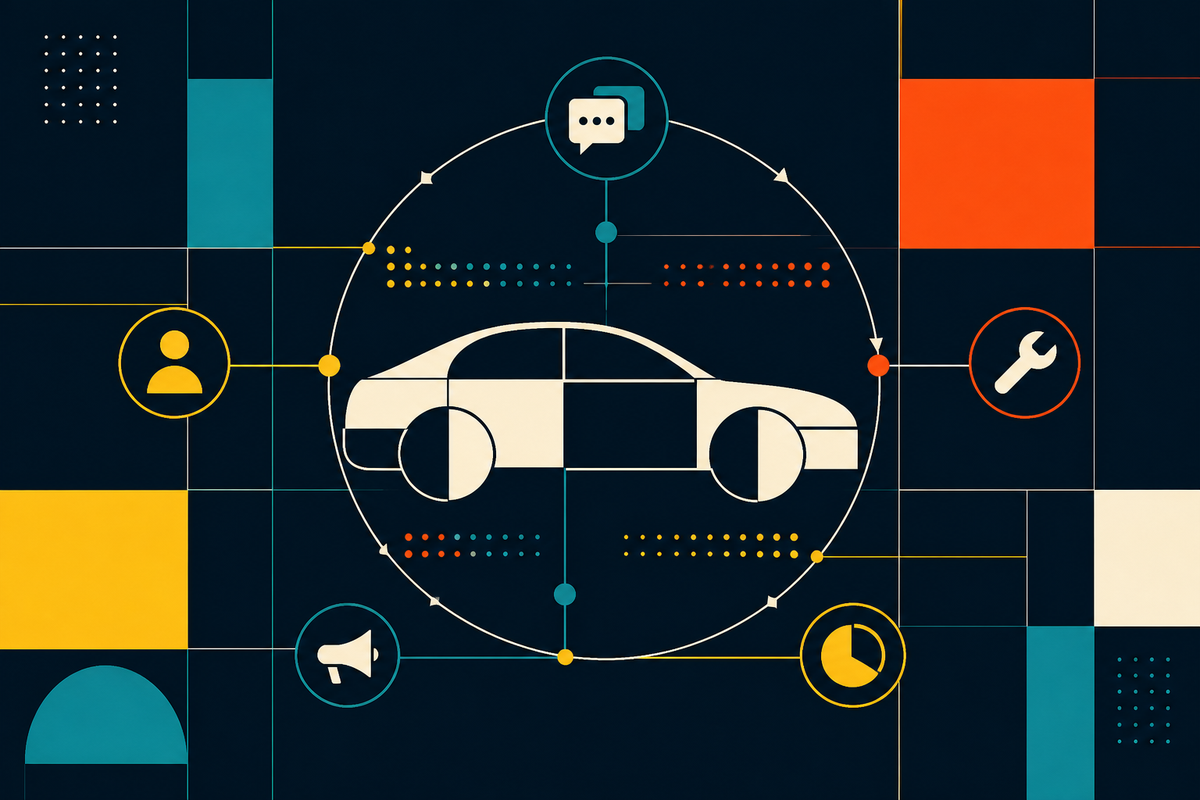
Impel's product suite follows the customer rather than the dealership org chart. Merchandising AI produces and improves the inventory presentation. Chat AI handles website conversations, including VIN-specific questions and vehicle recommendations. Sales AI answers incoming leads, qualifies interest, follows up and schedules showroom appointments. Service AI works on reminders, abandoned conversations, declined work and lapsed customers. Marketing AI uses dealership data to time trade-in, lease-end, loyalty and repurchase outreach.
The customer loop
The benefit is most legible in the chores people dislike. Leads arrive after hours. Follow-up needs persistence but not improvisational genius. A salesperson should not have to copy facts from a vehicle-history report into a message. A service adviser should not spend the afternoon chasing every customer who declined a repair. Impel's latest Sales AI can generate a personalized video introduction and attach what it calls a digital dossier - window sticker, vehicle history, 360-degree tour, feature highlights and payment calculator - to the first response.
For staff, the sales pitch is capacity. For managers, it is consistency: faster responses, brand-controlled language, complete follow-up and a record of what happened. For the buyer, at its best, it means not having to repeat the same details to every department. The risk is equally plain. A confident machine discussing price, financing or availability can make an expensive mistake. Automotive context and guardrails are therefore not decorative features; they are the product's permission to operate.
The vertical in vertical AI
Impel's moat is not a prettier sentence. General models can already write a warm follow-up. The harder work is knowing whether the exact vehicle is available, when the service lane is open, what a manufacturer allows a dealer to promise, how a lead is represented in the CRM and which conversation should stop when a human takes over.
That is where the company's automotive roots become useful. Impel integrates with dealership management systems, CRMs, websites and marketplaces. Its agents are configurable by store, brand and program. The Outsell acquisition added longer customer memory and predictive outreach. An image tool, a chat tool and a marketing platform might each be replaceable alone; connected to years of dealer workflow and one another, they become harder to pull apart.
Impel has also invested in model safety. In 2025 it showcased a domain-tuned Meta Llama model deployed with AWS through Amazon SageMaker. The company reported a 20 percent improvement in accuracy over the third-party model it replaced. Its research team separately released Archias, an expert model and benchmark designed to detect prompt injection, pricing manipulation and out-of-domain misuse. The work is a reminder that “knowing cars” also means knowing when not to answer.
Selling software to a business full of software
Dealership technology is crowded. CDK Global and Reynolds and Reynolds sit deep in systems of record. Tekion has a modern cloud platform. Cox Automotive spans listings, wholesale and retail tools. Fullpath, Toma, Numa and Stella Automotive AI attack pieces of marketing, voice and conversation. Gubagoo, DealerOn, Orbee and automotiveMastermind approach the buyer from other angles.
Impel's answer is breadth with specialization. It does not need to replace the DMS; it needs to activate the data inside it. It can begin with a visible product such as a WalkAround or Chat AI and expand across departments. The business model is recurring enterprise software, sold through demos and contracts. Pricing is private and likely varies by product, rooftop, inventory and usage. Integrations and implementation make the relationship stickier than a self-serve subscription.
The growth capital reflects that strategy. Wavecrest Growth Partners led a $22 million investment in 2018. Silversmith Capital Partners led a $104 million growth-equity round in 2023, with Wavecrest participating. The Outsell purchase came the next year. By 2025, Impel was describing itself as a company valued above $1 billion. FM Capital joined through a secondary share sale that December and increased its position in July 2026; neither transaction's price was disclosed.
Partnerships provide another route to scale. FordDirect made Impel's conversational AI available to more than 3,000 Ford and Lincoln retailers. Mitsubishi certified Sales AI, Chat AI and Merchandising AI for its U.S. network. TrueCar's 2026 agreement is larger still: Impel will provide customized agents and shopping experiences for a platform connected to 11,500 dealers and 250 membership organizations, including credit unions and affinity programs. That is not a one-size-fits-all chatbot. A Sam's Club member, a military family and a credit-union customer may arrive through different rules and expectations.
The handoff is the story
Automotive retail remains a human business because buying and maintaining a vehicle is expensive, infrequent and emotional. Impel's mission is not credible if it simply adds another automated voice. It works when software absorbs the repetitive administration and hands a better-informed customer to a person at the right moment.
Public case studies show why dealers listen. Etheridge Ford in Australia said Impel engaged nearly 1,000 leads in three months while saving 400 labor hours. Murfreesboro Nissan reported $110,000 in incremental repair-order revenue over two months. Walter Automotive Group reported cutting days-to-sale by 56 percent across six luxury rooftops. Results from vendor case studies vary by store and should not be treated as promises, but the pattern is coherent: respond sooner, persist longer and preserve staff time for the conversation that needs a human.
There is also a less obvious adoption problem: people must learn what to delegate. Impel and mobile-learning company RockED launched an Automotive AI certification with more than 70 short modules covering practical use and oversight. Two thousand industry professionals enrolled during a limited four-week rollout in 2025. The program is partly education and partly market-making. Software spreads faster when a sales manager can explain where it belongs, where it should yield and how to judge its work.
The useful lesson in Impel's history is not “add AI.” It is to enter through a job with an obvious before-and-after, then earn the right to handle adjacent work. The 360-degree spin was a small product with a front-row seat to buyer intent. Every expansion since has moved closer to the dealership's memory. If Impel succeeds, the machine will not replace the showroom. It will make sure the showroom never quite closes.