The most valuable person in a real estate agent’s database is not always the person who replied this morning. Sometimes it is Angela, who clicked on an apartment six months ago, stopped answering, changed jobs, changed neighborhoods and has just begun looking again. The industry calls Angela a lead. The ordinary workflow calls her old. LocalizeOS calls her unfinished.
The brief, before the long follow-up
- LocalizeOS nurtures leads that agents and brokerages already own; it is not a lead generator.
- Its AI, hunter, texts buyers, learns preferences, suggests homes and flags intent.
- Human homebuying advisors step in when a conversation needs more than automation.
- Public plans begin at $249 monthly plus a referral fee on successful business.
- The fit is strongest for teams with a large, contactable lead pool and fast agent handoffs.
There is a small absurdity at the center of residential sales. Brokerages pay to acquire names, phone numbers and fleeting signs of interest. Then busy agents concentrate on the people nearest to a transaction. This is sensible. It is also how a database becomes a graveyard. A person who is merely early looks identical to a person who will never buy.
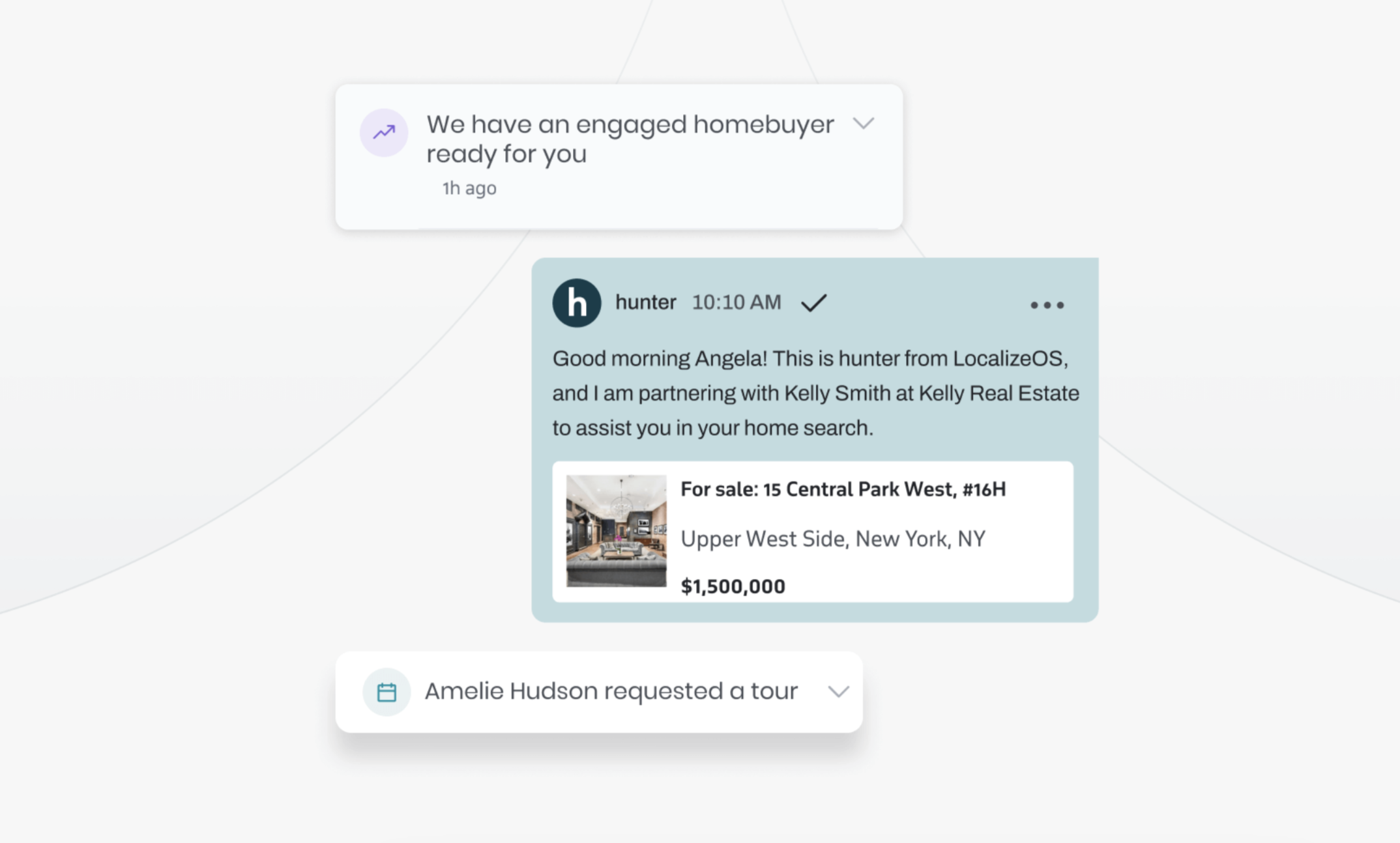
LocalizeOS built its company around telling those two people apart. Its core system imports contacts from a CRM, a lead source or a plain spreadsheet. Hunter begins an SMS conversation, builds a profile from budget, location, timing and home preferences, and sends listings that give the buyer a reason to reply. LocalizeHQ shows the brokerage what is happening. LocalizeBI shows where the opportunities sit. A human advisor can intervene. When the buyer crosses a defined threshold - perhaps renewed engagement, perhaps a request for a tour - the agent returns.
Bring the backlog
CRM, portal, CSV or spreadsheet
Start talking
SMS, preferences and listing feedback
Score intent
Qualification and pipeline visibility
Call the human
Showing, offer and close
It began with the neighborhood, not the chatbot
The company’s prehistory makes the current product easier to understand. Its roots run through Madlan, the Israeli property-information business founded in 2012, and Localize.city, a New York consumer search service launched in 2018. The original question was what a homebuyer could not see in a listing: noise, transit reliability, future construction, sunlight, the life around an address. Localize.city assembled public, commercial and private data into answers.
By 2021 the organization had raised a $25 million Series C led by Pitango Growth. The pitch was broadening. Property intelligence could do more than decorate a search result; it could power recommendations, guide a conversation and reduce the manual work between first click and serious buyer. LocalizeOS, the brand founded around that next act, put the agent workflow at the center.

The distinction is important. Plenty of software can send a canned follow-up. LocalizeOS’s claim is that property knowledge makes the conversation useful, while patience makes it valuable. A buyer can remain in the system for weeks, months or years. Each response can sharpen the next recommendation. The agent does not need to perform this ritual every morning for hundreds of people.
“We take all the manual, repetitive tasks that are better done by technology from the agent.”Omer Granot, CEO of LocalizeOS
The first thing that failed was the obvious thing
Elegran, a Manhattan brokerage affiliated with Forbes Global Properties, offers the cleanest account of a changed mind. The firm had already outsourced lead re-engagement to a calling operation built around an inside-sales-agent model. After more than six months, managing director Jaren Antin said the brokerage had not seen tangible results.
It did not answer disappointment with a company-wide leap into AI. Elegran tested. It worked with landlords and developers over three to four months, then chose roughly a dozen agents who had large databases and a taste for automation. Contacts moved by CSV; later, LocalizeOS connected to the brokerage CRM and used triggers to route leads into the system. The pilot expanded into a brokerage relationship.
That sequence is more useful than the standard AI fable. The new tool did not win because somebody uttered “machine learning.” It won because the old intervention had an observable failure, the replacement was tried on a bounded pool, and the people in the pilot were disposed to use what came back.
The 6,500-name experiment
Metropolitan Brokers supplied the more dramatic arithmetic. The New York brokerage had 6,500 leads, with a median age of two months, heading toward the discard pile. Its agents had spent time on prospects who were not ready, and the company wanted faster contact without asking humans to repeat qualification questions all day.
LocalizeOS’s published case study says the combination of hunter and its homebuying advisors produced a 5.5 percent deal rate, compared with the 0.5 percent online-lead benchmark cited in the study. The company describes that as twelve times the industry standard. It is a vendor case study, not a controlled trial. Still, it identifies the specific economic promise: recover a few more transactions from sunk acquisition spending.
Vendor-reported case-study figures. “12×” is the company’s comparison; 5.5 divided by 0.5 is 11.
The price reveals the product
An individual-agent plan is publicly listed at $249 per month plus a 15 percent referral fee. A team plan is $749 per month for as many as five agents plus a 12 percent referral fee. Large brokerages negotiate a custom arrangement. The subscription agreement runs for twelve months.
One agent
+ 15% referral fee
Up to five agents
+ 12% referral fee
Bespoke integration
and support
This is not quite ordinary SaaS. The monthly fee pays for access, infrastructure and service; the referral percentage lets LocalizeOS participate in the outcome. That design makes the company’s positioning legible. It is not selling text-message volume. It is asking to be valued against commissions that would otherwise disappear.
It also places LocalizeOS in a crowded stack without requiring it to replace the stack. A brokerage might already use Follow Up Boss, Salesforce, Zillow or StreetEasy. LocalizeOS advertises itself as the connective layer: ingest the lead, do the patient work, surface the opportunity and write the activity back into an operating view. The alternatives include full real estate suites such as BoldTrail, Lofty, BoomTown and CINC, or the older answer - hiring an inside-sales team and making more calls.
The constraints are the point
Hunter cannot revive a lead that never existed, invent consent to text, repair bad contact data or make an agent answer the phone. The system is most persuasive for a brokerage with volume: enough neglected prospects to justify integration, enough property inventory to make recommendations relevant, and enough operational discipline to act on the handoff. A small agent with twenty meticulously tended relationships may be buying scale they do not need.
Geography matters too. LocalizeOS currently advertises service in New York, the Washington, D.C. metro, Chicago and South Florida. Property feeds, buyer expectations and brokerage rules change by market. The original company spent years assembling local knowledge; national expansion is not simply a map recolored.
Then there is the buyer. Persistence becomes irritation when messages are poorly timed, repetitive or unwanted. The useful version of this product remembers, adapts and stops when asked. The useless version is merely a tireless stranger. LocalizeOS’s human advisors are not a decorative extra in that equation. They are an acknowledgment that high-stakes purchases produce questions a funnel stage cannot settle.
The part worth copying
- Start with the expensive backlog before buying another stream of leads.
- Choose a narrow pilot group that has both volume and a reason to use automation.
- Define the handoff before the machine starts talking: engagement, full profile, tour request or another explicit trigger.
- Measure showings, offers and closes - not just replies and messages.
- Keep a human path open for ambiguity, emotion and urgency.
What LocalizeOS sells, in the end, is organized patience. The company turned a real estate habit - following up until somebody is ready - into a system that can operate across thousands of conversations. Its cleverest decision was not to pretend that software should close the home. The machine waits. The agent arrives for the moment that cannot be automated.