A banking app can be charming. It can greet you by name, arrange your spending into agreeable colours and congratulate you for saving money you had quite intended to spend. Igor Tomych has spent much of his career dealing with what happens behind that charming surface. Somebody must make the accounts agree. Somebody must connect the payment providers. And somebody must ask whether the business can actually deliver what the screen has promised.
That is useful work for a founder with an engineer’s past. Tomych leads DashDevs, the software business he founded in 2011, and co-hosts Fintech Garden, where people who build financial products compare experiences. His career passes through UK challenger banking, open banking in Bahrain and the practical mechanics of launching financial software. The subjects sound imposing. His recurring concern is rather plain: how does this thing work when somebody has to use it?
A keyboard before a company
Kharkiv, Ukraine, is where Tomych’s story begins. He describes an early interest in software dating to 1998 and professional outsourcing work from 2003. Across three companies, he moved from developer towards engineering management. Founding his own business in 2011 added a new set of problems to the technical ones. Code had to be accompanied by clients, commercial decisions and people who needed something more useful from their boss than another clever solution.
His education includes a master’s in information security, completed in 2008. Later came the Leading Professional Services Firms programme at Harvard Business School in 2021. These are different kinds of preparation: one concerns the integrity of systems; the other concerns running a business whose product depends on people’s judgement. His working life has required both.
The transition took time. Tomych dates his experience of managing people to 2014 and has described the adjustment from engineering to leadership as a gradual one. There is an appealing lack of theatre in that admission. The founder does not arrive fully assembled, with an executive vocabulary and a talent for delegation. He learns, sometimes while everyone else is waiting for a decision.
Nine months, and a great many questions
Financial technology became a particular focus for DashDevs from 2016. By 2018, Tomych was helping architect and deliver Pi1, the banking platform associated with Project Imagine and the UK consumer brand Dozens. He served as vice president of engineering for Dozens from 2018 to 2020. This put him close to the machinery of a financial product rather than merely its presentation.
The team took the Pi1 platform from development to production in nine months, according to his account of the project. Speed makes a tidy headline. The more revealing detail is how he remembers the uncertainty. There was a destination, but little visibility into how comparable businesses had solved the same implementation problems. Banking had plenty of buildings. It was less generous with the blueprints.
“A journey in the dark at times.”
Igor Tomych, on building Pi1
In 2019, he also helped Tarabut deliver its open banking platform in Bahrain. His later leadership record includes work with Twisto and Param. Across these assignments, the settings change while the engineering questions persist: what information can move, which organisation controls the process, and how do the pieces behave together? A product can travel internationally rather more easily in a presentation than in production.
When continuity became personal
In February 2022, the distance between business planning and ordinary life disappeared. Before Russia’s full-scale invasion, Tomych and his wife got their children onto a flight out of Kharkiv with their grandparents. The airport closed hours later. The couple subsequently left the country too, travelling with relatives. By June, the family was living in Budapest.
For DashDevs, the immediate work included arranging buses, paying salaries in advance and helping employees find accommodation. Clients helped with places to stay. The team continued working from different locations, using remote processes already in place. At that point in 2022, the company had retained every client. That detail matters because it describes something concrete, achieved amid circumstances that no company handbook could adequately cover.
Tomych’s connection to Kharkiv remained explicit. He spoke of returning and helping rebuild, and of an education initiative intended to open a route into IT. In his own career chronology, he also records founding the ITOMYCH fund in 2022 to help Ukrainians. These commitments belong beside the commercial history. They show what the word continuity meant to him beyond keeping projects on schedule.
Give the next builder a starting point
Fintech Core, which Tomych dates to 2022, addresses a recurring business problem: new financial products need many of the same underlying capabilities. At FinovateEurope in 2024, he presented a modular banking solution encompassing onboarding, accounts, balances, payments and back-office functions. The intention was to give teams components they could assemble into a product, with room for their own requirements.
The distinction is practical. A team preparing a banking or payment service must decide where custom development earns its keep and where existing infrastructure can help. Every additional component introduces a relationship to manage. Every shortcut deserves examination. Fintech Core represents Tomych’s attempt to turn accumulated delivery experience into a reusable foundation for other builders.
He returned to the Finovate stage for the Spring 2025 event. The company’s presenter profile described DashDevs as having taken no external funding at that time. That gives the product effort a particular commercial context: a services business putting forward infrastructure of its own. Consulting and product development can inform each other, though each brings its own demands on attention and resources.
A garden planted in an information gap
Fintech Garden grew from another part of the same experience. Building a bank had exposed how difficult it could be to discover the reasoning behind other teams’ decisions. In November 2022, Tomych introduced a community intended to share technical and financial knowledge. Its ambitions included connecting experts and making the industry easier to understand. The original starting point was modest: information about UK banks and a place for blogging.
Today its conversations bring Tomych together with co-host Dumitru Condrea, founder of NOVAFIN. The format creates room for questions that a product announcement tends to hurry past. What went wrong? Why did a particular implementation work? Where did the operating model become awkward? The useful answer may be less polished than a launch speech, which is often a recommendation in its favour.
His interview subjects connect the technical and commercial sides. At Money20/20 Europe in 2026, he spoke with BridgerPay’s Ran Cohen and Daniel Holden about payment failures and orchestration. Another conversation, with payments adviser Viktoria Soltesz, examined the wider cost of choosing payment providers. A low advertised fee can be a poor description of what a business ultimately pays. The interesting arithmetic begins after the sales conversation ends.
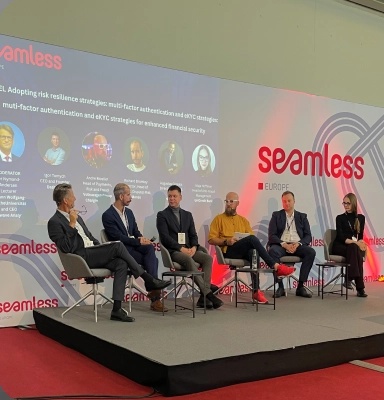
The public speaking follows similar paths. At FIBE Berlin in 2025, he joined Oliver Mohseni Skoglund, Roger Berger and Oana Ifrim to discuss new banking revenue streams and business models. His World Banking Forum material in 2026 turned to stablecoins. Across these settings, the discussion keeps coming back to the relationship between infrastructure and the business that depends on it.
The ledger gets its moment
In August 2026, Tomych took the guest’s chair for a conversation with Arthur Bedel. The subject was whether to launch a bank. His emphasis fell on control of the business process, including what happens when onboarding and customer checks are handed over to vendors. The ledger, too, received attention. Accounting is easily overlooked in a discussion of digital invention, until someone needs to establish whose money is where.
September brought a Fintech Garden conversation with Condrea about AI and financial management. Tomych returned to accounting fundamentals: cash flow, profit and loss, and the data needed to distinguish them. Their example of an annual subscription makes the point accessible. Cash leaving an account today and an expense distributed over a year describe different things. A predictive system needs to understand the difference before its advice becomes useful.
These are revealing subjects for someone working around AI. The discussion spends time on the quality and structure of the information underneath the proposed intelligence. There is a familiar engineer’s patience in that choice. A marvellous answer to a badly specified question can still leave a customer with a rather ordinary problem.
Reality has the casting vote
Tomych has a phrase for the discipline he values: the “best reality mapping model wins.” In practice, that means testing assumptions about markets, people and systems against what actually happens. His daily routine mixes project reviews, leadership discussions and client work; Getting Things Done is one framework he uses to organise it. The tools are recognisable. The number of competing demands is less forgiving.
There is also a small, pleasing anecdote about his personal website. He bought tomych.com in 2008, then published a return-to-blogging note in October 2023. Fifteen years is a generous interval between acquiring a writing desk and sitting down at it. His intended subjects were fintech, management and the technical interests collected along the way. Even people who help others launch things can have a project waiting at home.
The work now spans building software and asking people how they build theirs. That pairing suits the career: an engineer who has had to learn leadership, a founder whose team has worked across borders under extraordinary pressure, and an interviewer interested in the decisions beneath the announcement. The app may have the agreeable colours. Tomych keeps returning to the parts that must add up.