Somewhere between tapping “send” and seeing a payment arrive, an apparently simple banking app becomes a committee. A bank, an identity provider, a payment processor, a ledger, and a compliance system all have business to conduct. The customer sees a confirmation. Someone has to make the committee agree.
That is the territory DashDevs occupies. Founded by Igor Tomych in 2011, the company builds financial software for businesses whose customers would probably prefer never to think about software. Its most interesting move has been to take the infrastructure learned through individual assignments and package it for the next assignment.
- Custom fintech engineering, plus a reusable platform called Fintech Core.
- Client work includes Tarabut, Chip, Downing, Dozens, and Kleos.
- The proposition: reuse financial plumbing; spend more effort on the product.
First came the apps. Then came the money.
DashDevs’ early history includes Cameo, the video app acquired by Vimeo, and TV24.se. Those were consumer products, where the interface carried much of the argument. The company dates its turn toward fintech to 2016-2018, when work with Downing and Chip brought investment management, savings, identity checks, and financial data into the brief.
The customers had changed the curriculum. An attractive screen still mattered, but so did the journey underneath it. For Chip, DashDevs describes building banking-account integrations and preparing software for demanding security requirements. For Downing, it describes an outdated architecture that could no longer comfortably support growth. Its published Downing assignment lists eight people, one year, and a $500,000 budget.

This is a useful way to understand its expertise. DashDevs sells the work between disciplines: product discovery, design, architecture, mobile and web engineering, testing, and cloud operations. Its buyers include banks, payment businesses, lenders, investment managers, and brands adding financial services. They are buying help connecting a commercial idea to systems that must handle actual money.
Nine months is only one clock.
Consider Tarabut. The public case study describes a ten-person team, nine months, and a $500,000 budget. The brief called for connecting Bahrain’s 24 commercial banks while building around newly issued open-banking legislation. The difficulty was simultaneously technical and institutional: an application had to work with other organizations’ systems and rules.
Dozens supplied a different challenge. Its proposition joined spending, saving, tracking, and investing in one app. DashDevs says a cross-functional team of more than 60 people delivered the launch in nine months. The company had to coordinate numerous outside integrations while the product pursued e-money and investment permissions.
“DashDevs gives you a one-team feeling.”
Aritra Chakravarty / Founder, Dozens
That is a telling compliment for an outside developer, published in the agency’s client testimonial. Coordination was part of the product.
But Dozens closed its consumer operation in 2022. Its explanation pointed to pandemic disruption, lost investment and business deals, and a tougher funding environment. Project Imagine shifted toward business customers. The episode puts the delivery claim in perspective: a working product can reach the market quickly and still struggle to finance its future. Engineering speed measures one problem. Commercial survival measures another.
The second build should remember the first.
In 2022, DashDevs launched Fintech Core. The idea follows naturally from that history: preserve the recurring infrastructure so the next team can configure and extend it. DashDevs demonstrated the product at FinovateEurope in 2024, showing banking and payment capabilities to an audience of financial-technology buyers.
Today’s product page lists 16 infrastructure modules and more than 20 vendor integrations. There are modules for customer records, the ledger, reporting, authentication, and back-office work, alongside connections for banking, cards, payments, and verification. DashDevs describes a typical 12 weeks into production. Scope and provider readiness still determine what a particular customer can launch.
The operating view may be more revealing than the feature list. Fintech Core shows a payment’s status, provider, fees, failure reason, and reconciliation state. It separates product logic from individual vendors, allowing routing and fallback arrangements. For an operator, the useful question is beautifully unglamorous: why has this particular payment stopped?
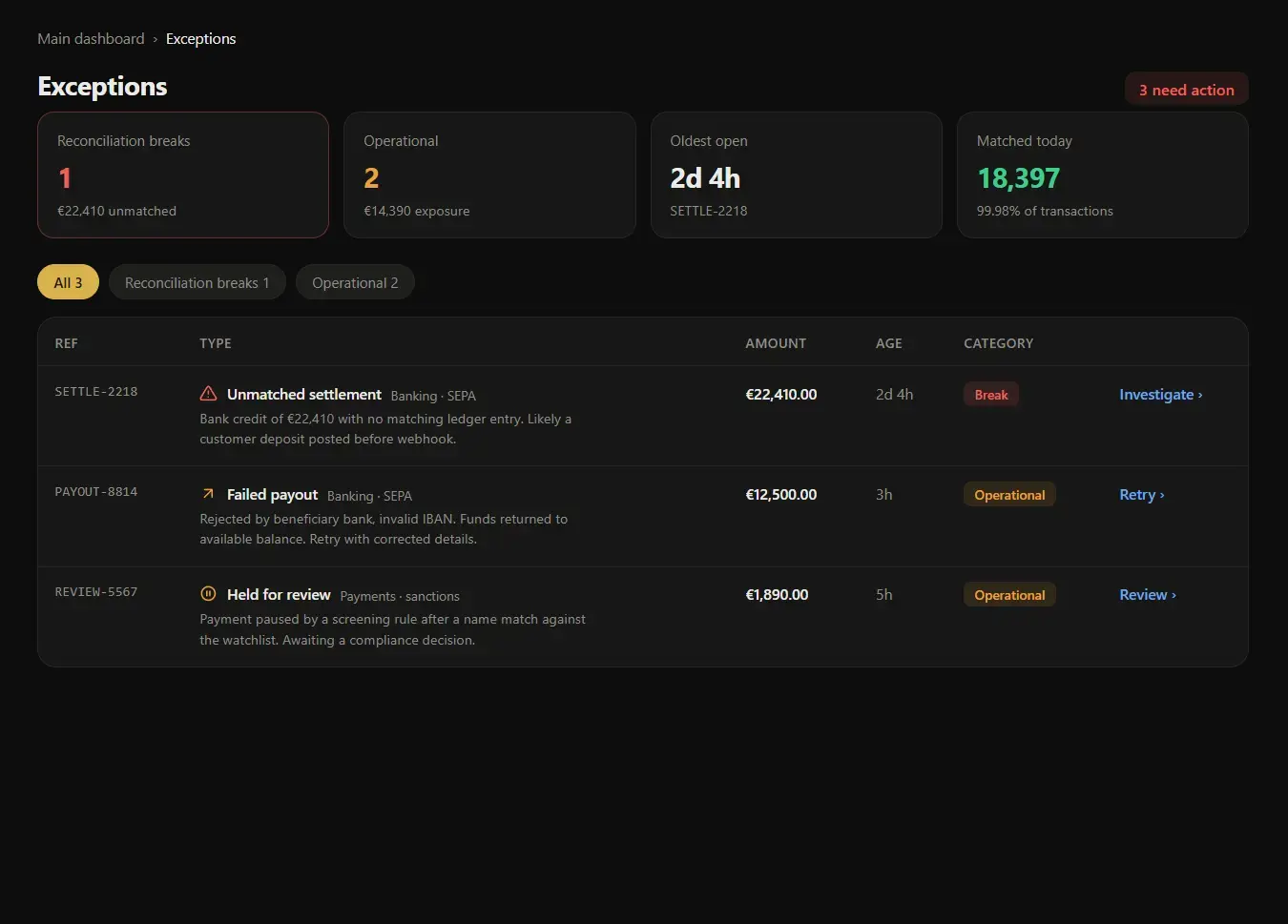
The expensive part is getting stuck.
Kleos makes the dependency problem concrete. DashDevs’ case describes a fintech constrained by its existing provider setup as it tried to expand across banking, cards, and digital assets. The chosen direction was a shared operating layer with greater control over future integrations. That meant making harder architectural decisions early to reduce repeated implementation work later.
A September 2026 announcement adds a measurable detail. DashDevs integrated Sumsub’s identity, business-verification, and transaction-monitoring capabilities into Fintech Core. At Kleos, DashDevs reports verification completion rising from 68% to 88% and manual compliance-review work falling by roughly 70%. These are vendor-reported results for one implementation, with a clear practical objective: fewer people stranded at the front door.
+20 percentage points · company-reported results
DashDevs earns through engineering engagements and platform implementation. Its service models include fixed-price or time-and-materials development, monthly dedicated teams, and hourly specialists. Choosing among them also assigns responsibility: a customer adding staff needs the management capacity to direct those people.

The company’s learning culture has some concrete machinery too: mentoring, internal lectures, certification support, and partial education funding appear in its employer materials. Its own business depends on turning specialist knowledge into something colleagues can reuse.
The lesson a buyer can copy is to map dependencies before admiring screens. Ask to see a failed payment, a rejected identity check, and a provider replacement. Reusable software helps when the product fits its modules and the operator has viable funding, distribution, and regulated partners. A completely unusual workflow may need more custom work. Even excellent infrastructure needs a business worth running on it.