Fourteen law firms had a problem in common. Howard Finger had a proposal: they could work on it together. In 2004, VinciWorks brought international and UK firms into a shared effort to develop anti-money-laundering training. They would keep competing for clients. But the lesson explaining how to recognise suspicious activity need not be reinvented behind fourteen separate doors. Even lawyers, whose working lives depend on distinctions, could find something useful in that one.
The arrangement became the Online Compliance Consortium. It also gives a useful introduction to Finger, the founder and former CEO of VinciWorks. Across a career in commercial law, online trade publishing, compliance software and intellectual property services, he has kept returning to a practical question: what happens when professional knowledge becomes easier to share?
There is a second question running alongside it. How does the person who builds a business stop becoming the person every part of it depends on? Finger eventually put that problem into a book, with help from a business coach and a rabbi. His career makes an interesting case for allowing other people into the room.
Fourteen firms, one shared problem
VinciWorks dates its founding to 2002. The consortium followed two years later, giving the young company a way to develop training with the people expected to use it. Its principle was that compliance offered no competitive advantage. A firm’s advice, relationships and judgement could distinguish it from a rival. Duplicating the basic training required to meet a shared obligation offered a less persuasive use of everyone’s time.
Finger gave the agreement a compact description: “It was defence in numbers.” Each firm could point to thirteen peers using the same training. For a supplier, that was a way to bring customers into development. For the customers, it offered the reassurance of a common approach. The bargain addressed both the content of the course and the confidence people needed to adopt it.
The appeal is easy to understand without pretending cooperation comes naturally. People who compete professionally still encounter the same administrative jobs. Sharing one of those jobs requires a clear boundary around what is being shared. Finger’s proposal drew that boundary around compliance learning, leaving the firms’ competition for business outside it.
Shared expertise in anti-money-laundering training. Separate firms, with their own clients and practices.
Before the course came the catalogue
Finger had already worked on getting professional information to travel. He began in commercial law in London and Hong Kong, becoming a company and commercial law partner in Hong Kong. His education included an honours degree in Business Law and qualification through the Law Society’s College of Law. Contracts and commercial arrangements were familiar territory before he began building the businesses that supplied them.
At Global Sources, his work moved into the transition from print publishing to online trade. In 1995, as a senior vice president, he was involved in designing, building and managing its website. A trade publisher’s established task was to connect people with commercial information. Putting that work online changed how buyers could reach it, and how the publisher could distribute it.
That experience sits neatly before VinciWorks, although the products were different. A catalogue helps a buyer discover a supplier. A training course helps a professional understand a responsibility. In both cases, the information has to arrive in a form someone can use. Finger’s move into learning carried that distribution problem into another profession.
By 2007, more than a hundred UK law firms were using VinciWorks. The customer base gave the original agreement a life beyond its first participants. A business founded around online learning had found a particular audience and a method for working with it.
Global Sources
Print meets online trade
VinciWorks founded
Learning moves online
Consortium established
Law firms pool expertise
The customers who helped write the product
There is a difference between inviting customers to applaud a finished product and asking them to help write it. In January 2015, experts from 23 law firms contributed to a substantial revision of VinciWorks’ anti-money-laundering courses. Their work covered scenarios, exercise questions and the training itself. The update also introduced a new interface and more opportunities for firms to insert their own material and links.
The details matter. A shared course still had to accommodate a firm’s own procedures. Collaboration could create common material while customisation connected that material to a particular workplace. A useful course had to survive both tests: agreement among the contributors and relevance to the person taking it.
“This AML project is yet more evidence that when there is no competitive advantage, sharing makes sense.”
Howard Finger · January 2015
The participating firms included DLA Piper, Hogan Lovells, Allen & Overy and Herbert Smith Freehills. Their compliance specialists supplied experience from different organisations. That gave the process something a supplier working alone would have difficulty manufacturing: a group of customers who could recognise the situations the training needed to address.
Finger was still convening those conversations in September 2017, when he chaired VinciWorks’ first risk summit at the Soho Hotel. More than thirty senior counsel and heads of risk gathered to discuss the issues they wanted their boards to notice. Data protection and the approaching implementation of GDPR occupied much of the discussion, alongside cyber risk and board responsibility.
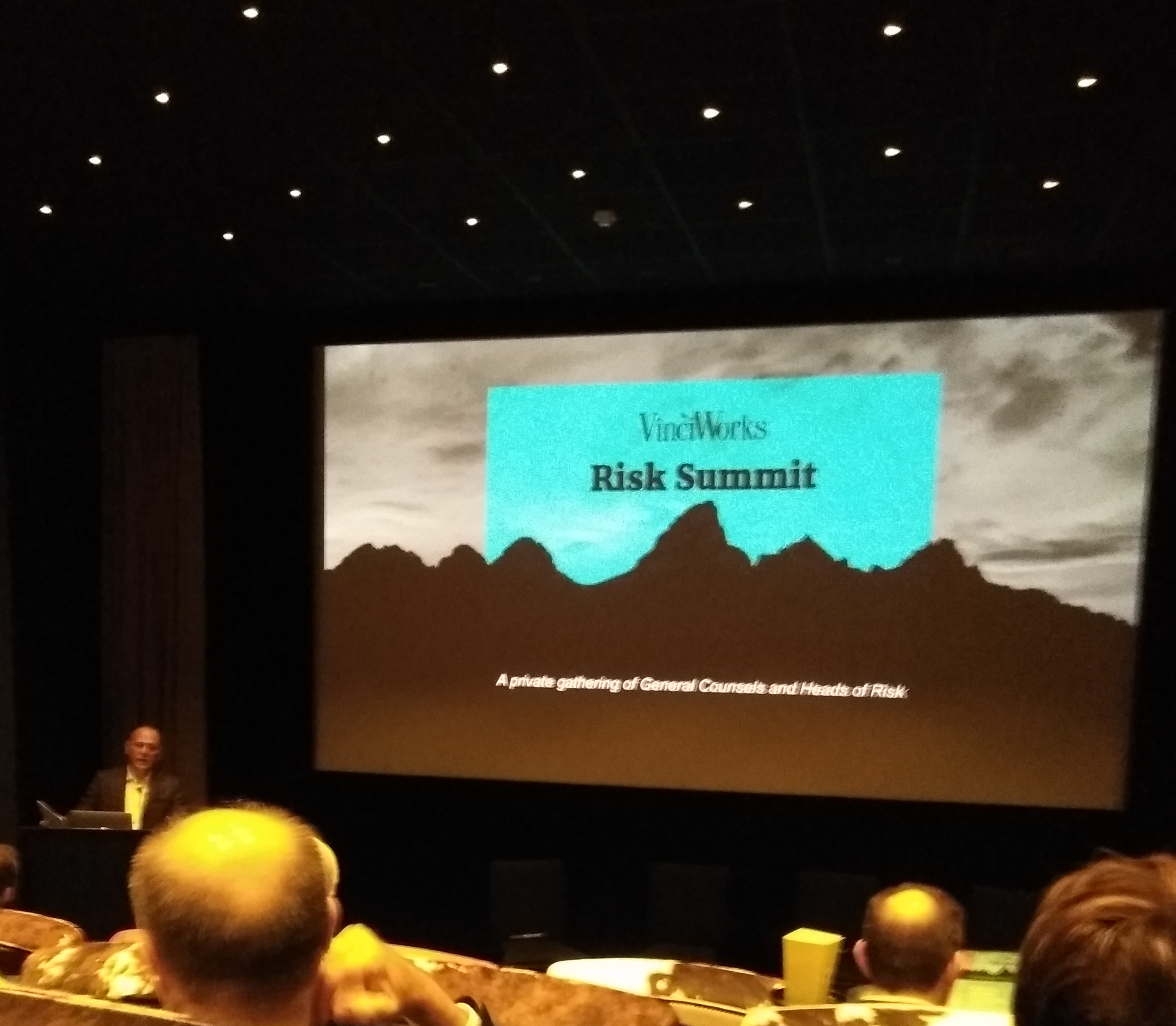
The summit brought together people from law firms, accountancy businesses and companies. Participants included representatives of Grant Thornton International and Peninsula Petroleum, as well as Airmic’s Julia Graham. The gathering extended the cooperative habit beyond a course-writing group: professionals could compare concerns before those concerns became another urgent item on a board agenda.
The founder who needed a system
That same year, Finger became a co-author of The Mindful Entrepreneur, published by Xoum. Joel Gerschman brought business-coaching experience; Aryeh Goldman brought his work as a rabbi and teacher. Finger brought the experience of developing VinciWorks. The book organised the relationship among those three people into a story about building a business with purpose.
Its practical ambitions included profitable growth and a company able to operate without its owner’s constant involvement. That is an awkward aspiration for a founder. Starting a business rewards the willingness to get involved in everything. Growing it eventually requires a person to stop treating that willingness as an operating system.
Finger and Gerschman discussed their collaboration on Steve Glaveski’s Future Squared podcast in May 2017. Their conversation covered defining a core purpose, setting measurable goals, making action plans and finding time to work on the business itself. These are unglamorous subjects beside the usual entrepreneurial furniture of launches and exits. They are also the subjects that decide who has to answer the next question when the founder leaves the office.
The book gives Finger’s public story a different emphasis from the standard procession of job titles. He appears as someone willing to turn his own business experience into material for examination, alongside collaborators with other kinds of expertise. The arrangement echoes the consortium: bring people with different experience to a shared problem, then give their work a usable form.
There are less corporate details, too. Finger holds a black belt in karate. His biography also records completion of the daf yomi study cycle. Neither detail explains a company’s performance, but both make room for a person beyond the organisational chart. A founder’s biography need not end at the edge of a spreadsheet.
A sale, and a wider audience
On 4 October 2021, Marlowe acquired VinciWorks. By then, Josh Goodhardt was CEO and Finger was identified as founder and executive chairman. The distinction matters to the story: the business already had a leadership structure that reached beyond the founder’s original role.
At the time of the transaction, VinciWorks served more than 530 global clients. Contemporary reporting put the deal at at least £54 million. Marlowe’s later annual results described £57.5 million in total consideration, including performance-dependent payments. Those figures describe the acquisition of the business; the commercial significance was that a specialist supplier was entering a much larger compliance group.
Finger’s public response focused on that access. He pointed to Marlowe’s network of forty thousand compliance customers and the opportunity to get VinciWorks’ tools and training to more organisations. An entrepreneur who had spent years developing shared learning was now discussing a larger audience for it.
The teaching continued in a different format. In 2022, Finger and Goldman launched The Mindful Entrepreneur Podcast, with Gerschman also participating. Episodes addressed business purpose and content marketing. One later instalment featured Finger recommending No Rules Rules. The format made the business conversation smaller and more direct: a question, a discussion, a book from the shelf.
Another profession, a familiar question
Insperanto now lists Finger as executive chairman. The company works in patent translation and foreign filing, with Adam Fox leading the business. Finger’s role centres on strategic oversight and the experience of building and growing technology-enabled services companies.
The setting puts him near professional expertise again. Insperanto combines translators, paralegals and intellectual property specialists with software designed to coordinate instructions and make work more visible. Its Filing IQ platform supports that process while keeping expert judgement involved. The parallel with compliance learning is a useful way to read the career, rather than a claim that the two businesses do the same job.
Each chapter asks people to trust information and work they cannot simply produce afresh every morning. Finger has approached that problem as a lawyer, a publishing executive, a founder and a chairman. His most distinctive early agreement remains pleasingly plain: fourteen firms could share their homework. The hard part was getting them to agree that it was homework worth sharing.
Continue the conversation
Explore the businesses, the book and the interviews.