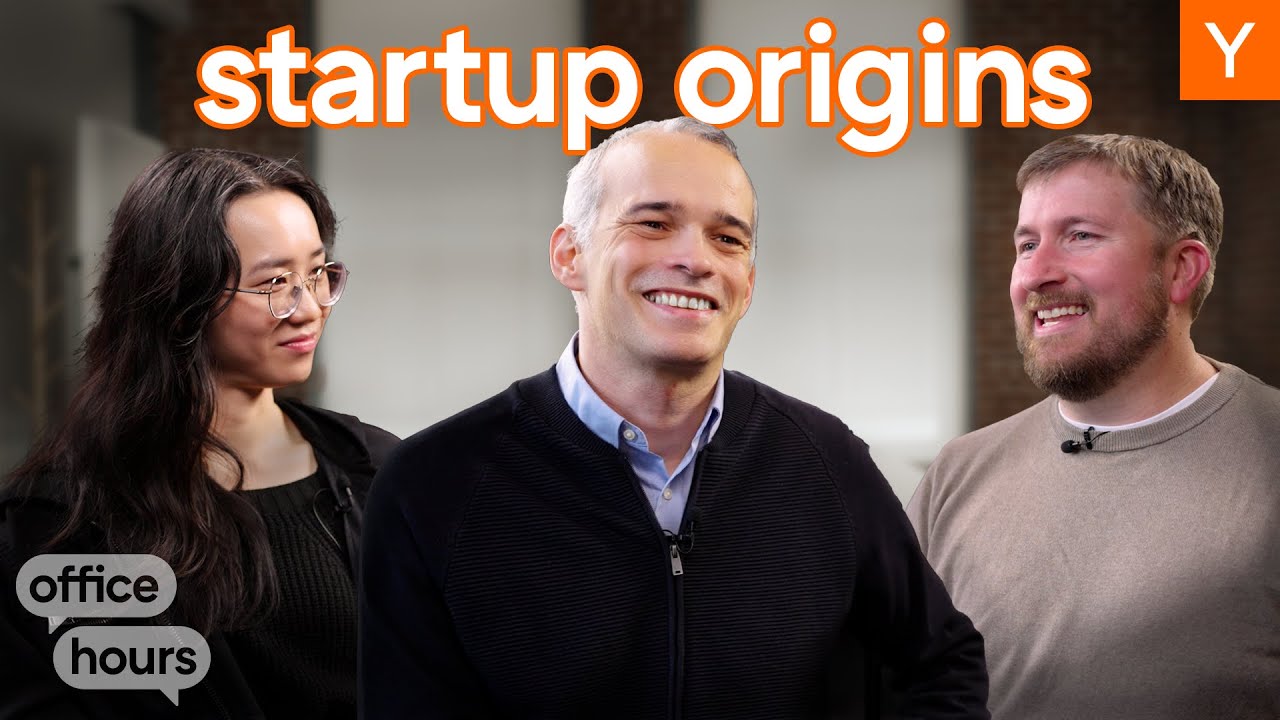
Every founder, sooner or later, does the same thing. They look at Airbnb and imagine that the early days must have been something special — a garage lit by genius, a growth chart that only ever pointed up and to the right. It is a comforting story. It is also, according to the people who have funded more of these companies than almost anyone alive, almost entirely wrong.
“We like to put companies on a pedestal as if they were great from Day Zero,” the narrator of this episode of Y Combinator's Office Hours says early on, “but it isn't actually like that. It's actually the tens of thousands of decisions along the way that made them great.” The premise of the episode is disarmingly simple, and quietly radical: at one point or another, the founders of companies like Airbnb, Stripe and Dropbox looked indistinguishable from every other startup getting started in their time. Every company, no matter how large it eventually becomes, has to start somewhere — and that somewhere is usually a lot more ordinary than the legend suggests.
What follows is a relay of YC group partners — Jared, Diana, Michael, Harj, Pete, Brad, Nicola, Aaron — each taking the microphone to recount a real interview, a real application, a real founder who walked in with almost nothing and walked out with a bet placed on their future. Taken together, their stories form a field guide to what greatness actually looks like before anyone calls it greatness.
The founders who brought a beaker
The story that anchors the episode belongs to Solugen, the industrial-chemicals company that, for a long time, made essentially one thing: hydrogen peroxide. Not the exotic kind — the same stuff you buy at the drugstore to clean a cut. What Solugen had invented was a new process, using an organic catalyst, that made the compound without massive heat, without massive pressure, and without the constant threat that it would blow up. Crucially, the process scaled down, which meant the founders could start by making very small quantities.
So they did. Jared, who was in the room, remembers it vividly. “This was back when interviews were so in person,” he recalls, describing the old-school ritual where founders would haul their hardware — or, memorably, their food — straight into the interview. The Solugen founders brought chemistry. “They literally brought in hydrogen peroxide,” Jared says. “They literally have a beaker of hydrogen peroxide, which I think at the time was like most of the hydrogen peroxide they had ever produced.”
From garage batches to tanker trucks
Rather than raise a hundred million dollars to build a giant facility, Solugen's founders set up shop in their garage, made bottles of hydrogen peroxide, and sold them to anyone who would buy one — just to prove there was a real business. Today, the company runs a huge plant in Houston that ships tanker-truck-fulls of hydrogen peroxide every single day.
What convinced YC wasn't the beaker itself. It was what the beaker represented. “These guys clearly had great backgrounds,” Jared explains, “but unlike some of the academic science folks that we interview from time to time, these guys were doers. They weren't waiting for anyone's permission to go do the thing.” They had made the product and were already hunting for someone to sell it to. That, he says, is a bias for action — a doer mentality that applies to any startup, in any industry.
Paired with that action was a certain humility about the unknown. The best founders, the partners argue, are willing to admit they may not have every step mapped out — but they are signed up for the ride anyway. “You have to be comfortable with this idea that you're going to do a thing and work really hard at it, and you don't really have all the details worked out,” the narration continues, “but that's okay.”
Which leads to one of the cleanest pieces of advice in the whole episode: “The most important thing is to decide that you're going to make it there and to take that first step on the journey.” Sometimes, that first step is simply building a demo before you have a single customer — exactly what CaptivateIQ did in the Winter 2018 batch, when one founder built software to untangle the genuinely complex math of sales-team compensation, with no customers and nothing else. “That's how every company starts,” the partners note.
The myth of the empty market
CaptivateIQ also illustrates a counterintuitive lesson about competition. The founders convinced YC that there were only two major players in their space in the U.S. — and that both were big and both were, frankly, bad. That's not a warning sign. It's a green light.
It is a reframing that cuts against startup folklore. Founders love to claim they have no competitors. The partners hear that and worry. The far healthier signal is a fat, lazy incumbent — proof that a market exists, that budgets exist, and that all a startup has to do is be meaningfully better. “This is one of those companies,” the partners add of CaptivateIQ, “where everything they kind of said at the interview turned out to be true.”
Quirky, intense, and impossible to average
If there is a psychological profile buried in the episode, Diana and Michael sketch it. The best people at the top of their careers, they argue, are not well-rounded. They are quirky — and for a good reason. “If you're average, then it's like, okay, you're not going to build a great company,” Michael says, “because building a successful large company, by definition, you're going to be multiple standard deviations out of the norm.”
The uncomfortable corollary is that the very strategy that gets a young person into an elite school, then a job at Meta, then an Ivy League degree, is not the strategy that makes them a successful founder. Hedging, optimizing, keeping options open — sensible in most careers — is a losing game in startups, where so few people win that you have to be both lucky and genuinely good. As the partners put it, the hard truth is that “so few people turn any amount of their paper stock value into real cash.”
Harj and Pete give the trait a name: obstinance. They tell the story of Amplitude, now a public analytics company, which YC interviewed back in 2011 — when it was neither analytics nor public. The founders, Spencer and Curtis, applied with an Android app that turned voice into text so you could send messages while driving. YC didn't believe in it. Gmail creator and early Google employee Paul Buchheit sat in the interview hammering the point: Google is great at this, how will you win?
Spencer's comebacks were so intense, so determined, that YC funded the founders despite disagreeing with the idea. It took Amplitude about a year and a half after YC to find the analytics product that made it — and once they did, it took off. “There's almost a sort of obstinance about the best founders,” the partners observe. “Whatever they're working on, they don't do it at 60 or 70 or even 80 percent. They're always at 100 percent, committed, with high conviction.”
The list of founders who arrived with objectively bad ideas is long and glittering. The Brex founders were working on a VR startup. The Segment founders showed up in an edtech idea — software to let professors poll students during lectures — with zero traction. YC pushed them: you're great engineers, why not build something technically hard? They refused to abandon their mission of fixing education, but they were, as the partners put it, “obstinate without being obstinate without direction.” Eventually they pivoted into developer tools and API services, built Segment, and sold it to Twilio for roughly $3.2 billion.
Obstinance cuts both ways
The same intensity that makes a founder unstoppable in the right direction can dig them into the wrong direction for even longer. But the partners are clear about which risk they'd take: a founder who operates at 60 percent risks being permanently stuck in a mediocre “safe” zone. The all-in founder, once pointed the right way, is “basically unstoppable.”
Say less, and say it plainly
Grit gets a founder to the interview. What happens inside the room is a separate craft — and Brad and Nicola argue that the best founders are startlingly clear from day one. Brad's example is Jeeves, a digital bank for startups based outside the U.S. When he re-read their application, one thing jumped out: it was plainly written and remarkably succinct. Asked how much progress they'd made, the founders answered in two sentences: they had completed a deal with their first bank partner and were ready to onboard initial customers. That was it.
It is exactly the opposite of what most applicants do, which is to slide into pitch mode — paragraph after paragraph, “first I did this, then I did that.” The confident move is to state the single most noteworthy thing you've done, and stop. In the interview itself, Brad remembers, the Jeeves founders were upfront about what they knew and, more importantly, what they didn't. They didn't try to razzle-dazzle with fake traction. There were “many question marks,” and they didn't hide any of them.
The partners invoke a classic Paul Graham essay: the most convincing way to talk to investors is simply to tell them, plainly, what you're working on, and let them build the mental model themselves. That is what an interviewer actually wants — to understand who the founders are, what they think, and how they think. And the only way to get there is a genuine conversation, not a performance. With Jeeves, the funding decision wasn't a slam dunk; there were plenty of question marks. But the ten-minute conversation felt real, felt genuine, felt like actual work — and that was enough to say, “let's do it.”
Don't copy the ending
The final warning, delivered by Serbian and Aaron, is aimed squarely at founders who study today's icons and try to reverse-engineer their moves. The danger is that you're studying the wrong chapter. Founders just starting out imagine the growth graph went straight up. They don't see the early, early days — the different idea, the absent product, the thing nobody wanted.
Everything you read in the press, Aaron notes, carries a “PR gloss” that shows only the positives and hides the difficult stretches that made the story worth telling. His antidote is a thought experiment: when you're in the middle of a hard patch, imagine the story you'll want to tell in ten years — and how boring it would be if everything had gone up and to the right the entire time. “You wouldn't learn anything,” he says. “There was no challenge.” The struggle is what makes the story memorable, and it is also what makes the company real.
The proof arrives in the form of Nourish, one of YC's recent healthcare successes, which just closed a meaningful Series A from a brand-name investor. The headlines make it look inevitable. The reality: the team spent the entire batch pivoting, and pivoted five times before landing on the right idea. The team was always promising, always great. But, as the partners put it, “it wasn't always roses.”
That is the thesis, stated one last time in the closing frames: “Truly legendary startups aren't just born that way. They are forged through difficult decisions, uncertainty, mistakes and pain.” The partners close on their own credential — not merely that they've been there, but that they've worked directly with more zero-to-one startups than anyone on the planet. It is a fitting note. The whole episode is an argument that the beginning is never the polished thing we remember. It's a beaker in a room, an obstinate answer to a skeptical question, two plain sentences on an application — and the decision, made before any of the details are worked out, to climb the mountain anyway.
Watch the full episode: Watch on YouTube →