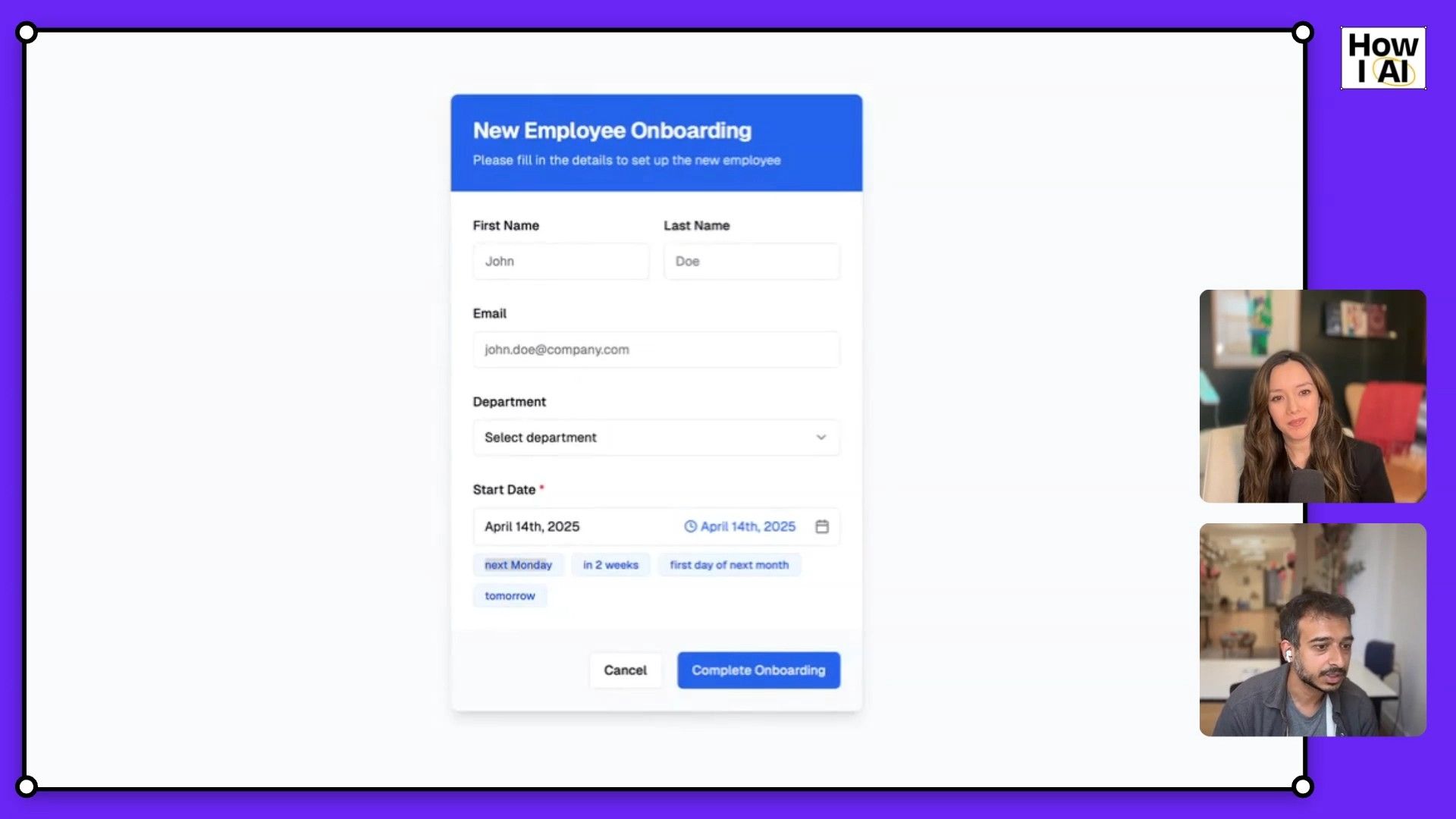
Consider a date picker. An employee starts next Monday, and somebody has to persuade an onboarding form to understand that perfectly ordinary sentence. In How I AI’s opening episode, Gumroad founder Sahil Lavingia works through this small problem with v0, Devin, and Cursor. A prototype becomes a requirement. A requirement becomes a pull request. The viewer can see where the decisions happen.
- Free video and audio lessons in practical AI.
- Guests share their screens and explain the steps.
- Copy a small workflow, then check your own result.
That is an unusually useful opening for an AI show. A calendar is small enough to understand, yet consequential enough to expose the distance between a handsome demonstration and working software. How I AI builds its editorial identity around that distance. Its product is practical instruction, delivered through conversations in which the guest’s screen does much of the talking.
A show built for the pause button
Launched in April 2025, How I AI was the first addition to Lenny Rachitsky’s podcast network. The original promise was roughly half-hour episodes, with guests showing one or two useful applications. Video was central from the beginning. You can listen on a walk, but a screen share rewards the person willing to stop, rewind, and inspect what actually happened.
The intended audience includes product builders, team leaders, founders, and people trying to make everyday work less cumbersome. Their problem is familiar: knowing a tool exists is much easier than knowing what to do with it on Tuesday morning. The show supplies a task, a sequence, and an observable result. Those ingredients make an episode easier to send to a colleague with a specific problem.
The episode library on ChatPRD extends that format into written notes and individual workflow pages. A searchable set of steps gives viewers something to revisit after the demonstration has faded from memory.
- 01WatchSee a real task
- 02TryKeep it bounded
- 03CheckInspect the result
The host has shipped things
Vo brings a particular kind of authority to the chair. She has led product and engineering at LaunchDarkly, Color Health, and Optimizely. Optimizely acquired her startup, Experiment Engine. She also builds ChatPRD. Her experience suits a show about finishing real work.
Her launch announcement described learning through her own experiments as a solo founder and through helping larger product and engineering teams adopt AI. The show’s sensibility follows naturally: investigate a real task, ask how the person approaches it, and show the work. The public material suggests a culture of demonstration and experimentation.

The little mistake worth keeping
Lavingia also showed an AI-generated weekly Slack recap with empty categories and backend changes described as user-facing shipments. Devin located both the assembly script and the text-generation prompt. The proposed correction needed review: a filter that keeps projects with more than one item might also hide a single legitimate shipment. Here, a small annoyance opens a discussion about what the output should mean.
His much-advertised 40x comparison referred to turning a two-week process into a two-hour implementation. It should be read as his comparison, rather than a measured gain across all engineering. He also described a $33,000 internal competition to encourage Devin adoption. That was Gumroad’s incentive budget, separate from the cost of watching How I AI.
The lesson a reader can copy is modest: make the interaction clear before handing it to an agent, then inspect the resulting change. A weak repository, ambiguous requirement, or missing review process makes that sequence harder to trust.
Free to watch. Someone still pays.
How I AI operates as an educational media brand. The episodes are publicly available through YouTube, Spotify, Apple Podcasts, and the newsletter’s show section. Sponsor placements provide a visible commercial model; episode pages thank brands including Enterpret and Vanta. Production and marketing credits identify Penname. The viewer buys the tools used in a demonstration separately, if they choose to reproduce it.
This arrangement places the show between technology media and professional education. News coverage helps readers notice a release. Vendor tutorials help them operate one product. A course can provide a planned curriculum. How I AI’s appeal is the worked example from somebody with a reason to use the tool. Its distribution through Lenny’s network supplies a natural audience already interested in building products.
ChatPRD hosts the companion library and promotes its own product alongside episodes. That relationship is part of the commercial setting. Readers can use the free demonstrations while recognizing that an educational show also creates attention for sponsors and adjacent businesses.
“I’ve been learning a new skill every single episode.”Claire Vo, launch announcement
A company brain, with boundaries
A September 2026 episode moves from small product changes to Stripe’s internal agent, Kai. Engineering manager Sharadh Krishnamurthy demonstrates building a dashboard, packaging a successful session as a reusable skill, and using project controls to govern access. The episode describes adoption by more than 10,000 employees. That is a claim about Stripe’s system, rather than the podcast’s audience.
The transferable idea is to preserve a successful workflow so the next person does not have to reinvent it. The conditions matter just as much: usable data, scoped permissions, and infrastructure that can withstand agents making repeated queries. A viewer cannot reproduce Stripe’s system simply by copying a prompt. They can ask which repeated task deserves a reliable, shared procedure.
Stripe employees using Kai, according to the episode. A guest’s adoption figure - not the show’s audience.
Changing your mind is part of the product
Vo’s September review of Claude Opus 5.5 offers a different kind of demonstration. She describes abandoning earlier Claude tooling because its rambling and hedging irritated her. Tests of the newer model brought it back into her work, particularly for complex interfaces and code review. The review also records poor consumer-app design and disappointing video editing. Her preference has a job attached to it.
That distinction makes the archive useful even as individual tools change. An episode can teach a way to evaluate output: choose a real task, specify the result, inspect the attempt, and decide where human judgment is still required. Completing a video-editing task does not mean the resulting video is worth watching.
For a reader, the sensible starting point is one recurring irritation. Find an episode close to it. Try the smallest reversible version. Compare the result with the work you already do. How I AI gives that experiment a visible starting point, and enough imperfect detail to make it interesting. The date picker is a fine place to begin.
Watch, try, follow
Start with the Gumroad product demonstration, explore Stripe’s reusable workflows, or read Vo’s Claude review.