In environmental consulting, the first sign of trouble may be botanical: a plant growing where the project map says the ground should be ordinary. Or it may be social: a resident standing at a microphone, holding a flood map upside down, asking why nobody explained this sooner. The two moments look unrelated. Hollaway Environmental + Communications Services has spent three decades betting that they are the same kind of problem - evidence that has not yet been turned into a workable decision.
The Houston firm does the expected technical work. Its scientists delineate wetlands, assess endangered-species habitat, prepare NEPA documents, evaluate sites, map constraints, and shepherd permits through agencies. But down the hall are people writing messages, designing information graphics, running public meetings, handling media, and preparing a project team for the question it hopes nobody asks. Hollaway calls this a hybrid model. The practical effect is simpler: fewer handoffs at precisely the points where meaning tends to leak out.
That plus sign in the company name carries a remarkable amount of weight. It connects the muddy boot to the meeting board.
The hidden product is momentum
Consultants sell deliverables: a permit application, a biological evaluation, a communications plan, a video, a room full of easels. Hollaway sells all of those. Yet its more useful product is momentum through the slow, interlocking machinery of infrastructure. A road cannot advance until its wetland impacts are understood. A flood project cannot earn trust if the people living beside it cannot read the map. A technically sound coastal plan still needs agencies to coordinate and communities to believe that their concerns entered the calculation.
The customer list follows the infrastructure rather than a single industry. Public agencies, water authorities, flood-control programs, transportation teams, engineering firms, and private developers hire Hollaway for some combination of clearance and explanation. On the 55-mile Surface Water Supply Project, for example, the assignment spans environmental permitting, community education, engagement, and crisis communications around an eight-foot-diameter transmission line. The pipe is engineering. Living with years of construction is a communications problem. Delivering the thing requires both.
This is where Hollaway differs from the giant multidisciplinary firms and the narrowly defined boutiques on either side of it. A global engineer can supply enormous bench strength. A specialist can go very deep. Hollaway's position is between them: small enough to put senior people close to a job, broad enough to keep science, engagement, and visual communication inside one operating conversation. That advantage is strongest on complicated regional projects where approval, public legitimacy, and schedule are entangled. It matters less on a commodity inspection or a purely technical assignment with no meaningful stakeholder surface.
“The entirely digital process reduced errors and simplified data processing.”Molly Lenihan, field scientist, on a wetland assessment workflow
One hundred points, one and a half weeks
A 300-acre Harris County site makes the operating idea concrete. The Flood Control District needed environmental due diligence before planning a $11.9 million detention basin. An ephemeral stream meant mitigation credits would be necessary. The first constraint was speed: construction planning was waiting for a reliable site profile.
Hollaway's team used Ecobot's field and management software to replace repetitive data entry with a digital workflow. Reference tools helped identify soils in the field. Similar sample points could be cloned. Locations populated automatically, quality checks could be made in bulk, and nearby mitigation banks could be identified from the same system. The team surveyed nearly 100 sample points and completed the wetland delineation in a week and a half. The estimated saving was 10 to 12 hours, roughly a 50 percent reduction in field and reporting time for the case.
Months later, a newly emerged wetland could be added during regulatory review without repeating the fieldwork. That detail is the part worth copying. Digitization was not decoration and it was not innovation theater. It preserved the chain between what the team saw outdoors and what a regulator needed later. The method works when observations are structured, the field team uses the system consistently, and the client values faster review. It is less useful when site conditions cannot be standardized, connectivity fails without an offline process, or the tool becomes another database that nobody owns.
The firm's rates are not public. The disclosed figures describe project scale, not Hollaway's fee: the detention basin was valued at $11.9 million. In a separate record, Harris County approved a $350,000 amendment for Hollaway's community engagement and outreach work on the 2022 bond program.
When the landscape fails first
The cleanest illustration of Hollaway's problem-solving begins with an actual break. During construction of the State Highway 99 Segment I-2 Cedar Bayou Bridge, a hydrological connection to a large wetland complex was severed. The wetlands began to dry. Here, the failure was physical before it was procedural: water no longer moved where the ecosystem required it.
Hollaway worked with the contractor, TxDOT, and the U.S. Army Corps of Engineers to find an answer that met the intent of the Clean Water Act permit. The group settled on a voluntary restoration plan. Hollaway designed it, obtained approval, and helped implement work that restored and enhanced three forested wetlands. The lesson is not that every damaged landscape can be negotiated back to health. It is that the useful consultant can translate among regulation, construction reality, and ecology quickly enough for a remedy to remain possible.
The owner who asked for help
The company began in 1994 as Crouch Environmental Services. Leslie Hollaway worked there for more than a decade before buying it in 2016. She has described the purchase less as an immaculate entrepreneurial insight than as a leap made by a single mother who wanted a future for her daughters. Hope, she said, was the primary motivator.
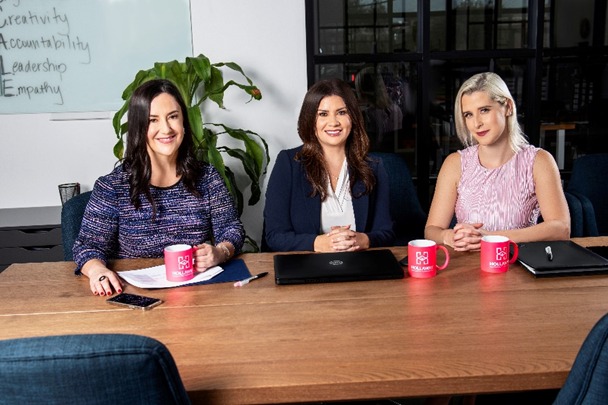
Cash flow, staffing, and imposter syndrome arrived with ownership. What changed her approach was not a management slogan. “I overcame each challenge by ditching my ego and asking for help,” she later said. In 2019, the firm took the Hollaway name. In 2021, Claire Garvin and Jennifer Smith became co-owners. Garvin, now COO, had expanded the environmental team and built operating discipline. Smith, the chief people officer, had moved from keeping the office running to recruiting and developing its talent.
The progression matters because the company's structure mirrors its service pitch. It argues that difficult projects improve when distinct expertise is allowed into the room early. Its own leadership shifted from one owner carrying the risk to three owners with complementary jobs. The firm publishes values of creativity, accountability, leadership, and empathy; the more persuasive evidence is the willingness to distribute authority.
Deep benches and broad delivery capacity, often with more layers between specialist and client.
Focused technical depth, often requiring a separate communications or design partner.
Message and media expertise, typically without in-house field science or permitting.
Environmental science, coastal planning, engagement, and creative work in one senior-led team.
A map people can use
Hollaway's portfolio ranges from habitat surveys for listed birds and sea turtles to the design of three editions of the Texas Coastal Resiliency Master Plan. It supported stakeholder engagement after Hurricane Harvey across all 23 Harris County watersheds. It has worked on a $4 billion Orange County coastal-risk program and communications for a $26 billion coastal protection and restoration study. The firm is small; the nouns in its assignments are not.
The scale can obscure the everyday craft. Somebody must decide which map layer belongs on the page. Somebody must anticipate the resident's question, find the scientist who can answer it, and remove three acronyms before the answer reaches the microphone. Somebody must spot the plant that changes the permit. Hollaway has made a business from treating those tasks as parts of one system.
The idea is portable. Bring the communicator in before the technical work is frozen. Let public feedback travel backward into project decisions. Keep the field record structured enough to survive review months later. Give senior specialists direct access to the client. And when a room is confused, do not assume the room is the problem.