The first useful thing Joanne Stokes made was a record. In 1985, she took photographs at New Jersey job sites - practical pictures of utilities, trenches and work that would soon be covered up or transformed. Then came a clever extension: a van, a cameraperson and a video system that could travel the route of a proposed project. The footage gave engineers and owners something better than memory. It showed what was there before construction arrived.
This is not the usual origin story for a marketing agency. There is no brainstorm around a polished conference table, only an active site and the need to see it properly. Yet it explains Stokes Creative Group better than a list of services does. The company learned its trade beside the work. Photography became video; video became visualization; visualization became a way to explain engineering; explanation became public outreach.
The translation layer no one sees
Most people encounter infrastructure at its least persuasive moment. A lane closes. A meeting notice appears in the mail. A familiar road acquires cones and a completion date that feels abstract. The engineer sees drainage, load and staging. The resident sees a longer commute and wonders what will happen to the driveway.
Stokes works in that gap. Its public-outreach teams prepare involvement plans, run meetings, maintain project websites, build stakeholder databases, collect surveys and answer community questions. Its designers turn a project into maps, signs and presentations. Its photographers and videographers document the work from the ground and air. For an agency or engineering team, the attraction is not simply that one vendor can make many things. It is that the people making them already understand why a construction complaint, a detour map and a progress photograph belong to the same story.
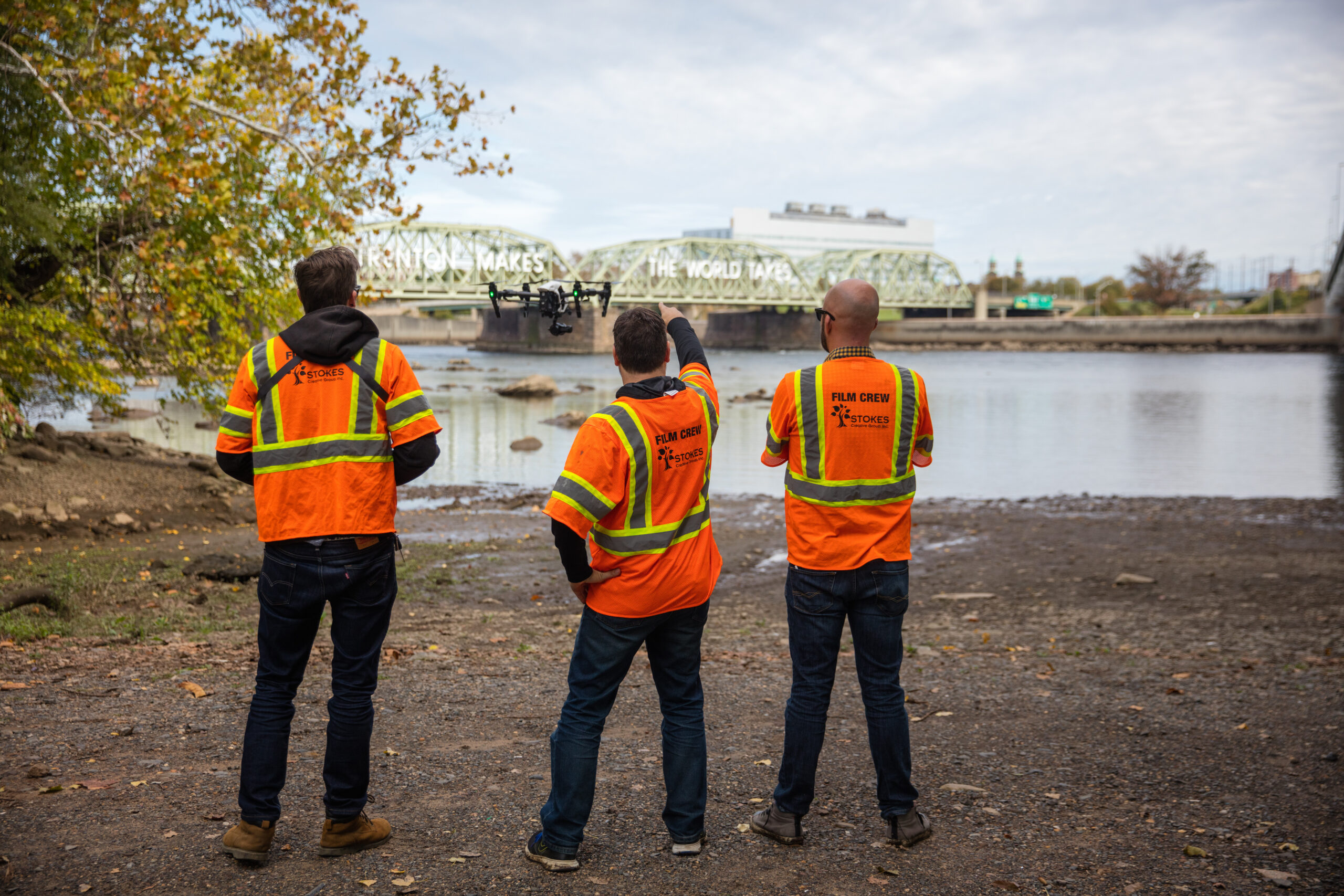
The field credentials matter. Stokes says its photo and video technicians are trained for railroad track safety and hold OSHA, SWAC, TWIC and confined-space credentials. A general production crew may know how to compose a shot; an infrastructure crew also has to know where it can stand. This is the firm's sharpest competitive distinction. It brings agency work onto the job site without behaving like a visitor.
A bridge can be structurally complete and publicly mysterious. Stokes sells the work of removing the mystery.The operating idea, in one sentence
Five years beside a bridge
The Tappan Zee replacement shows what this combination looks like at full scale. Stokes partnered with Tappan Zee Constructors on the New York State Thruway Authority's $3.14 billion project. Over five years, its job was to help keep Lower Hudson Valley residents and stakeholders connected to the work. That included photography and video, project branding, a website and two public information centers. It also included a less cinematic tool: a communications log that tracked stakeholders, construction complaints and community issues.
The log may be the most revealing artifact. Public trust is often treated as a matter of tone - be clear, sound reassuring, publish an update. In practice it is also operations. Someone has to record the concern, route it, follow it and close the loop. Stokes paired that administrative discipline with school programming that reached thousands of students and imagery strong enough to place one of its bridge photographs on the cover of Engineering News-Record's 2018 Year in Construction Photos issue.
That model now stretches from bridge work to mobility campaigns. For Miami's 2026 FIFA World Cup planning, Stokes worked with EXP and FDOT on video and digital content explaining shuttles, transit connections and other options for visitors. The audience and spectacle changed; the assignment did not. Take a complicated movement plan and give people enough clarity to act.
The company changed when the client's problem changed
The useful lesson in Stokes's history is not “add more services.” Plenty of firms do that and produce a menu with no center. Stokes expanded along the path of the same problem. Construction photos created a record. Video explained a process. Brochures and logos helped a client present it. Websites distributed it. Public meetings and stakeholder systems created a way to hear back.
The turning point, by the company's own account, was the recognition that making clients more successful made the production business more successful too. Marketing and advertising followed. In 2010, JMS Visual Communications adopted the Stokes Creative Group name, broad enough for a firm that had become part studio, part outreach office and part construction-support specialist.
The business model remains services-led. Public agencies, contractors and engineering consultancies hire Stokes directly or bring it into larger teams. The work can include a defined production, such as a video, or extend across a project through field documentation, website maintenance, meetings and stakeholder communication. There is no public rate card. In this corner of the market, scope depends on geography, duration, access, compliance and the number of people who need answers.
What another specialist can copy
First, begin with the evidence your customer already needs. Stokes did not invent demand for job-site records; it made those records more useful. Second, expand into the adjacent question. After “what was here?” comes “what is being built?” and then “how do we explain it?” Third, let operational credibility shape the creative offer. Safety training, agency certifications and knowledge of public-involvement procedure are not decorative credentials. They make the photographs, meetings and websites possible.
The fourth move is easy to miss: build memory. A stakeholder database remembers the neighbor who called. Progress photography remembers what stood behind the wall. A communications log remembers whether anyone replied. On long projects, memory is part of customer service - and sometimes part of risk control.
The conditions have to fit.
This approach is strongest when the work is technical, visible, long-running and accountable to many audiences. It is less useful for a simple consumer campaign, a one-off asset with no field complexity, or an organization unwilling to respond after asking the public for input. The integrated model also depends on real subject knowledge; bundling unrelated creative services without it would only imitate the surface.
Stokes today is a relatively small company - LinkedIn places it in the 11-to-50 employee range - with a headquarters in Mount Laurel, New Jersey, and an Orlando office. Its WBE, DBE, SBE and WBENC certifications help it participate in public and transportation work, but certification alone does not explain four decades. The better explanation is continuity. The tools changed from four-megapixel cameras to drones and 360-degree documentation. The basic task stayed put: look closely, keep a record and help the people around a project understand what they are seeing.