A traffic light has a longer memory than a smartphone. Cities bolt equipment beside roads and expect it to work through rain, heat, budget cycles and several generations of wireless jargon. The trouble is that radio standards do not share this patience. They advance while the steel cabinet stays put. Hojun Kim has built his company around that awkward gap: the expensive object ages slowly, the intelligence inside it should not.
Kim is the co-founder and chief executive of Ettifos, a connected-mobility company with roots in California and an engineering base in Seongnam, South Korea. Its central product idea is a software-defined modem, or SDM, for vehicle-to-everything communication. V2X is the umbrella term for the small, urgent messages exchanged among vehicles, roadside units, traffic systems and other road users. A car can announce that it is braking. An intersection can broadcast the remaining signal time. Infrastructure can pass along a warning that a camera on one vehicle cannot see.
The useful part of Kim’s proposition is not merely that these things can speak. It is that their language can change without replacing every piece of hardware. Ettifos implements core modem functions in software, so an installed unit can be updated as communications move from LTE-V2X toward 5G-V2X. To a city engineer staring at miles of roadside equipment, “software update” may be among the lovelier phrases in the English language.
One road, four conversations
The engineer before the executive
Kim came to this problem by way of the circuitry underneath it. He studied electrical engineering at the University of Minnesota, then participated in CPU and communications-semiconductor design at companies including Intel and GlobeSpan. The experience matters because software-defined radio is not an airy software slogan. It lives inside tight constraints: processing budgets, latency, protocols and hardware that must behave predictably at speed.
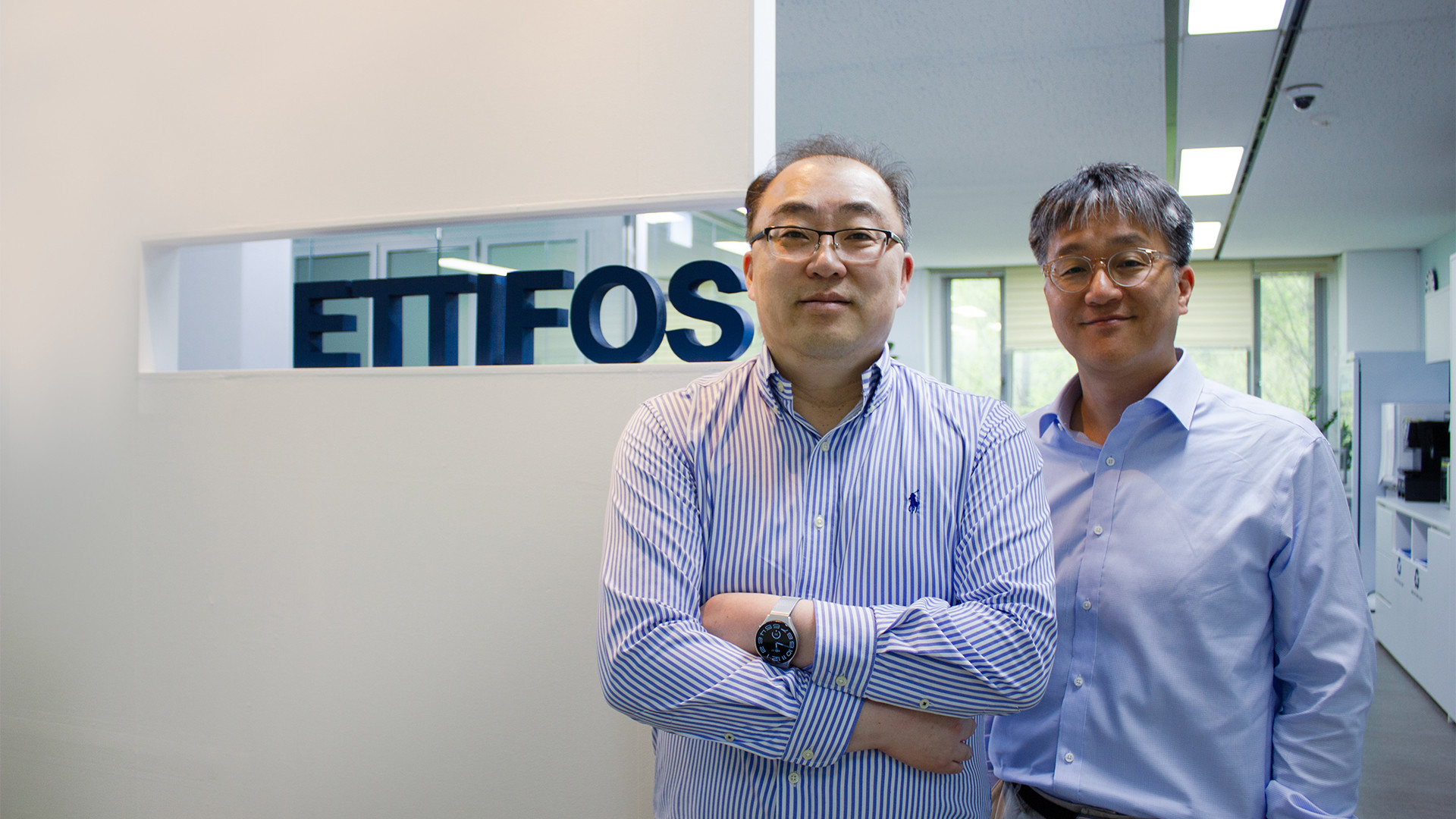
In 2018, Kim helped establish Ettifos with a U.S. headquarters and a Korean research center. He served as global chief technology officer, leading the acquisition of core V2X capabilities and the company’s international business partnerships. In September 2023, Ettifos appointed him CEO. It was a revealing promotion. The person responsible for the technical spine and global relationships was now responsible for the whole animal.
His timing was neither easy nor dull. Connected-road policy had spent years divided among standards and regional choices. Automakers, infrastructure agencies and chip companies had to decide which technology would survive long enough to deserve a purchase order. Ettifos’s answer was to make the choice less terminal. A modem that could change in software offered a hedge against the future becoming inconvenient.
“5G-V2X is only the beginning.”Hojun Kim, describing Ettifos’s platform ambition in 2025
Kim’s public comments are full of the market nouns one expects from a semiconductor executive: compatibility, infrastructure, aftermarket, intellectual property. Yet a clear product instinct sits beneath them. He wants Ettifos to earn revenue first from V2X infrastructure and devices for vehicles already on the road, then supply semiconductor IP to global chipmakers and expand the modem architecture into adjacent communications markets.
A startup measured in tests
Deep-tech progress rarely arrives with a satisfying ding. It accumulates in compatibility reports, permissions and certificates. In 2019, Ettifos demonstrated an LTE-V2X modem at the ITS World Congress in Singapore. In 2023, it completed compatibility work between its 5G-V2X modem and Keysight test equipment. During 2024, the company verified interoperability with commercial LTE and 5G products and received permission to deploy C-V2X technology in the United States’ 5.9 GHz band.
These are bureaucratic words with physical consequences. A radio that performs beautifully only in its own lab is a science project. A radio that exchanges messages with someone else’s chipset, survives a certification regime and operates inside a regulated band can become infrastructure. Kim has repeatedly appeared where those boundaries are negotiated: an ETSI and 5G Automotive Association workshop in Málaga, the GSMA M360 APAC mobility summit in Seoul, and Korean policy and engineering forums.
Money followed the testing. Ettifos announced a Series A in April 2024, led by LB Investment with Korea Development Bank participating. The company said it would use the capital to establish revenue in infrastructure and aftermarket V2X devices before moving deeper into semiconductor IP. In 2025, it completed a larger Series B. The round was designed to support a C-V2X hardware accelerator chip, a third generation of its compact V2X-AIR on-board device, and production, sales and support in the United States and Europe.
Funding totals vary in English-language conversions because the round was announced in stages and reported in both dollars and won. The durable fact is simpler: the company moved from proving a modem architecture to financing silicon and operations. Its V2X-AIR device also gained ITS Korea and OmniAir certification in 2025, two more stamps in the passport from prototype to deployment.
Kim co-founds Ettifos and builds its software-defined V2X foundation.
5G-V2X compatibility work advances; Kim moves from global CTO to CEO.
Series A financing, U.S. 5.9 GHz permission and international interoperability work.
Series B financing, device certifications and a planned move into accelerator silicon.
The charm of the unthrown-away box
Ettifos’s pitch rests on a wonderfully unromantic object: hardware that need not be discarded. Traditional modem functions are often fixed in dedicated silicon. If the standard changes materially, the equipment may need a redesign or replacement. A software-defined approach puts more of that function on a general-purpose processing platform. New releases, regional variations and engineering changes can be handled through software, within the limits of the installed hardware.
This is especially relevant to transport agencies, whose clocks run differently from those of consumer electronics. A public deployment involves procurement, construction, maintenance and public accountability. Nobody wants to learn that an expensive roadside unit has developed the strategic lifespan of a fruit fly. Upgradeability turns uncertainty from a reason to wait into something closer to a manageable cost.
The idea worth stealing
When a customer’s physical asset lasts longer than the standard inside it, make the expensive layer adaptable. Flexibility can be a capital-protection feature, not an optional flourish.
Kim’s ambition now extends beyond the roadside. He has described a communications-semiconductor platform that could serve autonomous mobility, drones, defense applications, non-terrestrial networks and AI-oriented radio access networks. These are distinct markets, and each will demand its own evidence. The connective tissue is the same engineering proposition: move modem behavior into a form that can be adapted, deployed and improved without starting the machine again from bare metal.
That expansion also changes Ettifos’s identity. A V2X device maker sells boxes for a defined purpose. A fabless platform company sells reusable architecture, accelerator chips and intellectual property. Kim’s semiconductor career points naturally toward the latter, but the road there is paved with the former. Devices create deployments. Deployments expose problems. Problems harden the modem. The glamorous destination depends on a great many ordinary packets arriving on time.
A wider field of view
Autonomous vehicles are commonly portrayed as solitary prodigies, carrying enough sensors and computation to understand everything around them. V2X offers a more social idea of intelligence. A vehicle’s camera cannot see through a bus. A roadside unit can know what is behind it. One car may detect a slippery patch before the next car reaches it. The network’s advantage is not omniscience; it is shared perspective.
Kim has spoken about sensor sharing, low-latency communication and the policy infrastructure required for cooperative mobility. The word “cooperative” deserves attention. Roads are public systems full of old vehicles, new vehicles, municipal equipment and rival vendors. The technical achievement is not a perfect conversation between identical devices. It is a useful conversation among strangers.
This helps explain his emphasis on interoperability. Ettifos has tested against equipment from established measurement and chipset companies because no startup gets to redraw the road alone. Standards bodies, automakers, chip suppliers, governments and infrastructure operators all hold a corner of the map. Kim’s work is partly engineering and partly diplomacy conducted in radio waves.
The overlooked product is often the translator between a slow-moving customer and a fast-moving technology.
There is an appealing modesty to the modem’s role. It is not the car, the road or the destination. It is the agreement that lets them exchange a useful sentence. Kim spent years designing chips, then founded a company around making that agreement less brittle. The bet is that smarter mobility will depend not only on what each machine can perceive, but on whether the machines can keep learning how to speak.
The road will remain stubbornly physical. Asphalt cracks. Cabinets rust. Standards acquire new release numbers with serene indifference. Ettifos cannot repeal any of that. Its proposition is simply that the intelligence inside the roadside box should be allowed to travel faster than the box itself. For an infrastructure business, that is a practical kind of optimism.