The customer had a payroll problem. Hoala Greevy had a floppy disk. Their meeting place was a Safeway parking lot near Portland State University, which is an economical sort of conference room if your business has yet to acquire furniture. The program ran. The customer wrote a check. Greevy remembers the amount as roughly $1,000, half of which went to the friend whose C++ compiler had made the transaction possible.
He had spotted the job on a bulletin board while taking his first semester of computer science courses. The assignment looked remarkably like the previous week’s homework. He assumed somebody else would have called already. He called anyway. That small act produced a sale, a collaborator’s share and a fairly persuasive argument for a career in software.
Years later, Greevy is the founder and CEO of Paubox, an email security company he started in Hawaiʻi and moved to San Francisco. The parking lot story offers a useful introduction. His businesses tend to begin with someone describing an inconvenience, followed by his decision that he might be able to fix it. His celebrations have included free food, socks and, eventually, recurring college scholarships. The conversation keeps acquiring new participants.
A geography degree, with time in the computer lab
Greevy grew up in Honolulu’s Liliha Valley and graduated from McKinley High School. Baseball mattered to him; so did the public schools that educated him. His route to Portland State included a stop at Menlo College to play baseball. The eventual qualification was a bachelor’s degree in geography and social sciences. Software, it turns out, allows a certain latitude about latitude.
His father, photographer Ed Greevy, gave him a Commodore computer when he was about ten. By college, connecting to the internet had caught his imagination. He changed his academic course so that he could graduate sooner, while continuing to pursue computing in the labs. The diploma and the work were allowed to develop different interests.
There was another practical advantage to college: a scholarship through Kamehameha Schools. Greevy has spoken about how much that support mattered. It gave him a route through university without the burden he might otherwise have carried. Much later, when he began funding students himself, this experience supplied a working example. Someone had helped make his education possible. He remembered.
The complaints were the business plan
In 1999, his first job out of college took him to Critical Path, an email company in San Francisco. He arrived during the dot-com era, when the city was conducting a noisy experiment in what the internet might become. Email became his line of work and remained it through changes in geography, companies and the things people expected their inboxes to do.
He returned to Hawaiʻi in 2001 and started doing Linux consulting. Customers kept complaining about spam and viruses. Repeated complaints are useful to a programmer: they identify work that somebody already wants done. He built Pau Spam, turning the filtering service into a subscription business. Its name also gave him a joke that would prove unusually durable.
As a child, he had admired the garbage collectors, with their timing, movement and impressive machinery. Looking back at his email filtering work, he could see a family resemblance to that early ambition: he was helping remove unwanted material. The internet had supplied a different truck.
Another lunch set Paubox in motion in 2014. His companion was Siana Austin Hunt, then CEO of Make-A-Wish Hawaiʻi. She described a business problem involving secure communication. Greevy went to work on a solution. The sequence was familiar by then: an existing relationship, a specific difficulty, something to build.
He would later explain that talking to more customers helped him recognize a pattern. Paubox’s design aimed to keep encryption from becoming an obstacle for the person sending or receiving a message. That required attention to the ordinary experience of using email. A technical solution had to survive contact with somebody who simply wanted to get on with the day.
A San Francisco address, a Honolulu sense of occasion
Building the product and persuading people to consider it proved to be different jobs. Greevy found that being based in Hawaiʻi could work against him when pitching a software business. Some prospective customers questioned whether a company calling from the islands could be credible. An area code was doing rather more editorial work than it deserved.
He moved Paubox to San Francisco in 2015. By December, the company was celebrating its first 100 customers with 100 spam musubi and 100 pairs of socks. The milestone had become a meal and something warm to wear. For an email business, Spam had acquired a welcome second career.
The giveaways grew with the customer count. At 500 customers came 500 musubi; at 1,000 came 1,000. Greevy later recalled that the thousand-customer celebration involved hundreds of pounds of food. Gratitude had become a logistics operation. It also raised a practical question: what else could the money accomplish?
“The Leader always gives back.”
Hoala Greevy’s operating principles, 2018
The community work extended beyond milestone arithmetic. When Paubox moved into the Hearst Building in 2019, employees cleaned the surrounding streets. Greevy described splitting into groups to cover Market and Third. A company could introduce itself to a neighborhood with a press release. This introduction involved picking things up.
Food also brought a comic lesson in purchasing. For an earlier rice-bowl giveaway, Greevy ordered hoodies for the staff and exhausted the limited merchandise budget, to Rick Kuwahara’s displeasure. Then the weather turned wet. The hoodies suddenly had a practical argument in their favor. Even company clothing occasionally gets its timing right.
The scholarship named for his grandmother
In 2019, the Paubox Kahikina Scholarship began with one recipient, Nick Wong. Its mission was to encourage Native Hawaiians to pursue STEM and technology careers. A celebration could now help someone stay in college. The award would recur each year until graduation, rather than disappear after the first congratulatory photograph.
Greevy named the program for his grandmother. They had been close, and she had never had the opportunity to attend college. He had received educational help himself; her name gave that act of repayment a personal address. The connection runs through three generations without requiring any of them to have followed the same professional path.
Per recipient, each year until graduation.
A recurring award for Native Hawaiian students pursuing STEM or technology.The scholarship asks recipients to share an annual account of their college journey. A blog post or video gives other people a chance to see the work taking shape. The program also organizes opportunities to meet people. A check helps with the cost of study; a conversation can help a student imagine where that study might lead.
By a March 2026 conversation about the program, Greevy reported 62 recipients since its start, with about 50 still active. The scholarship had also gained nonprofit status, opening another route for donations. The original musubi giveaways had produced an education project with its own future. It is a pleasingly indirect result for a lunch budget.
Eleven patents, and room for a selfie
Greevy’s September 2026 return to Hawaiʻi included a panel on invention with Olin Lagon and John Borland. He wrote that his eleventh patent had been published the previous month. Much of his patent work concerns email security. The conversation put him alongside other inventors discussing the long, procedural business of protecting an idea.
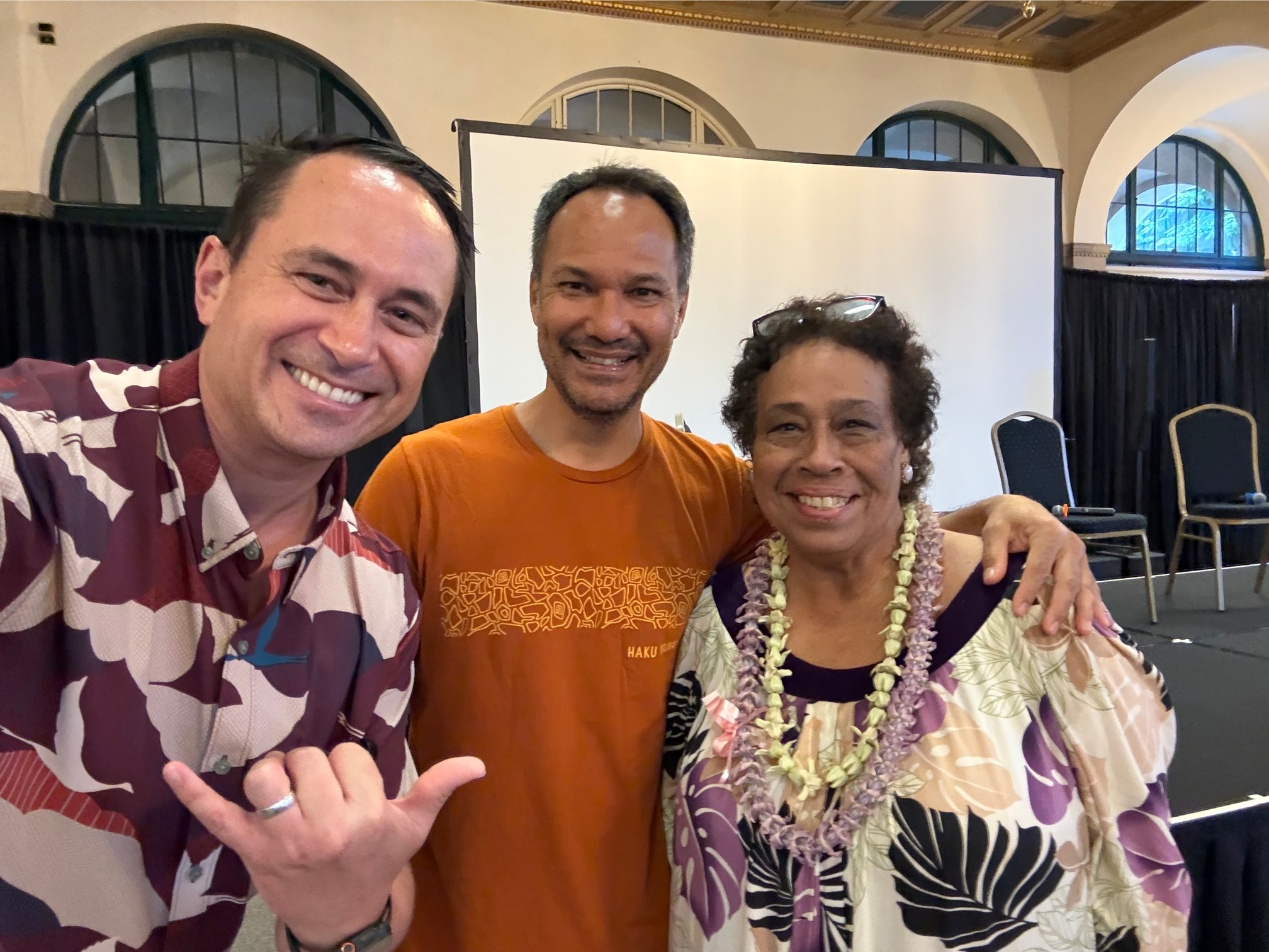
One detail particularly pleased him: he and both fellow panelists were Hawaiʻi public school graduates. For someone who has remained vocal about McKinley, that was worth recording. Inventorship was on the agenda, but the route into it mattered too. The photograph from the event has the relaxed air of people glad to have found one another before the formal proceedings begin.
His other 2026 dispatches show the same habit of gathering people. An August dinner in New York brought together roughly 30 guests. A September dinner in Tampa drew 17. In Honolulu, a mixer included customers, scholarship recipients, family and friends. His old McKinley baseball teammates appeared among the photographs. Work has given him more tables to sit around.
The notebook still comes along
For all the software, Greevy keeps an affection for paper. He has described a journal that began as a surfing journal, became a kayak fishing journal and eventually became simply a journal. Handwritten to-do lists remain part of his routine. The naming has become less specialized; the habit has lasted.
Fishing has lasted too. His public biography includes blue marlin caught from a kayak and an IGFA record for finescale triggerfish. These are unusual credentials to place beside email patents, although they do give a conversation somewhere unexpected to go. A founder can spend only so long discussing inboxes before a fish becomes a social advantage.
In May 2026, he announced a Paubox command-line tool for developers and software agents. By August, he was demonstrating ways to create forms through Claude. The interfaces have changed considerably since the floppy disk. The work still begins with a task someone wants made easier. Somewhere between the notebook, the dinner table and the next customer conversation, Greevy continues looking for it.