The useful clue in Ranvir Deshmukh’s story is a course catalogue. Not the glossy sort arranged for prospective students, but the practical maze that appears when thousands of undergraduates need to decide what to take next. At Dartmouth, the available tools could be unreliable or simply unavailable. Students grumbled. Deshmukh and his collaborators built CourseMe. Then the campus did something founders prefer to any compliment: it used the thing.
More than 4,000 students came through CourseMe. It logged over one million page views and, according to its Y Combinator profile, reached roughly 90 percent of Dartmouth’s student body in a typical month before being acquired. The numbers are neat. The underlying education was messier and more valuable. A real product did not begin with a grand declaration about changing education. It began with an unreliable workflow, a close community, and students who needed an answer before registration closed.
Deshmukh now applies that education to a larger and much more expensive stack of forms. He is the co-founder and CEO of RealPact, a Y Combinator Summer 2026 company that builds AI agents for real estate brokerages. Give the system a property address and its agents can retrieve deeds, tax information, parcel data, permits and MLS records, then use those facts to prepare contracts, organize documents and track deadlines. Its promise is not conversational sparkle. It is fewer afternoons spent hunting, checking and typing.
The campus as a small, honest market
Deshmukh did not arrive at Dartmouth with a tidy founder narrative. He had first encountered the college in ninth grade through a “Dartmouth is Happy” video. He read about Sanborn Library, kept browsing, and liked the atmosphere he could feel through a screen. Years later, he arrived as an international student and recreated the video during his first year. Before graduation, he made another version called “Full Circle,” a farewell assembled around growth, gratitude, friends and the strange compression of four college years.
That instinct to make a thing and release it appeared elsewhere. During his first year he built MemeMe, a meme maker designed to take about five seconds. It attracted some attention and won a TuckLAB pitch competition, but he later described it with bracing economy: fun, some traction, not a real need. The project was not wasted. It supplied contrast. CourseMe worked because the annoyance returned every term and because the product made a recurring decision easier.
“Start early and ship. Classes will help, but you’ll also learn by building lots of small projects.”Ranvir Deshmukh, Dartmouth Admissions interview
Dartmouth helped because it is compact. Deshmukh calls its size a superpower: useful ideas can travel by word of mouth, feedback arrives quickly, and collaborators are nearby. CourseMe pulled course data into its own pipelines and added search, summaries, reviews and metrics. Each choice could be tested by the same people who might mention the tool over lunch. In a large market, weak software can remain anonymous for a while. On a small campus, everybody knows by Tuesday.
The community also provided structure. Deshmukh points to the Magnuson Center for Entrepreneurship and Dartmouth Venture Studio as places to find mentors and other builders. In 2024, CourseMe received a $1,000 founder grant. He worked as a computer science teaching assistant and grader, completed research work in the department, and studied subjects ranging from algorithms and operating systems to machine learning and human-computer interaction. His parents worked in business, he has said, so entrepreneurship felt familiar. Computer science supplied the medium.
A rejection with instructions attached
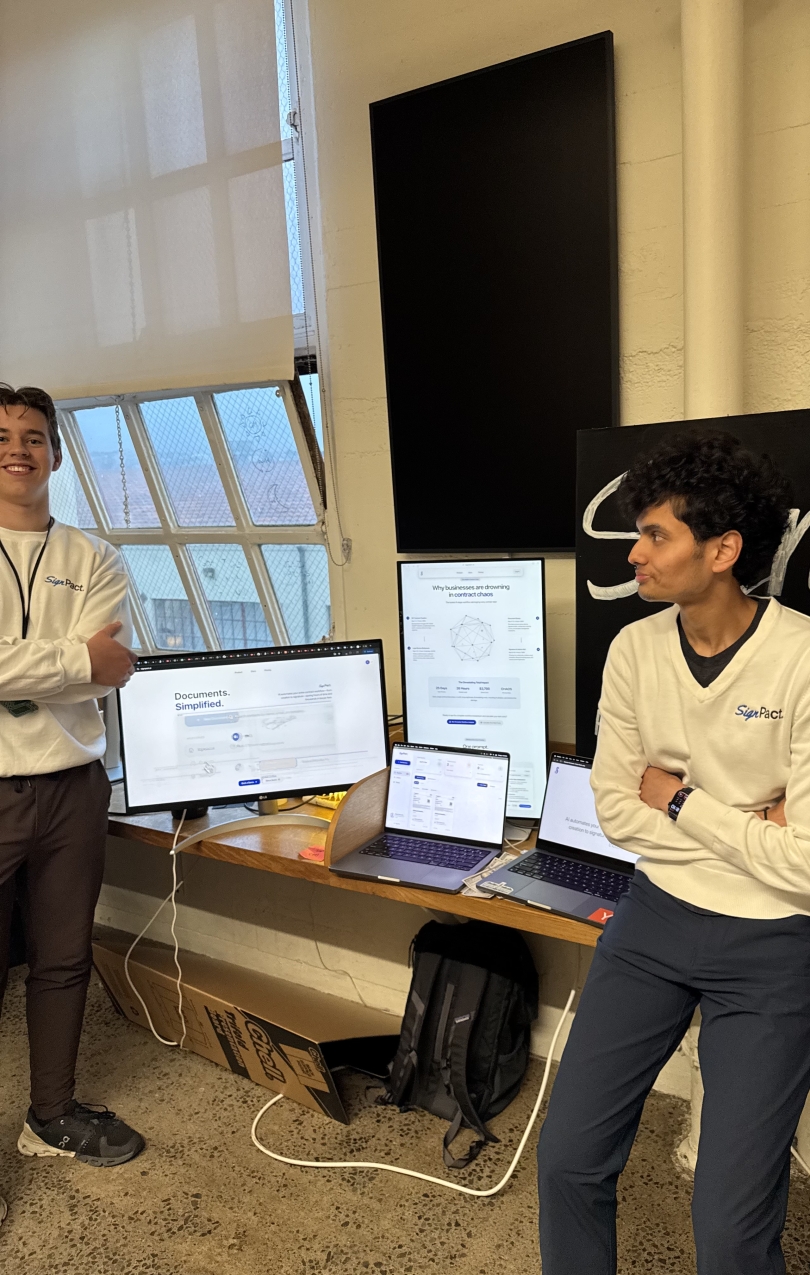
CourseMe led to SignPact, which focused on signatures and contract workflow, and SignPact evolved into RealPact. The founders, Deshmukh and Erik Peterson, had already learned to build together. Yet progress was not a clean ascent. After a Y Combinator interview in San Francisco in May 2025, the feedback asked for more traction and larger-client validation. Deshmukh wrote publicly that his heart sank and that he cried.
The disclosure matters because founder stories have a bad habit of turning disappointment into decorative foreshadowing. At the time, rejection does not feel decorative. Deshmukh had believed this attempt might work. The more interesting part came later: he decided the criticism was right. The team doubled down, kept talking to people in law, energy, biotech and real estate, and found the sharpest pain in brokerage operations. By his later count, he was rejected seven times before RealPact entered YC.
Keep the problem in view. Let the product, proof and pitch change when customer behavior says they should.
Real estate offered ancient repetition in an industry of enormous transactions. The software was dated. Information sat across municipal, county and state portals. The same property facts had to be found, checked and moved into contracts. RealPact narrowed its entry point to this transaction work. It was a prosaic choice, which is often where useful enterprise software hides: the task everybody accepts because nobody has removed it.
Two hours at the brokerage
Deshmukh and Peterson went to Four Seasons Sotheby’s and spent two hours discussing the firm’s workflow. It is a small anecdote with more product substance than most launch slogans. The founders could see the sequence rather than merely hearing that paperwork was painful. A deed leads to a name. A tax map confirms a parcel. Records must agree. A contract requires the information in its prescribed place. A deadline belongs to somebody.
This is why the company describes its product as transaction infrastructure rather than a form filler. The ambition is to connect work from the first conversation through closing, eventually bringing realtors, loan officers, attorneys and title companies into a shared system. The immediate product starts with narrower chores: retrieve the evidence, extract the relevant facts, prepare the document, remember what follows.
By May 2026, the company had actual brokerages using it. That tangible traction helped RealPact win the Jeff Crowe ’78 Grand Prize at Dartmouth’s Magnuson Startup Competition. The award was $20,000, useful runway for AI development, customer work and enterprise compliance. Deshmukh and Peterson said they would work on the company full-time after graduation. RealPact subsequently announced a pre-seed round backed by Y Combinator, with Leap Year, the Dartmouth Venture Studio and real estate angels participating.
“Real estate software should do the work, not just store it.”RealPact pre-seed announcement
Today the company is based in San Francisco while selling to brokerages in New Hampshire. The arrangement gives RealPact two useful centers of gravity: an early customer market where workflows can be observed up close, and the ecosystem of a YC batch. The company says more than ten brokerages are running on its product. Its live demo shows a New Hampshire purchase-and-sale agreement being prepared from retrieved records in under five minutes.
The discipline inside “useful”
Deshmukh’s personal site is sparse. “I write software,” says his LinkedIn summary. His website expands the thought only slightly: he likes keeping things simple and wants to make useful things for people. This is easy to mistake for modest branding. It is better read as a test. Usefulness demands an identifiable person, a recurring task and evidence that the result improved.
His products form a compact syllabus in that test. MemeMe showed the pleasure of quick creation. CourseMe showed how a tight community distributes a solution to a repeated problem. SignPact found an entry point. RealPact widened the lens from one document action to the operational chain around a transaction. The company names changed because the understanding changed.
There is personality in the edges. Deshmukh speaks English, Hindi and Marathi. He occasionally makes videos. He has cited the iPhone X launch and the SOFI TUKKER song in its commercial as inspiration for RealPact’s own launch film. He publicly thanked early believer Hank Couture, Dartmouth mentor Roy Schmidt, YC partner Jon Xu, investors and customers after the financing. Gratitude and ambition share the page without much ceremony.
The most portable lesson is not “apply seven times.” Repetition without learning is merely a calendar. Deshmukh’s path is more specific: ship early, notice what people repeatedly need, enter the room where the work happens, and allow an unsuccessful version to teach the next one. The course catalogue and the property contract look unrelated. Both are institutional mazes full of scattered facts, anxious users and a deadline. Once you see that, the route from Hanover to San Francisco becomes almost tidy.
RealPact remains early. Its aspiration is broad, but its current work is concrete enough to point at: a deed retrieved, a field filled, a deadline tracked, an agent spared an afternoon. That is the quiet advantage of building around paperwork. Nobody needs to be persuaded that the paper exists. The founder only has to prove that, this time, it can move.