- Heal.me is a marketplace for people seeking holistic care and a software platform for the practitioners providing it.
- Its practitioner bundle covers websites, booking, payments, reminders, reviews, client records, and marketplace discovery.
- The current public offer is $799 to launch a site and $79 a month, aimed mainly at cash-pay practices.
- The company’s most repeatable lesson is simple: observe the moment a user leaves the desk, then design for that moment.
At sixteen, Max Coleman had a peculiar problem: his back hurt, and an orthopedist at Johns Hopkins told him nothing was wrong. The diagnosis failed before the company did. Coleman went looking elsewhere, first through a friend’s referral, then through acupuncture, massage, nutrition, yoga, chiropractic, and other therapies. Relief arrived gradually. So did a business idea.
The useful part of that origin story is not that one therapy conquered a mysterious pain. Heal.me makes no diagnosis and provides no treatment itself. The useful part is the referral. Coleman found an unfamiliar kind of care because another person knew where to point. That is a fragile system. It depends on whom you know, what they know, and whether the practitioner picks up the phone.
Heal.me tries to turn that lucky introduction into infrastructure. A consumer can search by service or condition, inspect a practitioner’s background, read reviews, and book in person or online. On the other side, an acupuncturist, massage therapist, chiropractor, naturopath, health coach, hypnotherapist, or energy worker can run the digital edges of a practice: website, calendar, payments, reminders, intake forms, client notes, and reviews.
The referral was the original product. Heal.me’s real work was making it searchable, bookable, and repeatable.From personal introduction to marketplace loop
The broad idea became a narrow button
The company did not begin with the crisp little verb “book.” Around 2013 and 2014, it was called DaoCloud, a social wellness network conceived by Coleman and his college collaborator Eric Green. Members would build wellness profiles, connect with friends and professionals, and share trusted information. Practitioners would connect with clients and one another. It was community, directory, and collaboration software in one generous cloud.
That breadth made emotional sense. It was also hard to measure. A community can contain thousands of profiles and still fail to produce the moment that matters: somebody choosing a practitioner and showing up. By 2020, Coleman described a network of about 7,000 practitioners in 50 states and 180 cities. The mission remained enormous - make wellness primary care - but the product had found a smaller unit of progress: an appointment.
The marketplace loop
This is what differentiates Heal.me from a directory. Discovery brings the consumer in; workflow gives the practitioner a reason to stay. Google or Yelp can surface a name. Acuity can expose a calendar. Squarespace can make a handsome page. Heal.me bundles those fragments around one category and then places the resulting practice back inside its marketplace.

A calendar seen from the hallway
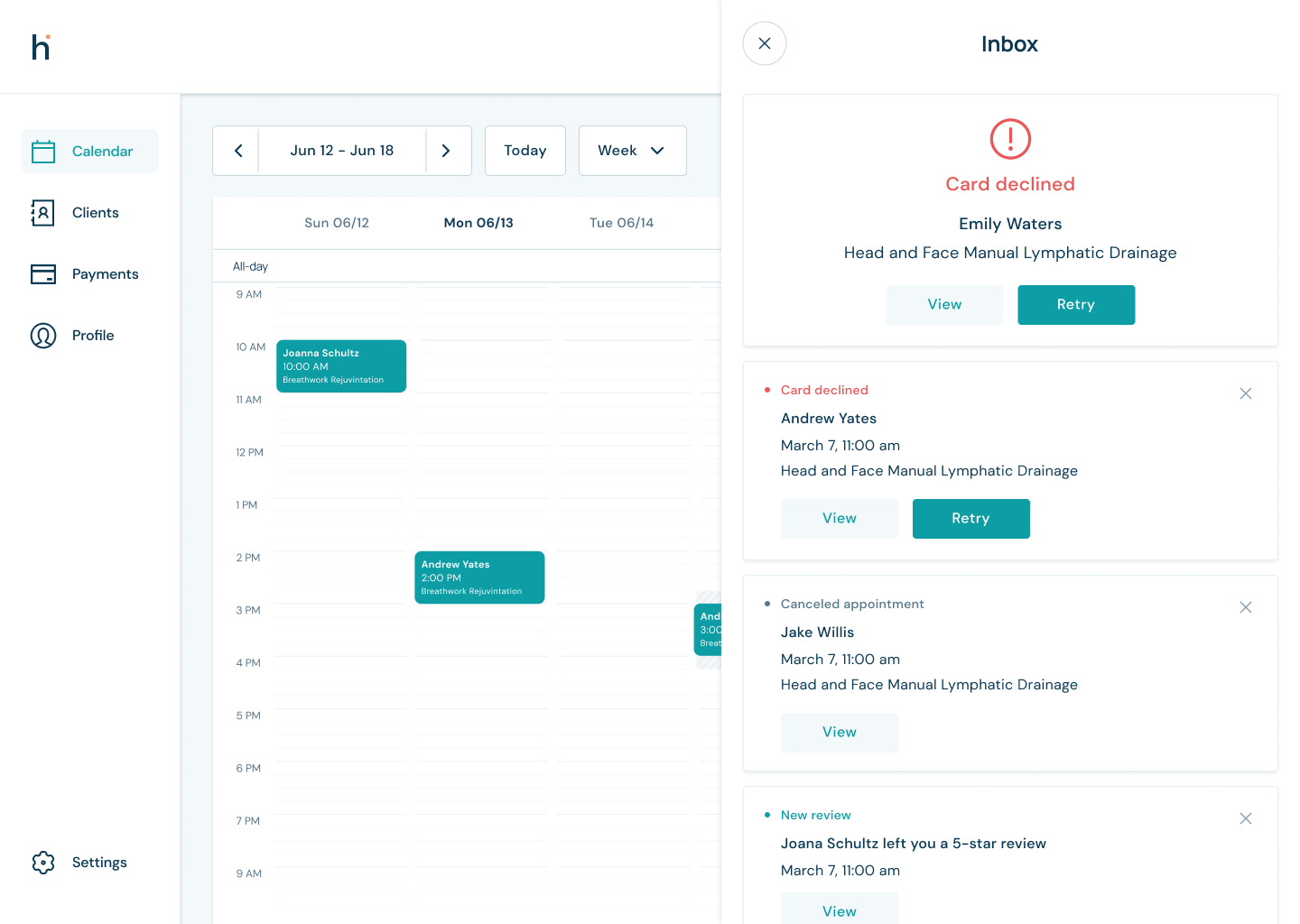
The best evidence of how Heal.me learned comes from a 2022 product-design case study. The service had been built primarily for desktop. Research uncovered a more awkward reality: practitioners checked their schedules while on calls, away from their computers, trying to see whether another person could fit into an actual day. The job was not “manage calendar.” It was “glance, decide, and book before this conversation ends.”
The team audited booking, onboarding, client management, payments, reminders, and scheduling across desktop, iOS, and Android. It added a native mobile companion with daily, weekly, and monthly calendars, recurring appointments, and visible payment states. The designer behind the work reported that bookings increased 200 percent after the redesign went live. That figure is a portfolio claim, not an audited company metric, but the product lesson is sturdier than the percentage: watch where work really happens.
The price of a digital front desk
Heal.me now sells a practitioner an unusually tangible bundle. A current public offer lists a one-time website launch at $799, including design, professional photography, SEO setup, and onboarding. The continuing platform costs $79 a month for hosting, booking, reminders, automated reviews, and promotion inside the marketplace. Heal.me says it does not add booking fees, though Stripe or Square fees can still apply.
Public pricing can change. Practitioners set their own service prices. Payment processing is separate.
The photography is more interesting than it appears. During the product redesign, the team upgraded practitioner profiles with professional shoots. The designer observed stronger sales and better customer response. In a category where the product is often another person’s hands, voice, or judgment, an image is not decoration. It is part of the trust mechanism.
| Choice | What it does well | What Heal.me adds |
|---|---|---|
| Referral | High personal trust | Search, availability, and repeatability |
| Google / Yelp | Broad local discovery | Modality context and direct booking |
| Scheduling app | Calendar and reminders | Marketplace demand and practitioner profiles |
| Practice software | Deeper clinical administration | A lighter cash-pay stack built around holistic care |
A tool, not a clinic
The same focus that makes Heal.me legible also creates its boundary. It is not a full electronic health record, not an insurance-billing system, and not a medical provider. Its own material says the platform is primarily designed for cash-pay practices. A practitioner serving complex insurance workflows may need Jane, SimplePractice, Vagaro, or another system with deeper administrative machinery. A clinic that already has strong demand and an integrated stack may not gain enough from marketplace exposure to justify a move.
Consumers have a different condition to watch. “Holistic” gathers regulated professions and unregulated practices under one friendly roof. A credential badge cannot erase differences in training, licensing, evidence, or scope. Heal.me can reduce search friction; it cannot outsource judgment. People should inspect qualifications, understand what a modality claims, and seek medical advice for decisions involving diagnosis or treatment.
What another marketplace can copy
- Choose one measurable handoff - for Heal.me, discovery to booking - and organize the product around it.
- Interview users in the context where the work happens, especially when that context is away from a desk.
- Treat trust assets such as photos, credentials, and reviews as product components, not marketing garnish.
- Keep serving both sides after the introduction: demand for one, workflow for the other.
Heal.me’s ambition remains provocatively large. “Make wellness primary care” is the sort of sentence that can start an argument before breakfast. Yet the company’s operating insight is modest: a new model of care still needs the old mechanics of a dependable appointment. Someone has to be discoverable. Someone has to have Tuesday at three open. Someone has to send the reminder.
The waiting room did not disappear. It was compressed into a profile, a calendar, and a button small enough to carry in a pocket.